 Back
The Chemical Context of Life: Elements, Atoms, and Chemical Bonds
Study Guide - Smart Notes
 Tailored notes based on your materials, expanded with key definitions, examples, and context.
The Chemical Context of Life
Elements and Matter
All living organisms are composed of matter, which is anything that occupies space and has mass. Matter is made up of elements, the simplest forms of chemical substances that cannot be broken down by ordinary chemical means.
Element: A substance consisting entirely of one type of atom.
Atom: The smallest unit of an element, retaining its chemical properties.
Matter: Anything that has mass and occupies space.
There are 92 naturally occurring elements, with about 25 essential to life.
Elements Essential to Life
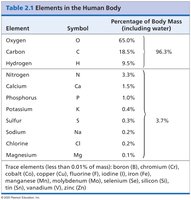
Only a small subset of elements are required for life, with four elements making up the vast majority of living matter: oxygen, carbon, hydrogen, and nitrogen.
Major elements: O, C, H, N (96% of body mass)
Minor elements: Ca, P, K, S, Na, Cl, Mg (3.7% of body mass)
Trace elements: Required in minute amounts (e.g., Fe, Zn, Cu)
Element | Symbol | Percentage of Body Mass |
|---|---|---|
Oxygen | O | 65.0% |
Carbon | C | 18.5% |
Hydrogen | H | 9.5% |
Nitrogen | N | 3.3% |
Calcium | Ca | 1.5% |
Phosphorus | P | 1.0% |
Potassium | K | 0.4% |
Sulfur | S | 0.3% |
Sodium | Na | 0.2% |
Chlorine | Cl | 0.2% |
Magnesium | Mg | 0.1% |
Atoms and Their Structure
Atoms consist of a nucleus containing protons and neutrons, surrounded by electrons in orbitals. The number of protons determines the atomic number and the identity of the element.
Proton: Positively charged, mass ≈ 1.0073 u
Neutron: No charge, mass ≈ 1.0087 u
Electron: Negatively charged, mass ≈ 0.00055 u
Atomic number: Number of protons
Atomic mass: Sum of protons and neutrons (electrons are negligible)
Mass number: Rounded atomic mass
Isotopes
Atoms of the same element can have different numbers of neutrons, resulting in isotopes. Isotopes are important in biological research for dating, tracing, and imaging.
Isotope: Variant of an element with different neutron number
Example: Carbon-12 and Carbon-14
Ions and Charge
Atoms become ions when they gain or lose electrons, resulting in a net charge.
Cation: Positively charged ion (loss of electrons)
Anion: Negatively charged ion (gain of electrons)
Reading the Periodic Table
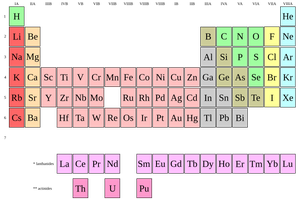
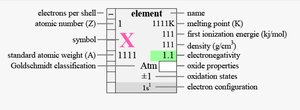
The periodic table provides key information about each element, including atomic number, atomic mass, and electronegativity.
Atomic number: Number of protons
Atomic mass: Mass of protons and neutrons
Electronegativity: Tendency to attract electrons
Electron Arrangement and Shells
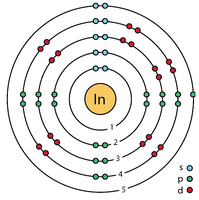
Electrons occupy energy levels called shells. The Bohr model shows electrons in fixed orbits, while the orbital model represents regions of probability.
Valence shell: Outermost electron shell
Stable configuration: Filled valence shell (e.g., noble gases)
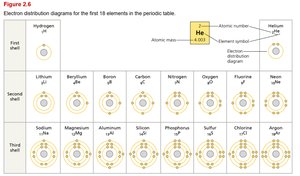
Shells fill in the order: 2, 8, 8 for elements important to life

Energy and Electron Movement
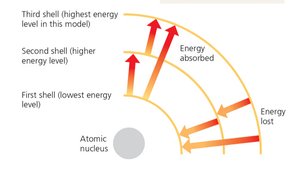
Moving electrons between shells requires energy. Electrons absorb energy to move to higher shells and release energy when moving closer to the nucleus.
Energy absorbed: Electron moves to higher shell
Energy released: Electron moves to lower shell
Electron Distribution in Elements
The distribution of electrons across shells determines chemical reactivity. Diagrams are used to visualize electron arrangements for the first 18 elements.
Chemical Bonds and Molecules
Atoms form bonds to achieve stable electron configurations. The main types of bonds are covalent, ionic, and hydrogen bonds.
Molecule: Two or more atoms bonded together
Compound: Molecule with more than one element
Covalent bond: Sharing of valence electrons
Ionic bond: Transfer of electrons
Covalent Bonds
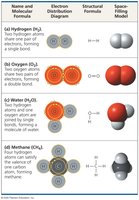
Covalent bonds involve the sharing of electron pairs between atoms. Single bonds share one pair, double bonds share two pairs, and triple bonds share three pairs.
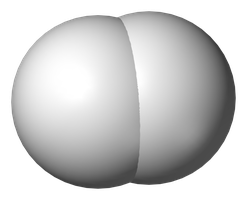
Single bond: One pair of shared electrons (e.g., H-H)
Double bond: Two pairs of shared electrons (e.g., C=C)
Triple bond: Three pairs of shared electrons
Covalent Bonding in Biological Molecules
Biologically important molecules such as oxygen (O2), water (H2O), and methane (CH4) are formed by covalent bonds.
Oxygen: Double bond (O=O)
Water: Two single bonds (H-O-H)
Methane: Four single bonds (CH4)
Bond Rotation and Molecular Properties
Single covalent bonds allow free rotation, while double bonds restrict movement, leading to different molecular shapes and properties.
Single bond: Free rotation
Double bond: Locked, no rotation
Electronegativity and Partial Charges
Electronegativity is the ability of an atom to attract shared electrons. Unequal sharing results in partial charges, denoted as δ⁻ (negative) and δ⁺ (positive).
Oxygen and nitrogen: High electronegativity
Carbon and hydrogen: Similar, lower electronegativity
Partial charges: Important for polarity and interactions in water
Summary Table: Types of Chemical Bonds
Bond Type | Electron Sharing/Transfer | Strength in Water |
|---|---|---|
Covalent | Shared | Strongest |
Ionic | Transferred | Moderate |
Hydrogen | Partial charge attraction | Weakest |
Additional info: The notes expand on the lecture content by providing definitions, examples, and tables for clarity. All images included directly reinforce the explanation of atomic structure, electron distribution, and covalent bonding.
