 Back
The Chemical Context of Life: Elements, Atoms, and Chemical Bonds
Study Guide - Smart Notes
 Tailored notes based on your materials, expanded with key definitions, examples, and context.
Chapter 2: The Chemical Context of Life
Introduction
Understanding the chemical basis of life is essential for studying biology. All living organisms are composed of matter, which is made up of elements and compounds. The structure and interactions of atoms determine the properties of molecules and, ultimately, the functions of cells and organisms.
Elements and Compounds
Elements
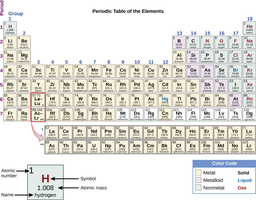
Elements are pure substances that cannot be broken down into simpler substances by chemical reactions. All life is primarily composed of four major elements: carbon (C), hydrogen (H), oxygen (O), and nitrogen (N).
Element: A substance consisting of one type of atom, distinguished by its number of protons.
There are 92 naturally occurring elements, but only about 25 are essential for life.
Major elements in living organisms: C, H, O, N (make up ~96% of living matter).
Compounds
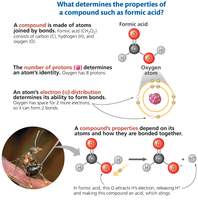
A compound is a substance consisting of two or more different elements combined in a fixed ratio. Compounds have unique properties that are different from those of their constituent elements (emergent properties).
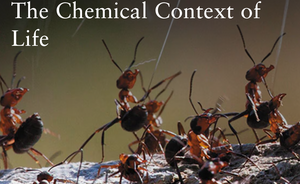
Example: Formic acid (HCOOH) is produced by ants as a defense mechanism.
Compounds are essential for biological processes and structures.
Atoms and Their Structure
Atomic Structure
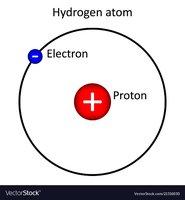
Each element consists of a unique type of atom. Atoms are composed of three types of subatomic particles: protons, neutrons, and electrons.
Protons: Positively charged particles found in the nucleus.
Neutrons: Neutral particles found in the nucleus.
Electrons: Negatively charged particles that orbit the nucleus in electron shells.
The number of protons equals the number of electrons in a neutral atom.
Nucleus and Electron Cloud
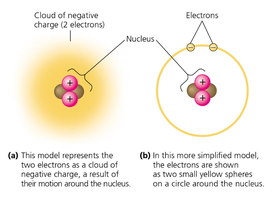
The nucleus is the dense core of the atom, containing protons and neutrons. Electrons move rapidly around the nucleus, forming an electron cloud. The attraction between opposite charges keeps electrons near the nucleus.
Electron Shells and Energy Levels
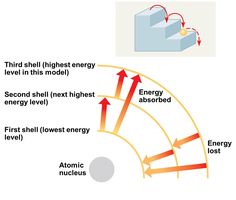
Electrons are arranged in shells around the nucleus. Each shell has a specific energy level and can hold a certain number of electrons:
1st shell: up to 2 electrons
2nd shell: up to 8 electrons
3rd shell: up to 8 electrons
Electrons have potential energy based on their distance from the nucleus. When electrons absorb energy, they move to higher energy shells; when they lose energy, they fall back to lower shells.
Valence Electrons and Chemical Properties
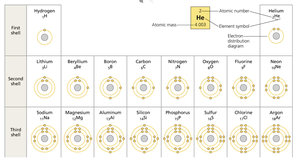
The valence shell is the outermost electron shell. The electrons in this shell, called valence electrons, determine the chemical behavior of an atom. Atoms are most stable when their valence shells are full.
Elements with a full valence shell are chemically inert (noble gases).
Atoms with incomplete valence shells are reactive and tend to form bonds to achieve stability.
Atoms with the same number of valence electrons exhibit similar chemical behaviors (e.g., fluorine and chlorine).
Chemical Bonds
Covalent Bonds
Covalent bonds form when two atoms share one or more pairs of valence electrons. These are strong bonds that hold molecules together.
Single, double, or triple covalent bonds can form depending on the number of shared electron pairs.
The number of covalent bonds an atom can form is called its valence (e.g., O = 2, N = 3, C = 4).
Examples: Water (H2O), Methane (CH4).
Different ways to represent covalent bonds include Lewis dot structures, structural formulas, and space-filling models.
Electronegativity and Bond Polarity
Electronegativity is the ability of an atom to attract shared electrons in a covalent bond. When two atoms have similar electronegativity, the bond is nonpolar; when they differ, the bond is polar.
Nonpolar covalent bond: Electrons are shared equally (e.g., H2).
Polar covalent bond: Electrons are shared unequally, creating partial charges (e.g., H2O).
Electronegativity difference scale:
0 to 0.4: Nonpolar covalent
0.5 to 1.7: Polar covalent
1.8 and up: Ionic
Ionic Bonds
Ionic bonds form when one atom transfers an electron to another, resulting in oppositely charged ions that attract each other. The atom that loses an electron becomes a cation (+), and the one that gains becomes an anion (-).
Example: Sodium chloride (NaCl) forms when sodium donates an electron to chlorine.
Ionic compounds (salts) are stable and dissociate easily in water.
Weak Chemical Interactions
In addition to strong covalent and ionic bonds, weak interactions play crucial roles in biological systems:
Hydrogen bonds: Attraction between a hydrogen atom (partially positive) and an electronegative atom (N, O, or F) on another molecule. Important in water, DNA, and proteins.
Van der Waals interactions: Weak attractions due to transient local charges as electrons move within molecules. Significant when many such interactions occur together.
Molecular Shape and Function
Molecular Shape
The shape of a molecule is determined by the arrangement of its atoms and the sharing of electrons. Molecular shape is critical for the specificity of interactions between biological molecules, such as enzyme-substrate binding or drug action.
Shape allows molecules to recognize and interact with each other precisely.
Drugs can mimic natural molecules by matching their shape.
Summary Table: Types of Chemical Bonds
Bond Type | Description | Relative Strength | Example |
|---|---|---|---|
Covalent | Atoms share electrons | Strong | H2O, CH4 |
Ionic | Electron transfer creates ions | Strong (in dry conditions) | NaCl |
Hydrogen Bond | Attraction between H and electronegative atom | Weak (individually) | Between water molecules |
Van der Waals | Transient local charges attract molecules | Very weak (individually) | Gecko feet adhesion |
Key Equations
Atomic number:
Mass number:
Electronegativity difference (for bond type):
Additional info: The study of chemical bonds and atomic structure is foundational for understanding biological molecules and processes, such as metabolism, genetics, and cellular communication.
