 Back
The Chemical Context of Life: Elements, Atoms, and Chemical Bonds
Study Guide - Smart Notes
 Tailored notes based on your materials, expanded with key definitions, examples, and context.
The Chemical Context of Life
Introduction
Understanding the chemical basis of life is fundamental to biology. Living organisms and their environments are governed by the laws of physics and chemistry, which determine the structure and function of biological molecules.
2.1 Matter Consists of Chemical Elements in Pure Form and in Combinations Called Compounds
Elements and Compounds
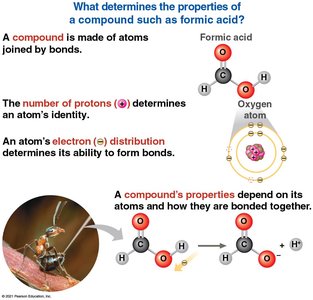
All matter is composed of elements, which are substances that cannot be broken down into simpler substances by chemical means. Compounds are substances formed when two or more elements combine in fixed ratios.
Element: A pure substance consisting of only one type of atom (e.g., Oxygen, O).
Compound: A substance made of two or more elements joined by chemical bonds (e.g., Water, H2O).
Example: Formic acid (HCOOH) is a compound made of hydrogen, carbon, and oxygen atoms.
The Elements of Life
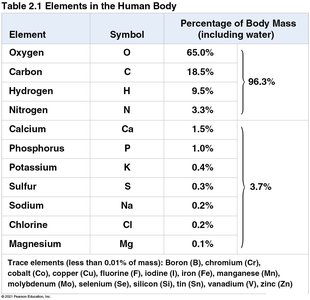
Only a few elements are essential for life, and they make up the majority of the human body.
Major elements: Oxygen, Carbon, Hydrogen, and Nitrogen constitute about 96% of body mass.
Minor elements: Calcium, Phosphorus, Potassium, Sulfur, Sodium, Chlorine, Magnesium, and trace elements are also vital.
Element | Symbol | Percentage of Body Mass (including water) |
|---|---|---|
Oxygen | O | 65.0% |
Carbon | C | 18.5% |
Hydrogen | H | 9.5% |
Nitrogen | N | 3.3% |
Calcium | Ca | 1.5% |
Phosphorus | P | 1.0% |
Potassium | K | 0.4% |
Sulfur | S | 0.3% |
Sodium | Na | 0.2% |
Chlorine | Cl | 0.2% |
Magnesium | Mg | 0.1% |
2.2 An Element’s Properties Depend on the Structure of Its Atoms
Atomic Structure
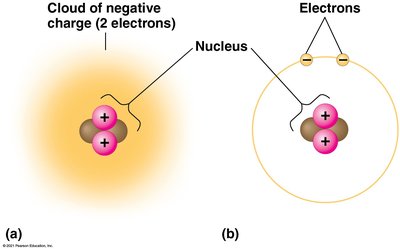
The properties of an element are determined by the structure of its atoms, which consist of a nucleus (containing protons and neutrons) surrounded by electrons.
Atomic number: Number of protons in the nucleus; defines the element.
Mass number: Sum of protons and neutrons in the nucleus.
Atomic mass: The total mass of an atom, approximately equal to the mass number.
Isotopes: Atoms of the same element with different numbers of neutrons.
Electron Shells and Energy Levels
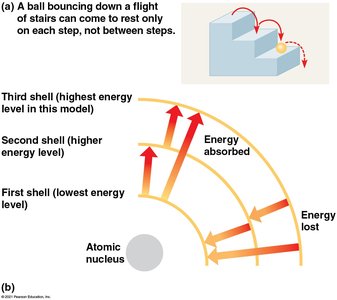
Electrons occupy specific energy levels, or shells, around the nucleus. The energy of an electron depends on its distance from the nucleus.
Electrons in higher shells have more potential energy.
Energy is absorbed when electrons move to higher shells and released when they return to lower shells.
2.3 The Formation & Function of Molecules and Ionic Compounds Depend on Chemical Bonding Between Atoms
Chemical Bonds
Atoms with incomplete valence shells can share or transfer electrons to achieve stability, forming chemical bonds.
Covalent bonds: Sharing of valence electrons between atoms.
Ionic bonds: Transfer of electrons from one atom to another, resulting in charged ions.
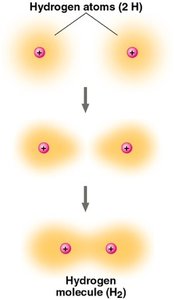
Polar Covalent Bonds
In polar covalent bonds, electrons are shared unequally, resulting in partial charges on atoms.
Electronegativity: The ability of an atom to attract electrons.
Example: Water (H2O) has a polar covalent bond, with oxygen being more electronegative than hydrogen.
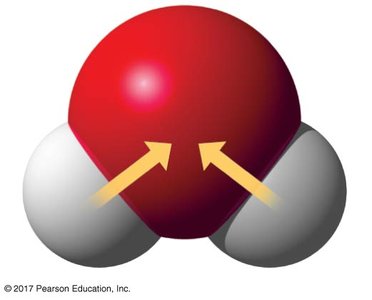
Ionic Bonds
Ionic bonds form when one atom strips electrons from another, creating ions with opposite charges that attract each other.
Cation: Positively charged ion (e.g., Na+).
Anion: Negatively charged ion (e.g., Cl-).
Example: Sodium chloride (NaCl) is formed by the transfer of an electron from sodium to chlorine.
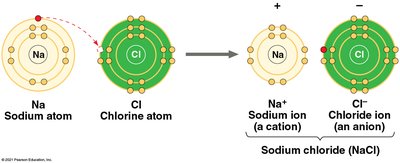
Hydrogen Bonds and Weak Chemical Interactions
Hydrogen bonds occur when a hydrogen atom covalently bonded to one electronegative atom is attracted to another electronegative atom. These are weaker than covalent and ionic bonds but are crucial for biological molecules.
Hydrogen bonds stabilize the structure of proteins and DNA.
Example: Hydrogen bonding between water and ammonia molecules.
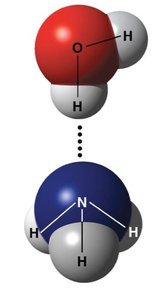
Molecular Shape and Function
Importance of Molecular Shape
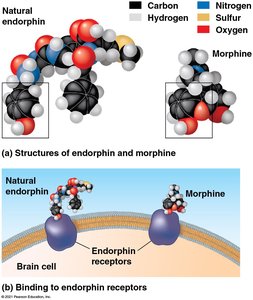
The shape of a molecule determines how it interacts with other molecules, affecting biological recognition and response.
Molecular shape is determined by the arrangement of atoms and the types of bonds.
Example: Opiates and endorphins have similar shapes, allowing them to bind to the same receptors in the brain and produce similar effects.
Additional info: The notes above expand on brief points from the original slides, providing definitions, examples, and context for each concept. All included images directly reinforce the adjacent explanations and are essential for visualizing the described chemical principles.
