 Back
BackThe Chemical Context of Life: Foundations for Biology
Study Guide - Smart Notes
 Tailored notes based on your materials, expanded with key definitions, examples, and context.
The Chemical Context of Life
Introduction
Understanding biology begins with a solid grasp of chemistry. Biological processes are governed by the properties and interactions of atoms and molecules. This chapter provides an essential overview of matter, atomic structure, chemical bonding, and molecular shape, forming the foundation for further study in biology.
Matter, Elements, and Compounds: The Building Blocks
Definitions and Classifications
Matter: Anything that occupies space and has mass.
Elements: Pure substances that cannot be broken down into simpler substances by normal chemical reactions. Examples: carbon (C), hydrogen (H), oxygen (O), nitrogen (N).
Compounds: Substances composed of two or more different elements combined in a fixed ratio. Changing this ratio alters the compound’s properties (e.g., H2O vs. H2O2).
Essential Elements for Life
Main Essential Elements (96% of body mass): Carbon, Oxygen, Hydrogen, Nitrogen.
Other Essential Elements (4%): Calcium, phosphorus, potassium, sulfur, etc.
Trace Elements: Required in very small quantities (e.g., boron, chromium, copper, iron, iodine). Crucial for specific biological processes.
Atomic Structure: The Smallest Units of Elements
Atoms and Subatomic Particles
Atom: The smallest unit of an element retaining its chemical properties.
Subatomic Particles:
Neutrons: Neutral, located in the nucleus. Number can vary (isotopes).
Protons: Positive charge (+1), located in the nucleus. Number defines the element.
Electrons: Negative charge (−1), orbit the nucleus in the electron cloud. Involved in bonding.
Overall Atomic Charge: In a neutral atom, protons = electrons (no net charge).
Number of Subatomic Particles: In non-isotope elements, protons = neutrons = electrons (e.g., carbon: 6 of each).
Deciphering the Periodic Table and Atomic Properties
Key Features
Symbol (e.g., C): Abbreviation for the element.
Atomic Number: Number of protons; unique to each element.
Atomic Mass: Sum of protons and neutrons (in Daltons). Electrons contribute negligible mass.
Isotopes and Radioactivity: Variations in Atoms
Isotopes
Isotopes: Atoms of the same element with different numbers of neutrons (e.g., Carbon-12 vs. Carbon-14).
Calculating Neutrons: Number of neutrons = Atomic Mass − Number of Protons.
Radioactive Isotopes
Radioactive Isotopes: Unstable, decay over time, releasing energy.
Half-life: Time required for 50% of a radioactive sample to decay. Decay follows an exponential pattern.
Applications:
Radiometric Dating: Determining the age of fossils and rocks using known half-lives (e.g., Carbon-14 dating).
Tracing Molecules: Using radioactive isotopes to track molecules in biological systems.
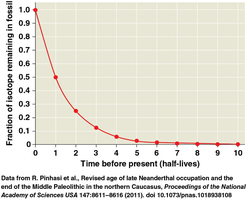
Example: If Np-240 has a half-life of 1 hour and you start with 60 grams, after 4 hours (4 half-lives), the amount remaining is:
grams
Electron Behavior and Energy Levels: The Foundation of Reactivity
Energy and Electron Arrangement
Energy: Capacity to cause change.
Potential Energy: Stored energy due to position or structure. Electrons have potential energy based on their distance from the nucleus.
Electron Shells: Discrete energy levels where electrons reside. Electrons absorb energy to move to higher shells and release energy when falling to lower shells.
Valence Electrons and Shells
Valence Shell: Outermost shell; electrons here are involved in bonding.
Shell Capacity: First shell holds 2 electrons; subsequent shells hold up to 8 (octet rule).
Electron Orbitals and Sublevels
Orbitals: 3D regions where electrons are likely found (90% probability).
Sublevels: S (spherical, 2 electrons), P (dumbbell, 6 electrons), D (cloverleaf, 10 electrons), F (complex, 14 electrons).
Example Electron Configurations:
Helium: 1s2
Neon: 1s2 2s2 2p6
Carbon: 1s2 2s2 2p2
Chemical Bonds: Connecting Atoms
Why Bonds Form
Atoms form bonds to achieve stable electron configurations, usually by filling their valence shells.
Intramolecular Forces (Strong Bonds)
Covalent Bonds: Sharing of electron pairs between atoms. Strongest bond in biological molecules.
Single bond: One pair shared.
Double bond: Two pairs shared.
Nonpolar Covalent: Equal sharing (similar electronegativity).
Polar Covalent: Unequal sharing (different electronegativity), creating partial charges (e.g., H2O).
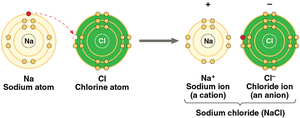
Ionic Bonds: One atom transfers electrons to another, forming ions (cations and anions). Electrostatic attraction holds them together. Example: NaCl (table salt).
Cation: Positively charged (lost electrons).
Anion: Negatively charged (gained electrons).
Intermolecular Forces (Weaker Attractions)
Hydrogen Bonds: Attraction between a hydrogen atom (partially positive, bonded to O or N) and a partially negative atom on another molecule. Crucial for water properties and macromolecule structure.
Van der Waals Interactions: Temporary attractions due to momentary uneven electron distribution. Weak individually, but significant collectively (e.g., gecko adhesion).
Molecular Shape and Function: Form Follows Function
Hybridization and Molecular Geometry
Hybridization: Mixing of atomic orbitals to form new orbitals for bonding.
sp: Linear (e.g., CO2).
sp2: Trigonal planar or bent (e.g., with one lone pair, as in water).
sp3: Tetrahedral, pyramidal, or bent (e.g., methane, CH4).
Impact of Lone Pairs: Lone pairs exert greater repulsion, distorting geometry from ideal shapes.
Biological Significance: The 3D shape of molecules determines their function (e.g., enzyme-substrate specificity).
Chemical Reactions: Dynamic Processes of Life
Definitions and Dynamics
Chemical Reactions: Making and breaking of chemical bonds, resulting in new substances.
Reactants: Starting substances.
Products: Substances formed.
Reversible Reactions: Most biological reactions are reversible.
Chemical Equilibrium: State where forward and reverse reaction rates are equal; concentrations remain constant, but reactions continue dynamically.
