 Back
The Chemical Context of Life: Foundations for Biological Understanding
Study Guide - Smart Notes
 Tailored notes based on your materials, expanded with key definitions, examples, and context.
2. The Chemical Context of Life
Introduction
The study of biology requires a foundational understanding of chemistry, as all living organisms are composed of matter and undergo chemical processes. This chapter explores the elements, atoms, and chemical bonds that form the basis of life, and how these chemical principles underpin biological structure and function.
Key Concepts
The elements and atoms that make up living organisms
The structure of atoms and their subatomic particles
How chemical bonds form and their significance in biology
The role of chemical reactions in biological systems
Case Study: Evolution of Tolerance to Toxic Elements
Biological Relevance of Chemical Elements
Organisms are composed primarily of a small number of elements, with carbon, hydrogen, oxygen, and nitrogen making up the majority of living matter. Some organisms have evolved to tolerate or even require elements that are toxic to others, demonstrating the importance of chemical context in evolution and adaptation.
Atomic Structure and Properties
Subatomic Particles
Protons: Positively charged particles found in the nucleus
Neutrons: Neutral particles also located in the nucleus
Electrons: Negatively charged particles orbiting the nucleus
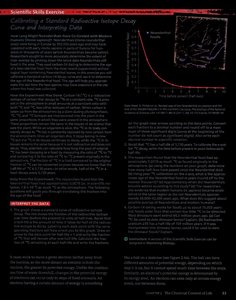
The number of protons (atomic number) defines the element, while the number of neutrons can vary, resulting in different isotopes.

Isotopes and Radioactivity
Isotopes are atoms of the same element with different numbers of neutrons. Some isotopes are unstable and radioactive, decaying over time and emitting energy. Radioactive isotopes have important applications in biology, such as in radiometric dating and medical diagnostics.
Electron Energy Levels
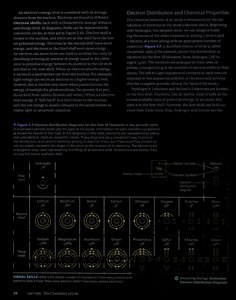
Electrons occupy specific energy levels or shells around the nucleus. The chemical behavior of an atom is largely determined by the distribution of electrons, especially those in the outermost shell (valence electrons).
Chemical Bonds and Molecular Formation
Covalent Bonds
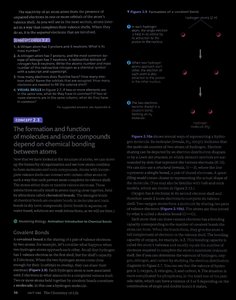
A covalent bond is formed when two atoms share one or more pairs of electrons. Covalent bonds are strong and are responsible for the formation of most biological molecules.
Single bond: Sharing of one pair of electrons
Double bond: Sharing of two pairs of electrons
Ionic Bonds
An ionic bond is formed when one atom donates an electron to another, resulting in oppositely charged ions that attract each other. Ionic compounds, such as salts, are common in biological systems.
Weak Chemical Interactions
In addition to covalent and ionic bonds, weak interactions such as hydrogen bonds and van der Waals forces play crucial roles in the structure and function of biological molecules. For example, hydrogen bonds stabilize the structure of DNA and proteins.
Chemical Reactions in Biology
Making and Breaking Bonds
Chemical reactions involve the making and breaking of chemical bonds, transforming reactants into products. In biological systems, enzymes catalyze these reactions, allowing life-sustaining processes to occur efficiently.
Reactants: Starting materials in a chemical reaction
Products: Substances formed as a result of the reaction
Summary Table: Types of Chemical Bonds
Bond Type | Description | Biological Example |
|---|---|---|
Covalent | Sharing of electron pairs between atoms | Water (H2O), DNA backbone |
Ionic | Transfer of electrons, attraction between ions | Sodium chloride (NaCl) |
Hydrogen | Attraction between hydrogen and electronegative atom | Base pairing in DNA |
Van der Waals | Weak attractions due to transient charges | Protein folding |
Conclusion
The chemical context of life provides the foundation for understanding biological structure and function. Mastery of atomic structure, chemical bonding, and reactions is essential for further study in biology.
