 Back
The Chemical Context of Life: Foundations for General Biology
Study Guide - Smart Notes
 Tailored notes based on your materials, expanded with key definitions, examples, and context.
Overview: The Importance of Chemistry to Life
Biology is deeply interconnected with chemistry, as all living organisms are composed of chemical substances. Understanding the chemical properties of water and other molecules is essential for studying biological processes.
Matter, Elements, and Compounds
Definitions and Properties
Matter: Anything that takes up space and has mass; all organisms are composed of matter.
Element: A substance that cannot be broken down into other substances by chemical reactions.
Compound: A substance consisting of two or more elements in a fixed ratio, exhibiting emergent properties distinct from its constituent elements.
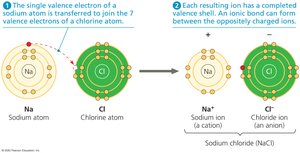
Example: Sodium (Na) and chlorine (Cl) are elements; when combined, they form sodium chloride (NaCl), a compound with properties different from either element alone.
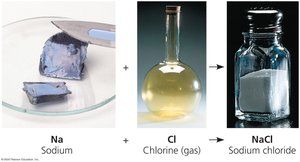
The Elements of Life
Essential and Trace Elements
Of the 92 naturally occurring elements, about 20–25% are essential for life.
Essential elements: Required for an organism to live and reproduce (e.g., oxygen, carbon, hydrogen, nitrogen).
Trace elements: Required in minute quantities (e.g., iodine, iron, zinc).
Example: Iodine is necessary for thyroid function; its deficiency can cause goiter in humans.
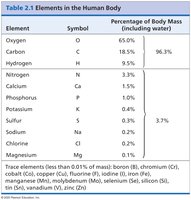
Element | Symbol | Percentage of Body Mass (including water) |
|---|---|---|
Oxygen | O | 65.0% |
Carbon | C | 18.5% |
Hydrogen | H | 9.5% |
Nitrogen | N | 3.3% |
Calcium | Ca | 1.5% |
Phosphorus | P | 1.0% |
Potassium | K | 0.4% |
Sulfur | S | 0.3% |
Sodium | Na | 0.2% |
Chlorine | Cl | 0.2% |
Magnesium | Mg | 0.1% |
An Element’s Properties Depend on the Structure of Its Atoms
Atomic Structure
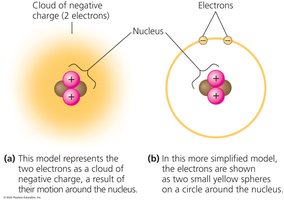
Atom: The smallest unit of an element that retains its properties.
Composed of subatomic particles: neutrons (no charge), protons (positive), and electrons (negative).
Neutrons and protons form the atomic nucleus; electrons form a cloud around the nucleus.
Atomic Number, Mass Number, and Isotopes
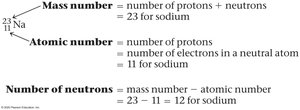
Atomic number: Number of protons in the nucleus.
Mass number: Sum of protons and neutrons.
Atomic mass: Approximate total mass of an atom (in daltons).
Isotopes: Atoms of the same element with different numbers of neutrons; some are radioactive.
Electron Distribution and Chemical Properties
Electron Shells and Valence Electrons
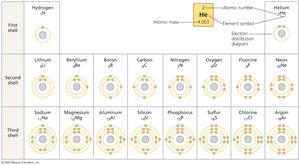
The chemical behavior of an atom is determined by the distribution of electrons in electron shells.
Valence electrons: Electrons in the outermost shell; determine reactivity.
Atoms with full valence shells are inert; those with incomplete shells are reactive.
Chemical Bonds and Molecular Formation
Covalent Bonds
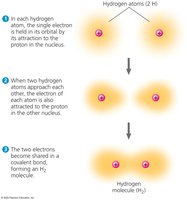
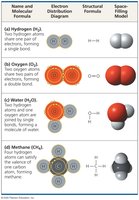
Covalent bond: Sharing of a pair of valence electrons between two atoms.
Can be single (one pair shared) or double (two pairs shared).
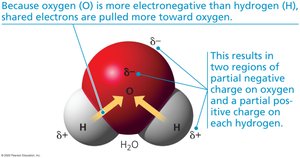
Electronegativity: Atom’s attraction for electrons in a covalent bond; unequal sharing leads to polar covalent bonds.
Ionic Bonds
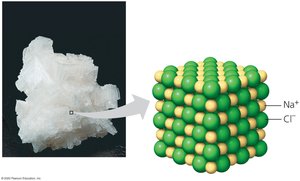
Ionic bond: Attraction between oppositely charged ions formed when electrons are transferred from one atom to another.
Compounds formed by ionic bonds are called salts (e.g., NaCl).
Hydrogen Bonds and Other Weak Interactions
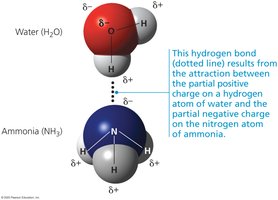
Hydrogen bond: Weak attraction between a hydrogen atom covalently bonded to one electronegative atom and another electronegative atom.
Important in stabilizing the structures of proteins and DNA.
Molecular Shape and Function
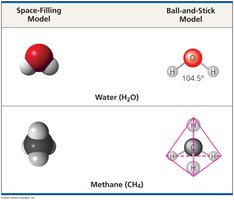
The shape of a molecule is crucial for its function, influencing how molecules interact and recognize each other in biological systems.
Chemical Reactions
Making and Breaking Bonds
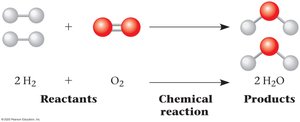
Chemical reaction: The making and breaking of chemical bonds, converting reactants to products.
All chemical reactions are reversible; equilibrium is reached when forward and reverse reaction rates are equal.
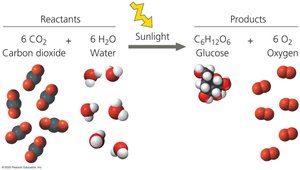
Example: Photosynthesis is a key chemical reaction in biology:
Water: Structure and Properties
Hydrogen Bonding in Water
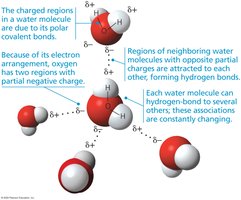
Water molecules are polar, with partial negative charge on oxygen and partial positive charge on hydrogen.
Hydrogen bonds form between water molecules, giving rise to unique properties essential for life.
Emergent Properties of Water
Cohesion: Water molecules stick together, aiding transport in plants.
Adhesion: Water molecules cling to other substances.
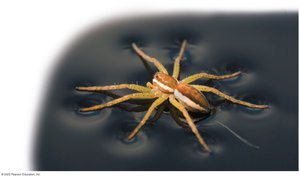
Surface tension: Difficulty of breaking the surface of water due to cohesion.
Moderation of Temperature
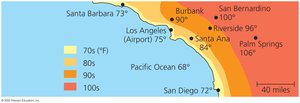
Water absorbs and releases heat with minimal temperature change due to its high specific heat.
Specific heat is the amount of heat needed to change 1 g of a substance by 1°C.
Evaporative cooling helps organisms and environments maintain stable temperatures.
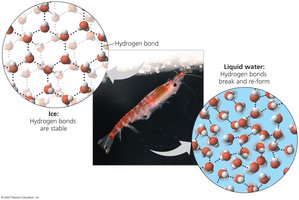
Floating of Ice on Liquid Water
Ice is less dense than liquid water due to stable hydrogen bonds, allowing it to float and insulate aquatic life below.
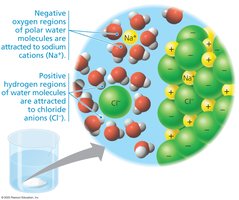
Water as a Solvent
Water’s polarity makes it an excellent solvent for ionic and polar substances.
When ionic compounds dissolve, water forms hydration shells around ions.
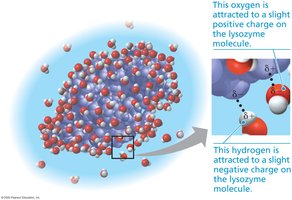
Even large polar molecules, such as proteins, can dissolve in water if they have ionic and polar regions.
Hydrophilic and Hydrophobic Substances
Hydrophilic: Substances with an affinity for water (e.g., salts, sugars).
Hydrophobic: Substances that repel water (e.g., oils).
Acids, Bases, and pH
Water Dissociation and the pH Scale
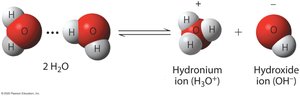
Water can dissociate into hydronium (H3O+) and hydroxide (OH−) ions.
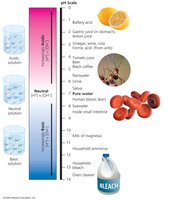
Acids: Increase H+ concentration in solution.
Bases: Reduce H+ concentration, often by increasing OH−.
pH scale: Measures H+ concentration; values below 7 are acidic, above 7 are basic, and 7 is neutral.
Buffers
Buffers: Substances that minimize changes in pH by accepting or donating H+ ions as needed.
Most biological fluids are buffered to maintain a stable internal environment, typically near pH 7.
