 Back
The Chemical Context of Life: Foundations for General Biology
Study Guide - Smart Notes
 Tailored notes based on your materials, expanded with key definitions, examples, and context.
Chemical Context of Life
Elements and Compounds
The study of biology begins with understanding the chemical basis of life. Elements and compounds are fundamental to all living organisms.
Element: A substance that cannot be broken down into other substances by chemical means.
Compound: A substance consisting of two or more elements combined in a fixed ratio.
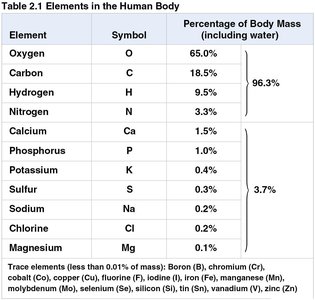
There are 92 naturally occurring elements, and about 25 are essential for life.
Element | Symbol | Percentage of Body Mass (including water) |
|---|---|---|
Oxygen | O | 65.0% |
Carbon | C | 18.5% |
Hydrogen | H | 9.5% |
Nitrogen | N | 3.3% |
Calcium | Ca | 1.5% |
Phosphorus | P | 1.0% |
Potassium | K | 0.4% |
Sulfur | S | 0.3% |
Sodium | Na | 0.2% |
Chlorine | Cl | 0.2% |
Magnesium | Mg | 0.1% |
Emergent Properties
Emergent properties arise when atoms combine to form molecules, and molecules interact to create new characteristics not found in individual atoms.
The structure of atoms determines how they combine to form molecules.
The way a molecule is built determines its properties.
These properties are critical for biological function.

Atomic Structure
Atoms are the basic units of matter, composed of protons, neutrons, and electrons.
Proton: Positive charge (+)
Neutron: No charge
Electron: Negative charge (-)
Atomic Number: Number of protons in the nucleus
Atomic Mass: Number of protons plus neutrons, measured in Daltons
Isotope: Atoms of the same element with different numbers of neutrons

Electron Configuration and Orbitals
Electrons occupy energy levels (shells) around the nucleus, and their arrangement determines chemical reactivity.
Electrons fill the lowest energy shells first.
Each shell contains orbitals; no more than 2 electrons per orbital.
First shell: 1s orbital (2 electrons)
Second shell: 2s (2 electrons) and 2p (6 electrons), total 8 electrons
Third shell: 3s and 3p orbitals, total 8 electrons
Valence shell: Outermost shell, determines chemical properties


Chemical Bonds
Atoms form chemical bonds to achieve stable electron configurations. The main types of bonds are covalent, ionic, and weak bonds.
Covalent bond: Sharing of electrons between atoms
Nonpolar covalent: Electrons shared equally
Polar covalent: Electrons shared unequally, creating partial charges
Electronegativity: The attraction of an atom's nucleus for shared electrons


Ionic Bonds
Ionic bonds form when atoms transfer electrons, resulting in charged ions that attract each other.
Cation: Positively charged ion
Anion: Negatively charged ion
Common in atoms with 1 or 7 electrons in the valence shell


Weak Chemical Bonds
Weak bonds, such as hydrogen bonds and van der Waals interactions, are essential for the structure and function of biological molecules.
Hydrogen bond: Attraction between partial charges in polar molecules, often involving O and N
Van der Waals interactions: Weak attractions due to transient charges as electrons move

Name | Basis of Interaction | Structure | Bond Energy (Kcal/mol) |
|---|---|---|---|
Covalent bond | Sharing of electron pairs | H—O—H | 50–110 |
Hydrogen bond | Sharing of H atom | H—O···H | 3–7 |
Ionic bond | Attraction of opposite charges | Na+ Cl- | 3–7 |
Hydrophobic interaction | Interaction of nonpolar substances in presence of polar substances | — | 1–2 |
van der Waals interaction | Interaction of electrons of nonpolar substances | — | 1 |

Molecular Shapes and Biological Function
The shape of molecules, determined by the arrangement of orbitals and bonds, is critical for their biological function.
Hybridization of orbitals creates three-dimensional shapes, such as tetrahedrons.
Molecular shape affects how molecules interact with each other.


Molecular Mimicry
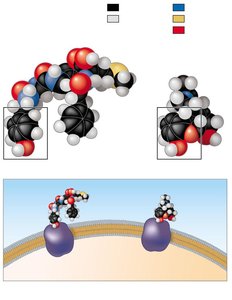
Some molecules mimic the shape of others, allowing them to interact with biological receptors and affect function.
Example: Morphine mimics endorphins and binds to endorphin receptors in the brain.
Chemical Reactions
Chemical reactions involve the breaking and forming of bonds, transforming molecules and energy in living cells.
Understanding molecular structure is key to understanding the chemical basis of life.
Reactants are transformed into products through chemical reactions.
Example: Photosynthesis converts carbon dioxide and water into glucose and oxygen.
Photosynthesis equation:

Additional info: The notes cover the essential chemical concepts foundational to General Biology, including atomic structure, chemical bonding, and the importance of molecular shape and reactions in biological systems.
