 Back
The Chemical Context of Life: Foundations of Biological Chemistry
Study Guide - Smart Notes
 Tailored notes based on your materials, expanded with key definitions, examples, and context.
Chapter 2: The Chemical Context of Life
Introduction to Chemistry in Biology
Understanding biological processes requires a foundational knowledge of chemistry, as all living matter is composed of chemical substances. This chapter explores the principles of chemistry that are essential for comprehending the structure and function of living organisms.
The Nature of Matter
What is Chemistry?
Chemistry is the study of matter—anything that occupies space and has mass.
Element: A pure substance that cannot be broken down into other substances by chemical reactions. There are 92 naturally occurring elements.
Compounds are substances formed by the chemical combination of two or more elements in fixed ratios.
The arrangement of atoms in compounds determines their unique properties.
Emergent Properties and Essential Elements
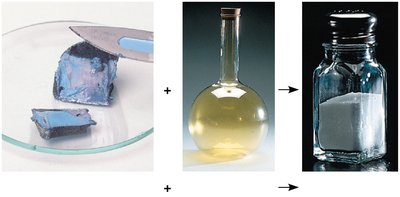
Emergent properties arise when elements combine to form compounds with new characteristics (e.g., sodium and chlorine form edible salt).
About 20-25% of elements are essential to life; four elements—carbon (C), oxygen (O), hydrogen (H), and nitrogen (N)—make up about 96% of living matter.
Other important elements include phosphorus (P), sulfur (S), calcium (Ca), and potassium (K).
Trace elements are required in very small amounts but are vital for health (e.g., iron, iodine).
Atoms: The Building Blocks of Elements
Atomic Structure
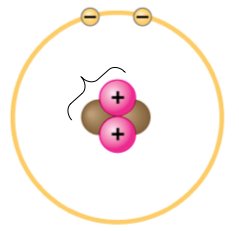
An atom is the smallest unit of an element that retains its properties.
Atoms are composed of subatomic particles: protons (+), neutrons (neutral), and electrons (−).
Protons and neutrons are located in the nucleus; electrons orbit the nucleus.
The atomic number is the number of protons in an atom and defines the element.
The atomic mass number is the sum of protons and neutrons.
Atoms are electrically neutral when the number of protons equals the number of electrons.
Isotopes
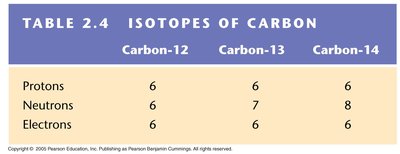
Isotopes are atoms of the same element with different numbers of neutrons, resulting in different mass numbers.
Some isotopes are stable, while others are radioactive and decay spontaneously, emitting radiation.
Carbon-12 | Carbon-13 | Carbon-14 | |
|---|---|---|---|
Protons | 6 | 6 | 6 |
Neutrons | 6 | 7 | 8 |
Electrons | 6 | 6 | 6 |
Applications of Radioactive Isotopes
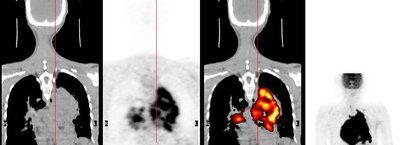
Radioactive isotopes are used as tracers in medical imaging (e.g., PET scans), radiometric dating, and labeling cellular components for detection.
All radioactive isotopes have a characteristic half-life, the time it takes for half of the atoms to decay.
Examples include carbon-14 for dating and technetium-99m for imaging the hepatobiliary tract.
Atoms, Ions, and Electron Configuration
Ions
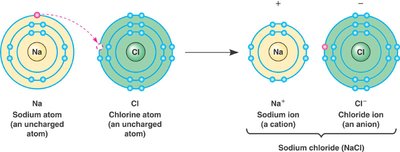
An ion is an atom or molecule with a net electric charge due to the loss or gain of electrons.
Cation: Positively charged ion (loss of electrons).
Anion: Negatively charged ion (gain of electrons).
Electron Shells and Orbitals
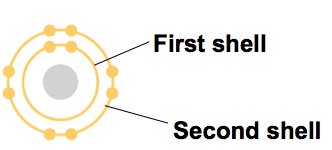
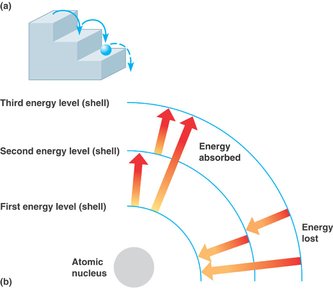
Electrons occupy energy levels called shells around the nucleus.
The valence shell is the outermost shell; its electrons determine the atom's chemical behavior.
Atoms with incomplete valence shells are reactive and tend to form bonds to achieve stability.
Orbitals are regions in space where electrons are likely to be found; each orbital can hold up to two electrons.
Chemical Bonds and Interactions
Types of Chemical Bonds
Covalent bonds: Atoms share pairs of valence electrons; these are the strongest bonds in biological systems.
Nonpolar covalent bond: Electrons are shared equally between atoms.
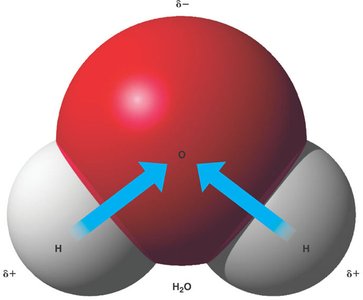
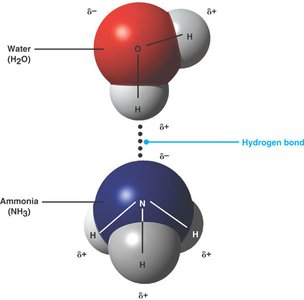
Polar covalent bond: Electrons are shared unequally, resulting in partial charges (e.g., water molecules).
Ionic bonds: Formed by the electrical attraction between oppositely charged ions after electron transfer.
Hydrogen bonds: Weak bonds between a hydrogen atom covalently bonded to an electronegative atom and another electronegative atom.
Van der Waals interactions: Weak attractions between molecules or parts of molecules that result from transient local partial charges.
Significance of Weak Interactions
Weak interactions allow for rapid association and dissociation, which is essential for dynamic biological processes (e.g., DNA replication, enzyme activity).
They enable fine-tuning of molecular interactions and contribute to the flexibility and specificity of biological molecules.
Molecular Shape and Function
Shape Determines Function
The three-dimensional shape of a molecule is determined by the positions of its atoms' orbitals.
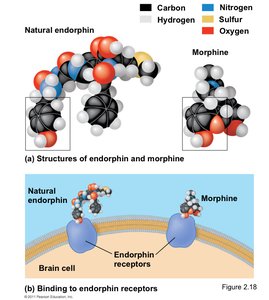
Molecular shape is crucial for the recognition and interaction of biological molecules (e.g., enzyme-substrate, hormone-receptor interactions).
Molecular mimicry occurs when different molecules have similar shapes and can bind to the same biological targets (e.g., morphine and endorphins).
Chemical Reactions
Making and Breaking Bonds
Chemical reactions involve the making and breaking of chemical bonds, resulting in changes in the composition of matter.
Reactions are represented as:
Chemical reactions do not create or destroy matter; they rearrange atoms.
Most reactions are reversible and reach chemical equilibrium when the forward and reverse reaction rates are equal.
Key Points for Review
Distinguish between atomic number and atomic mass number; calculate protons, neutrons, and electrons.
Identify the four major elements in biological systems and the role of trace elements.
Understand isotopes and their applications.
Differentiate between ions and atoms.
Describe electron configuration, shells, and valence electrons.
Compare the four major types of chemical bonds relevant to biology and their significance.
