 Back
The Chemical Context of Life: Matter, Elements, Atoms, and Bonding
Study Guide - Smart Notes
 Tailored notes based on your materials, expanded with key definitions, examples, and context.
The Chemical Context of Life
1.1 Matter, Elements, Atoms
Understanding the chemical basis of life is essential in biology, as living organisms are governed by the laws of physics and chemistry. Biology is a multidisciplinary science, and the organization of life begins at the atomic and molecular levels.
Matter: Anything that takes up space and has mass. Exists in three states: solid, liquid, and gas.
Elements: Pure substances consisting of only one type of atom. Cannot be broken down by ordinary chemical means.
Atoms: The smallest unit of an element, composed of subatomic particles: protons, neutrons, and electrons.
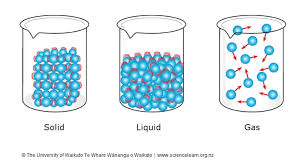
States of Matter
Solid: Atoms/molecules are closely packed.
Liquid: Atoms/molecules are less tightly packed, allowing flow.
Gas: Atoms/molecules are far apart and move freely.
Elements Essential for Life
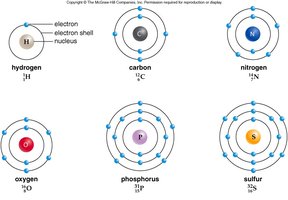
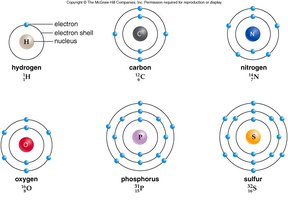
Of the 92 naturally occurring elements, only a few are essential for life. The most important are CHNOPS: Carbon, Hydrogen, Nitrogen, Oxygen, Phosphorus, and Sulfur. Other elements such as sodium (Na), potassium (K), calcium (Ca), iron (Fe), and magnesium (Mg) are also vital.
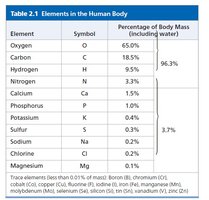
Element | Symbol | Percentage of Body Mass |
|---|---|---|
Oxygen | O | 65.0% |
Carbon | C | 18.5% |
Hydrogen | H | 9.5% |
Nitrogen | N | 3.3% |
Calcium | Ca | 1.5% |
Phosphorus | P | 1.0% |
Potassium | K | 0.4% |
Sulfur | S | 0.3% |
Sodium | Na | 0.2% |
Chlorine | Cl | 0.2% |
Magnesium | Mg | 0.1% |
Atomic Structure and Subatomic Particles
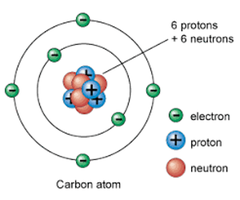
An atom consists of a nucleus containing protons (positive charge) and neutrons (neutral), surrounded by electrons (negative charge) in electron shells.
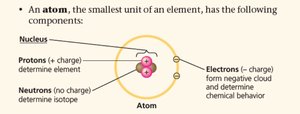
Protons: Determine the element's identity.
Neutrons: Determine isotope.
Electrons: Determine chemical behavior.
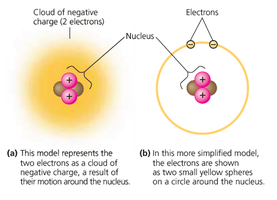
Atomic Number and Atomic Mass
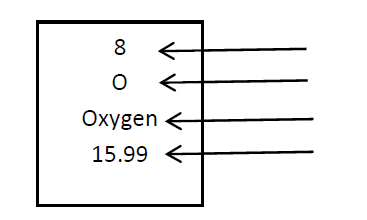
Atomic Number: Number of protons in the nucleus; also equals the number of electrons in a neutral atom.
Atomic Mass: Sum of protons and neutrons.
Number of Neutrons: Atomic Mass - Atomic Number.
Periodic Table Information
Each element is represented by a symbol, atomic number, name, and average atomic mass.
Atoms as the Smallest Unit of Matter
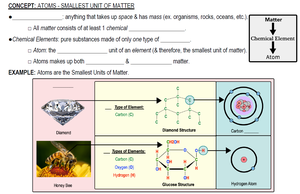
Atoms make up both living and nonliving matter. They are the smallest unit of an element and are fundamental to chemical elements and compounds.
1.2 Molecules, Types of Bonding
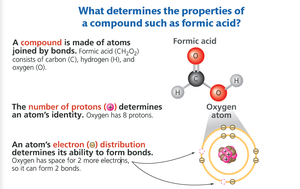
Molecules are formed when two or more atoms bond together. The type of bond formed depends on the electron arrangement and the elements involved.
Compounds
Compound: Substance composed of two or more different elements combined in a fixed ratio.
Properties of compounds differ from their constituent elements.
Examples: NaCl (table salt), H2O (water).
Isotopes
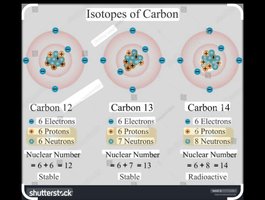
Isotopes: Atoms of the same element with different numbers of neutrons, resulting in different atomic masses.
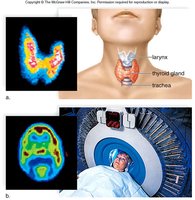
Radioactive Isotopes: Unstable isotopes that emit particles and energy.
Applications: Carbon dating, medical diagnostics.
Electron Arrangement and Bonding
Electrons are arranged in shells around the nucleus.
Valence electrons are in the outermost shell and determine bonding behavior.
Atoms with incomplete valence shells are reactive.
Molecules and Types of Chemical Bonds
Molecule: Two or more atoms joined together.
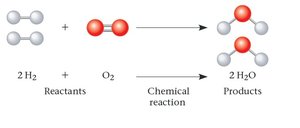
Diatomic Molecules: Made of the same type of atom (e.g., O2, H2).
Compound Molecules: Made of different atoms (e.g., H2O, CO2).
Molecules are held together by chemical bonds: ionic, covalent (polar and non-polar), and hydrogen bonds.
Covalent Bonds
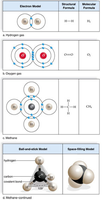
Covalent Bond: Formed when two atoms share a pair of valence electrons.
Electronegativity: The attraction of an atom for shared electrons.
Non-polar Covalent: Electrons shared equally (e.g., H2 gas).
Polar Covalent: Unequal sharing of electrons (e.g., H2O).
Single, double, or triple bonds are possible.

Ionic Bonds
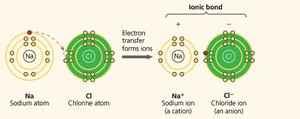
Ionic Bond: Formed when one atom donates or gains an electron, creating ions with opposite charges that attract each other.
Example: Sodium (Na) donates an electron to chlorine (Cl), forming Na+ and Cl-.
Hydrogen Bonds
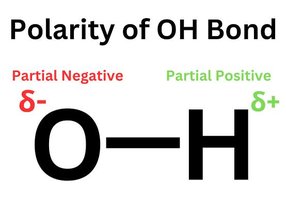
Hydrogen Bond: Weak attraction between a hydrogen atom covalently bonded to an electronegative atom and another electronegative atom.
Important in biological molecules, such as DNA and water.
Result from polar covalent bonds, where electrons are unequally shared.
Summary Table: Types of Chemical Bonds
Bond Type | Mechanism | Strength | Example |
|---|---|---|---|
Covalent (Non-polar) | Equal sharing of electrons | Strong | H2, O2 |
Covalent (Polar) | Unequal sharing of electrons | Strong | H2O |
Ionic | Electron transfer, attraction between ions | Moderate | NaCl |
Hydrogen | Attraction between partial charges | Weak (individually) | Water, DNA |
Key Equations
Atomic Number:
Atomic Mass:
Number of Neutrons:
Additional info:
Radioactive isotopes are used in medicine for imaging and treatment, and in archaeology for dating fossils.
Valence electrons determine the chemical reactivity and bonding capacity of atoms.
