 Back
The Chemical Context of Life: Matter, Elements, and Chemical Bonds
Study Guide - Smart Notes
 Tailored notes based on your materials, expanded with key definitions, examples, and context.
Overview: The Chemical Connection to Biology
Introduction
Living organisms and their environments are governed by the fundamental laws of physics and chemistry. Biology is inherently multidisciplinary, drawing from chemistry to explain the molecular basis of life. Life is organized hierarchically, from atoms to molecules to cells, with emergent properties appearing at each level.
Emergent Properties: New characteristics arise as simple components combine into more complex structures.
Hierarchy: Atoms → Molecules → Cells → Organisms
Concept 2.1: Matter, Elements, and Compounds
Matter and Its Composition
Matter is anything that occupies space and has mass. It is composed of elements and compounds.
Element: A pure substance that cannot be broken down by chemical reactions.
Compound: A substance made of two or more elements in a fixed ratio, with properties different from its constituent elements.
Emergent Properties: Compounds often have characteristics not found in their component elements.
Example: Sodium (a metal) and chlorine (a gas) combine to form sodium chloride (table salt), which is edible and safe. 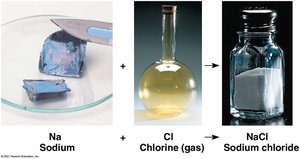
The Elements of Life
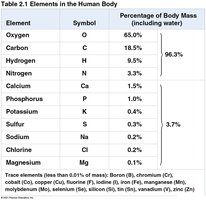
About 20–25% of the 92 naturally occurring elements are essential for life.
Major Elements: Carbon, hydrogen, oxygen, and nitrogen make up 96% of living matter.
Minor Elements: Calcium, phosphorus, potassium, and sulfur account for most of the remaining 4%.
Trace Elements: Required in minute quantities (e.g., iron, iodine).
Concept 2.2: Atomic Structure and Properties
Atoms and Subatomic Particles
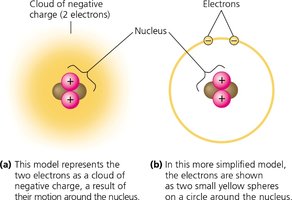
Atoms are the smallest units of matter retaining the properties of an element. They consist of subatomic particles:
Protons: Positive charge, found in the nucleus.
Neutrons: No charge, found in the nucleus.
Electrons: Negative charge, orbiting the nucleus.
Atomic Number, Mass Number, and Isotopes
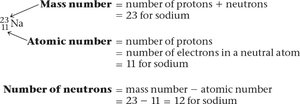
Atomic Number: Number of protons in the nucleus; also equals the number of electrons in a neutral atom.
Mass Number: Sum of protons and neutrons.
Isotopes: Atoms of the same element with different numbers of neutrons.
Radioactive Isotopes: Unstable isotopes that decay spontaneously, emitting energy.
Energy Levels and Electron Shells
Electrons occupy specific energy levels called shells.
Potential Energy: Energy due to position; electrons farther from the nucleus have higher potential energy.
Energy Transitions: Electrons move between shells by absorbing or releasing energy.
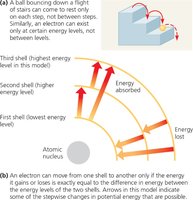
Electron Distribution and the Periodic Table
The arrangement of electrons in shells determines an atom’s chemical properties. The periodic table organizes elements by electron configuration. 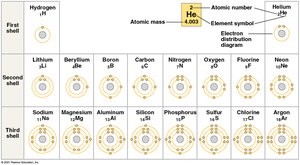
Valence Electrons and Chemical Reactivity
Valence Electrons: Electrons in the outermost shell; determine chemical behavior.
Chemically Inert Elements: Elements with full valence shells are unreactive.
Electron Orbitals
Orbital: A 3D region where an electron is likely to be found.
Shells and Orbitals: Each shell contains a specific number of orbitals; each orbital holds up to 2 electrons.
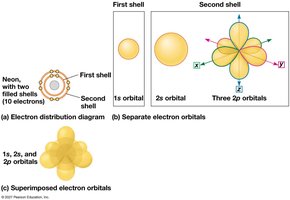
Concept 2.3: Chemical Bonds and Molecular Formation
Covalent Bonds
Covalent bonds involve the sharing of valence electrons between atoms.
Single Covalent Bond: Sharing one pair of electrons (e.g., H2).
Double Covalent Bond: Sharing two pairs of electrons (e.g., O2).
Bonding Capacity (Valence): Number of covalent bonds an atom can form.
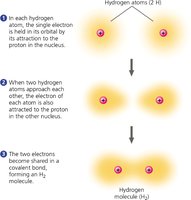
Electronegativity and Types of Covalent Bonds
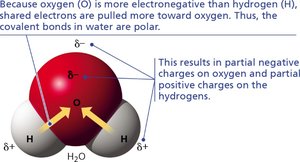
Electronegativity: An atom’s ability to attract electrons in a covalent bond.
Nonpolar Covalent Bond: Electrons are shared equally.
Polar Covalent Bond: Electrons are shared unequally, creating partial charges.
Ionic Bonds and Ionic Compounds
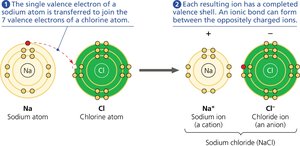
Ionic bonds form when electrons are transferred from one atom to another, creating ions.
Cation: Positively charged ion.
Anion: Negatively charged ion.
Ionic Compound: Formed by the attraction between cations and anions (e.g., NaCl).
Weak Chemical Interactions
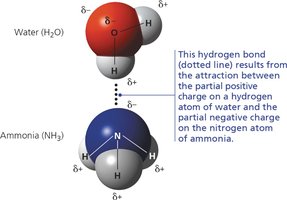
Hydrogen Bonds: Weak attractions between a hydrogen atom covalently bonded to an electronegative atom and another electronegative atom.
Importance: Stabilize DNA, protein structure, and water properties.
Van der Waals Interactions: Weak attractions due to temporary partial charges from uneven electron distribution.
Collective Strength: Many interactions together can be strong (e.g., gecko adhesion).
Molecular Shape and Function
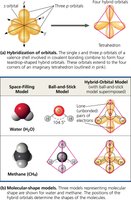
The shape of a molecule is determined by the arrangement of its atoms’ orbitals and is crucial for its biological function.
Hybridization: s and p orbitals combine to form specific shapes (e.g., tetrahedral in methane).
Recognition: Molecular shape allows biological molecules to interact specifically (e.g., opiates and endorphins).
Summary Table: Elements in the Human Body
Element | Symbol | Percentage of Body Mass (including water) |
|---|---|---|
Oxygen | O | 65.0% |
Carbon | C | 18.5% |
Hydrogen | H | 9.5% |
Nitrogen | N | 3.3% |
Calcium | Ca | 1.5% |
Phosphorus | P | 1.0% |
Potassium | K | 0.4% |
Sulfur | S | 0.3% |
Sodium | Na | 0.2% |
Chlorine | Cl | 0.2% |
Magnesium | Mg | 0.1% |
Key Equations
Mass Number:
Atomic Number:
Number of Neutrons:
Additional info:
Biological molecules are stabilized by both strong (covalent, ionic) and weak (hydrogen, van der Waals) interactions.
Molecular shape is essential for biological recognition and function.
