 Back
The Chemical Context of Life: Water and Its Properties
Study Guide - Smart Notes
 Tailored notes based on your materials, expanded with key definitions, examples, and context.
The Chemical Context of Life: Water and Its Properties
Water Molecule Structure and Polarity
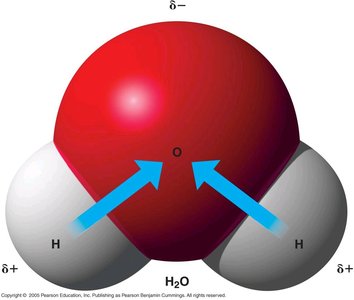
Water (H2O) is a polar molecule, meaning it has regions of partial positive and negative charge due to the unequal sharing of electrons between hydrogen and oxygen atoms. This polarity is fundamental to water's unique properties and its role in biological systems.
Atomic Structure: Hydrogen has an atomic number of 1 (1 proton, 1 electron), and oxygen has an atomic number of 8 (8 protons, 8 electrons).
Electron Shells: The first shell holds 2 electrons; the second shell holds up to 8 electrons. Oxygen needs 2 more electrons to fill its outer shell, so it forms two covalent bonds with hydrogen atoms.
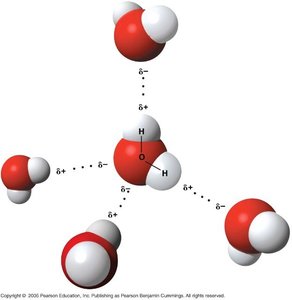
Polarity: Oxygen is highly electronegative and attracts shared electrons more strongly, resulting in a partial negative charge (δ−) near the oxygen and partial positive charges (δ+) near the hydrogens.
Bonding: The atoms in a water molecule are joined by polar covalent bonds.
Hydrogen Bonding in Water
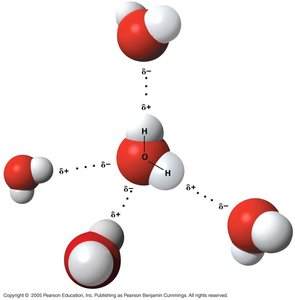
The polarity of water molecules allows them to form hydrogen bonds with each other and with other polar molecules. Hydrogen bonds are weak individually but collectively give water many of its unique properties.
Hydrogen Bond: An attraction between a hydrogen atom carrying a partial positive charge and an electronegative atom (like oxygen or nitrogen) carrying a partial negative charge.
Intermolecular Forces: Hydrogen bonds are not true bonds like covalent bonds but are strong intermolecular attractions.
Biological Importance: Hydrogen bonding is crucial for the structure of DNA, proteins, and the properties of water.
Emergent Properties of Water
Water's polarity and hydrogen bonding result in several emergent properties essential for life:
Cohesion: Water molecules stick to each other, allowing for surface tension and the transport of water in plants.
Adhesion: Water molecules can also stick to other substances, aiding in capillary action.
Moderation of Temperature: Water can absorb or release large amounts of heat with only a slight change in its own temperature due to its high specific heat.
Expansion Upon Freezing: Water is less dense as a solid than as a liquid, so ice floats, insulating aquatic environments.
Versatile Solvent: Water dissolves many substances, making it an excellent medium for chemical reactions in cells.
Cohesion, Adhesion, and Surface Tension
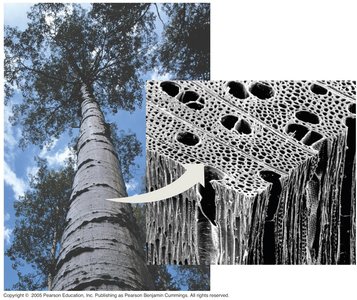
Cohesion and adhesion are responsible for water transport in plants and surface tension, which allows small organisms to move on water surfaces.
Cohesion: Responsible for the transport of water against gravity in plants.
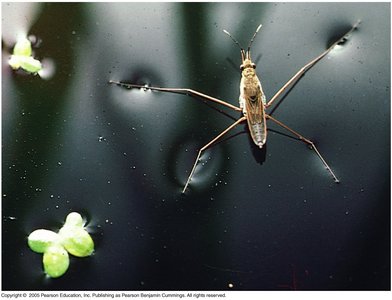
Surface Tension: The measure of how difficult it is to stretch or break the surface of a liquid; water has a high surface tension due to hydrogen bonding.
Example: Water striders can walk on water due to surface tension.
Water’s Ability to Moderate Temperature
Water stabilizes temperature in organisms and environments due to its high specific heat and high heat of vaporization.
Specific Heat: The amount of heat required to raise the temperature of 1 gram of a substance by 1°C. Water’s high specific heat helps buffer temperature changes.
Heat of Vaporization: The amount of energy needed to convert 1 gram of liquid to gas. Evaporative cooling helps organisms regulate temperature.
Example: Oceans and lakes moderate climate by absorbing heat in the summer and releasing it in the winter.
Expansion Upon Freezing
Unlike most substances, water expands when it freezes due to the formation of a crystalline lattice structure stabilized by hydrogen bonds. This makes ice less dense than liquid water.
Biological Importance: Floating ice insulates bodies of water, protecting aquatic life during cold periods.
Example: Lakes and ponds freeze from the top down, allowing life to persist below the ice layer.

Water as a Versatile Solvent
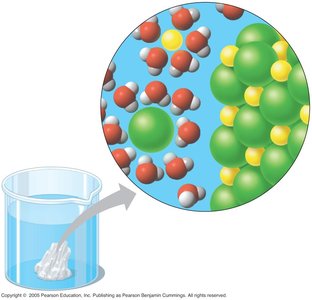
Water’s polarity allows it to dissolve a wide variety of substances, making it the “universal solvent.”
Solvent: The dissolving agent (water in biological systems).
Solute: The substance dissolved in the solvent.
Hydration Shell: Water molecules surround and separate ions or polar molecules, facilitating dissolution.
Hydrophilic vs. Hydrophobic: Hydrophilic substances (ionic or polar) dissolve in water; hydrophobic substances (nonpolar) do not.
Acids, Bases, and the pH Scale
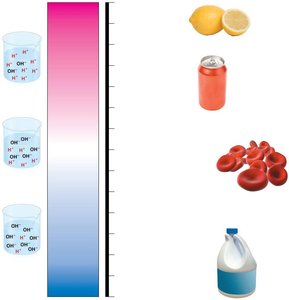
Water can dissociate into hydronium (H3O+) and hydroxide (OH−) ions. The concentration of these ions determines the acidity or basicity of a solution, measured by the pH scale.
Acid: A substance that increases the H+ concentration in a solution.
Base: A substance that decreases the H+ concentration, either by accepting H+ or releasing OH−.
pH Scale: Ranges from 0 (most acidic) to 14 (most basic); pH 7 is neutral.
Formula:
Pure Water: [H+] = [OH−] = M, so pH = 7.
Logarithmic Scale: Each pH unit represents a tenfold difference in H+ concentration.
Summary Table: Properties of Water
Property | Description | Biological Importance |
|---|---|---|
Cohesion & Adhesion | Water molecules stick to each other and to other substances | Transport in plants, surface tension |
High Specific Heat | Resists temperature changes | Stabilizes climate and organism temperature |
Expansion Upon Freezing | Ice is less dense than liquid water | Insulates aquatic environments |
Versatile Solvent | Dissolves many substances | Facilitates chemical reactions in cells |
Additional info: The emergent properties of water are critical for life on Earth, influencing climate, cellular processes, and the structure of biological molecules.
