 Back
The Chemical Context of Life, Water, and Carbon: Foundations for General Biology
Study Guide - Smart Notes
 Tailored notes based on your materials, expanded with key definitions, examples, and context.
The Chemical Context of Life
Elements and Compounds
All living organisms are composed of matter, which consists of chemical elements in pure form and in combinations called compounds. Understanding the nature of elements and compounds is fundamental to biology.
Element: A substance that cannot be broken down to other substances by chemical reactions.
Compound: A substance consisting of two or more elements in a fixed ratio, with properties different from its constituent elements.
Emergent Properties: Compounds exhibit characteristics not found in their individual elements.
The Elements of Life
Only a subset of the 92 naturally occurring elements are essential for life. The most abundant elements in living matter are carbon, hydrogen, oxygen, and nitrogen.
Essential Elements: About 20–25% of elements are required for life.
Major Elements: Carbon, hydrogen, oxygen, and nitrogen make up 96% of living matter.
Minor Elements: Calcium, phosphorus, potassium, and sulfur constitute most of the remaining 4%.
Trace Elements: Required in minute quantities for proper biological function.
Atomic Structure and Subatomic Particles
The properties of elements depend on the structure of their atoms, which are composed of subatomic particles.
Atom: The smallest unit of matter retaining the properties of an element.
Subatomic Particles: Neutrons (no charge), protons (positive charge), electrons (negative charge).
Atomic Number: Number of protons in the nucleus.
Mass Number: Sum of protons and neutrons.
Atomic Mass: Total mass of an atom, approximated by mass number.
Isotopes
Isotopes are variants of elements with differing numbers of neutrons. Some isotopes are radioactive and decay spontaneously, emitting energy.
Isotope: Atoms of the same element with different neutron counts.
Radioactive Isotope: Unstable, decays and releases energy.
Chemical Bonds
Atoms interact through chemical bonds, forming molecules and compounds essential for life.
Covalent Bond: Sharing of valence electrons between atoms.
Single Bond: One pair of electrons shared.
Double Bond: Two pairs of electrons shared.
Electronegativity: Atom's attraction for electrons in a covalent bond.
Nonpolar Covalent Bond: Electrons shared equally.
Polar Covalent Bond: Unequal sharing, resulting in partial charges.
Ionic Bond: Attraction between oppositely charged ions (cation and anion).
Ionic Compound: Formed by ionic bonds, often stable as crystals.
Weak Chemical Interactions
Weak bonds, such as hydrogen bonds and van der Waals interactions, play crucial roles in maintaining the structure and function of biological molecules.
Hydrogen Bond: Attraction between a hydrogen atom covalently bonded to an electronegative atom and another electronegative atom.
Van der Waals Interactions: Weak attractions due to transient local partial charges.
Chemical Reactions
Chemical reactions involve the making and breaking of chemical bonds, transforming reactants into products. Equilibrium is reached when forward and reverse reactions occur at the same rate.
Reactants: Starting molecules.
Products: Resulting molecules.
Chemical Equilibrium: State where concentrations of reactants and products remain constant.
Water and Life
Structure and Properties of Water
Water's unique properties arise from its polar covalent bonds and ability to form hydrogen bonds, making it essential for life.
Polarity: Uneven charge distribution in water molecules.
Hydrogen Bonding: Water molecules form hydrogen bonds with each other.
Emergent Properties of Water
Four key properties of water facilitate life on Earth: cohesion, moderation of temperature, expansion upon freezing, and versatility as a solvent.
Cohesion: Hydrogen bonds hold water molecules together, resulting in high surface tension.
Adhesion: Attraction between water and other substances, aiding water transport in plants.
Moderation of Temperature: Water absorbs and releases heat with minimal temperature change due to high specific heat.
Evaporative Cooling: As water evaporates, its surface cools, stabilizing temperatures in organisms and environments.
Expansion Upon Freezing: Ice floats on water due to lower density, crucial for aquatic life.
Versatility as a Solvent: Water dissolves a wide range of substances due to its polarity.
Solutions and Solubility
Water acts as a solvent in biological systems, forming solutions with solutes. Hydrophilic substances dissolve readily, while hydrophobic substances do not.
Solution: Homogeneous mixture of substances.
Solvent: Dissolving agent (water in aqueous solutions).
Solute: Substance dissolved.
Hydrophilic: Affinity for water.
Hydrophobic: Repels water; major component of cell membranes.
Carbon and the Molecular Diversity of Life
Organic Chemistry and Carbon
Organic chemistry studies compounds containing carbon, which forms the backbone of biological molecules due to its ability to make four covalent bonds.
Organic Compound: Contains carbon, ranges from simple to complex.
Major Elements: C, H, O, N, S, P are uniform across organisms.
Versatility of Carbon: Enables diversity of organic molecules.
Carbon Skeletons and Molecular Diversity
Carbon atoms can form chains, rings, and branched structures, leading to molecular diversity.
Carbon Skeleton: Framework of carbon atoms in organic molecules.
Hydrocarbons: Molecules of only carbon and hydrogen; store energy.
Isomers
Isomers are compounds with the same molecular formula but different structures and properties. Types include structural isomers, cis-trans isomers, and enantiomers.
Structural Isomers: Different covalent arrangements.
Cis-trans Isomers: Same bonds, different spatial arrangements.
Enantiomers: Mirror images; often only one is biologically active.
Functional Groups and Molecular Function
Functional groups are specific chemical groups attached to carbon skeletons, determining the properties and reactivity of organic molecules.
Functional Group: Commonly involved in chemical reactions.
Estradiol and Testosterone: Differ only in functional groups, leading to distinct biological effects.
ATP: The Energy Currency of the Cell
ATP (adenosine triphosphate) is a key organic phosphate that stores and releases energy for cellular processes.
Structure: Adenosine attached to three phosphate groups.
Function: Stores potential energy; releases energy upon reaction with water.
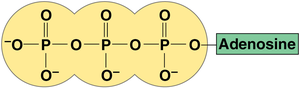
Example: ATP hydrolysis releases energy used for cellular work.
Summary Table: Elements in the Human Body
The following table summarizes the main elements found in the human body and their approximate abundance:
Element | Approximate % of Body Mass | Role in Biology |
|---|---|---|
Oxygen (O) | 65% | Major component of water and organic molecules |
Carbon (C) | 18% | Backbone of organic molecules |
Hydrogen (H) | 10% | Component of water and organic molecules |
Nitrogen (N) | 3% | Component of proteins and nucleic acids |
Calcium (Ca) | 1.5% | Bone structure, signaling |
Phosphorus (P) | 1% | ATP, nucleic acids |
Potassium (K) | 0.4% | Cell function |
Sulfur (S) | 0.3% | Proteins |
Trace Elements | <0.01% | Enzyme function, other roles |
Additional info: Table values are inferred from standard biology references.
