 Back
The Chemical Context of Life: Water and Its Properties
Study Guide - Smart Notes
 Tailored notes based on your materials, expanded with key definitions, examples, and context.
Chemical Bonds and the Nature of Water
Covalent and Ionic Bonds
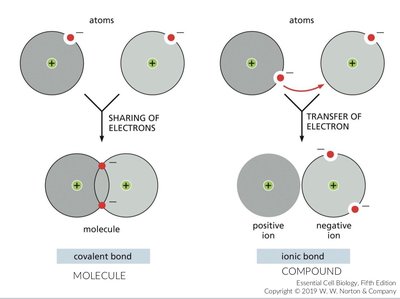
Chemical bonds are the forces that hold atoms together in molecules and compounds. The type of bond formed depends on how electrons are distributed between atoms.
Covalent Bonds: Atoms share electrons. If the sharing is equal, the bond is nonpolar covalent (e.g., C–C, C–H). If the sharing is unequal, the bond is polar covalent (e.g., O–H, N–H, C–O).
Ionic Bonds: One atom transfers electrons to another, resulting in the formation of oppositely charged ions that attract each other.
Electronegativity is the ability of an atom to attract electrons in a bond. The difference in electronegativity between two atoms determines the bond type:
Small or no difference: Nonpolar covalent bond
Moderate difference: Polar covalent bond
Large difference: Ionic bond
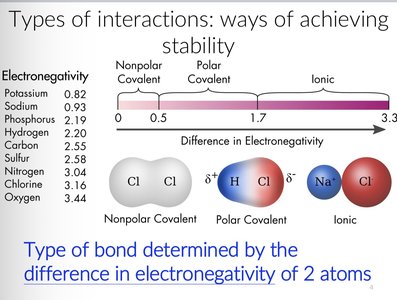
Example: In water (H2O), oxygen is more electronegative than hydrogen, resulting in polar covalent bonds.
Polarity and Molecular Shape
The polarity of a molecule depends on both the type of bonds and the shape of the molecule. Polar molecules have regions of partial positive and negative charge, while nonpolar molecules do not.
Bond type | Molecular shape | Molecular type |
|---|---|---|
Water (H2O): Polar covalent | Bent | Polar |
Methane (CH4): Nonpolar covalent | Tetrahedral | Nonpolar |
Carbon dioxide (CO2): Polar covalent | Linear | Nonpolar |
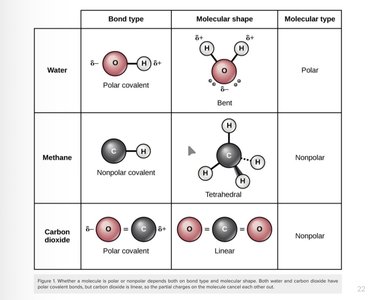
Additional info: Even though CO2 has polar bonds, its linear shape causes the dipoles to cancel, making the molecule nonpolar overall.
Properties of Water and Their Biological Importance
Polarity and Hydrogen Bonding
Water is a polar molecule due to the unequal sharing of electrons and its bent shape. This polarity allows water molecules to form hydrogen bonds—weak attractions between the partially positive hydrogen of one molecule and the partially negative oxygen or nitrogen of another.
Hydrogen bonds are much weaker than covalent bonds (about 5% as strong), but their cumulative effect is significant in biological systems.
Emergent Properties of Water
Hydrogen bonding gives rise to several unique and essential properties of water, which are critical for life:
Cohesion: Water molecules stick to each other, creating surface tension. Example: Water striders walking on water.
Adhesion: Water molecules stick to other polar substances. Example: Capillary action in plants.
High Specific Heat and Heat of Vaporization: Water resists temperature changes and can absorb large amounts of heat. This moderates Earth's climate and helps organisms maintain stable internal temperatures.
When water is heated, hydrogen bonds are disrupted before molecules move faster.
Evaporative cooling (e.g., sweating) helps organisms regulate temperature.
Ice Floats: At low temperatures, water forms a crystalline structure that is less dense than liquid water, allowing ice to float. This insulates aquatic life in winter.
Water as a Solvent: Water dissolves many polar and ionic substances, making it the "universal solvent." Hydrophilic substances dissolve in water, while hydrophobic substances (nonpolar) do not.
Hydrophilic and Hydrophobic Substances
Hydrophilic: "Water-loving"; polar or ionic compounds that dissolve in water (e.g., salts, sugars, proteins like lysozyme).
Hydrophobic: "Water-fearing"; nonpolar molecules that do not dissolve in water (e.g., oils, phospholipid tails in cell membranes).
Additional info: Hydrophobic interactions are crucial for the structure and function of biological membranes and macromolecules.
Summary Table: Properties of Water
Property | Biological Importance |
|---|---|
Cohesion | Surface tension, water transport in plants |
Adhesion | Capillary action, nutrient transport |
High Specific Heat | Temperature stability for organisms and environments |
Ice Floats | Insulation of aquatic habitats |
Solvent Properties | Facilitates chemical reactions, transport of substances |
