 Back
The Chemical Foundation of Life: Atoms, Bonds, and Water
Study Guide - Smart Notes
 Tailored notes based on your materials, expanded with key definitions, examples, and context.
The Chemical Context of Life
Atomic Theory and the Nature of Matter
Chemistry, the foundation of biology, is based on the understanding that all matter is composed of atoms. Modern atomic theory is built on four key assumptions:
All matter is composed of atoms.
Atoms of each element are unique and differ from those of other elements.
Chemical compounds consist of atoms combined in specific ratios.
Chemical reactions rearrange atoms in compounds but do not change the atoms themselves.
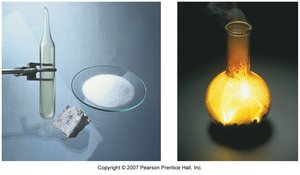
A compound is a substance consisting of two or more elements in a fixed ratio, and it has properties distinct from its constituent elements.
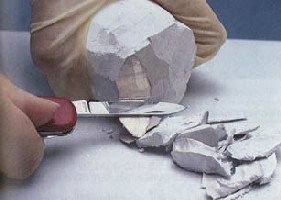
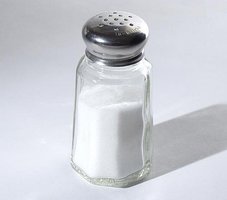
Example: Sodium (a reactive metal) and chlorine (a poisonous gas) combine to form sodium chloride (table salt), which is safe to eat.
Atoms: Structure and Subatomic Particles
An atom is the smallest unit of matter that retains the properties of an element. Atoms are composed of subatomic particles:
Protons: Positively charged, found in the nucleus.
Neutrons: No charge, found in the nucleus.
Electrons: Negatively charged, orbit the nucleus in electron shells.
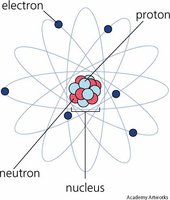
The nucleus is dense and contains protons and neutrons, while electrons occupy orbitals in a much larger volume around the nucleus.
Properties of Subatomic Particles
Protons and neutrons have nearly equal mass (about 1 atomic mass unit, amu).
Electrons are much lighter (about 1/1836 the mass of a proton).
Protons and electrons have equal but opposite charges.
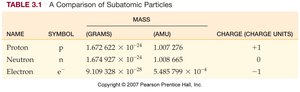
The nucleus is extremely small compared to the overall size of the atom, similar to a pea in a stadium.

Atomic Number, Mass Number, and Isotopes
Atomic number (Z): Number of protons in the nucleus; identifies the element.
Mass number (A): Total number of protons and neutrons in the nucleus.
Atoms are electrically neutral when the number of protons equals the number of electrons.
Isotopes are atoms of the same element with different numbers of neutrons. Some isotopes are radioactive and decay, emitting particles and energy.
Applications: Dating fossils, tracing metabolic pathways, medical imaging.
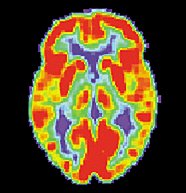
Example: Carbon-14 decays to Nitrogen-14 and is used in radiometric dating of fossils.
Atomic Weight and Isotopic Abundance
The atomic weight of an element is the weighted average of the masses of its naturally occurring isotopes. It is calculated as:
Example: Copper has two main isotopes, Cu-63 and Cu-65. The atomic weight is calculated using their relative abundances and masses.
Electronic Structure of Atoms
Quantum Mechanical Model: Shells, Subshells, and Orbitals
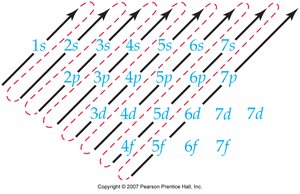
Electrons are arranged in shells around the nucleus. Each shell contains subshells (s, p, d, f) with increasing energy and capacity:
Shell 1: 1 subshell (s)
Shell 2: 2 subshells (s, p)
Shell 3: 3 subshells (s, p, d)
Shell 4: 4 subshells (s, p, d, f)

Each subshell contains a specific number of orbitals:
s: 1 orbital (2 electrons)
p: 3 orbitals (6 electrons)
d: 5 orbitals (10 electrons)
f: 7 orbitals (14 electrons)
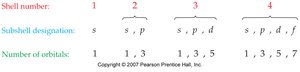
The total electron capacity of each shell increases with shell number.
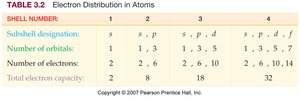
Electron Configuration
The electron configuration of an atom describes the arrangement of electrons in shells and subshells. The rules for filling orbitals are:
Electrons fill the lowest energy orbitals first (Aufbau principle).
Each orbital holds a maximum of two electrons with opposite spins (Pauli exclusion principle).
Orbitals of equal energy are filled singly before pairing (Hund's rule).
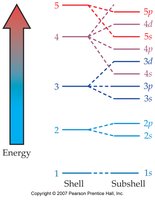
Valence Electrons and the Periodic Table
The valence shell is the outermost shell of an atom, and valence electrons are the electrons in this shell. These electrons determine the chemical properties and reactivity of the element. Elements in the same group of the periodic table have the same number of valence electrons.
Chemical Bonds: Covalent and Ionic
Covalent Bonds
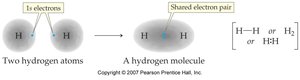
A covalent bond forms when two atoms share one or more pairs of electrons. This type of bond is common in biological molecules.
A molecule is a group of atoms held together by covalent bonds.
Main group elements achieve stable electron configurations (octet rule) by sharing electrons.
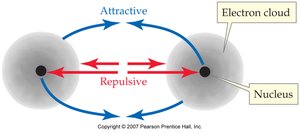
When two atoms approach, attractive and repulsive forces determine if a bond forms. If attractions outweigh repulsions, a covalent bond results.
Example: In H2, two hydrogen atoms share electrons to achieve the stable configuration of helium.
Example: Two chlorine atoms share a pair of electrons to form Cl2, each achieving a noble gas configuration.

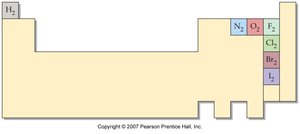
Some elements exist naturally as diatomic molecules (H2, N2, O2, F2, Cl2, Br2, I2).
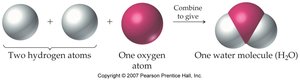
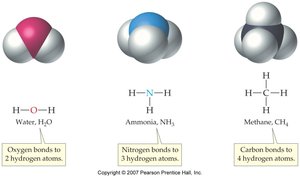
Other common molecules: water (H2O), ammonia (NH3), methane (CH4).
Multiple Covalent Bonds
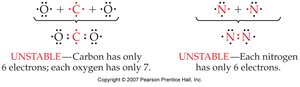
Atoms can share more than one pair of electrons, forming double or triple bonds. For example, O2 has a double bond, and N2 has a triple bond.
Polar Covalent Bonds and Electronegativity
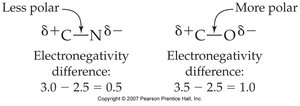
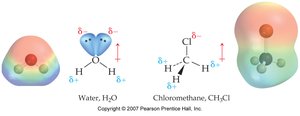
When atoms in a covalent bond have different electronegativities, electrons are shared unequally, resulting in a polar covalent bond. The atom with higher electronegativity attracts electrons more strongly and becomes partially negative (δ-), while the other becomes partially positive (δ+).
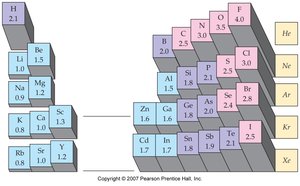
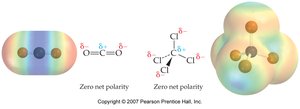
Molecules with polar bonds may be polar overall if the bond dipoles do not cancel out.
Ions and Ionic Bonds
Formation of Ions
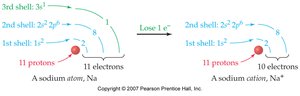
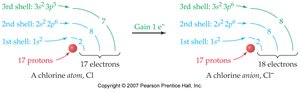
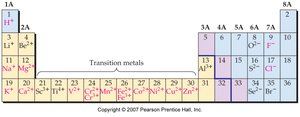
Atoms become ions by gaining or losing electrons:
Cation: Positively charged ion (loss of electrons).
Anion: Negatively charged ion (gain of electrons).
Ionization Energy and Electron Affinity
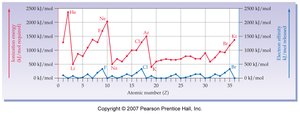
Ionization energy (IE) is the energy required to remove an electron from an atom. Electron affinity (EA) is the energy released when an atom gains an electron. Alkali metals have low IE and form cations easily; halogens have high EA and form anions easily.
Ionic Bonds and Compounds
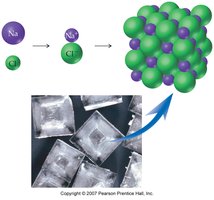
An ionic bond is the electrostatic attraction between oppositely charged ions. Ionic compounds, such as sodium chloride (NaCl), form crystalline solids with a regular arrangement of ions.
Acids, Bases, and Water
Acids and Bases
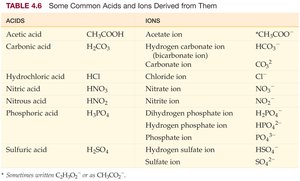
Acids are substances that release H+ ions in water; bases release OH- ions. These ions are fundamental to many biological processes.
Hydrogen Bonds and van der Waals Interactions
Hydrogen bonds are weak attractions between the δ+ hydrogen of one molecule and the δ- atom (often oxygen or nitrogen) of another. Van der Waals interactions are weak attractions due to transient changes in electron density.

Properties of Water
Water is essential for life due to its unique properties:
It is a polar molecule and forms hydrogen bonds.
It has high specific heat and heat of vaporization.
It is an excellent solvent for ions and polar molecules.
It exhibits cohesion (attraction between water molecules) and adhesion (attraction to other substances).
These properties allow water to moderate temperature, dissolve substances, and support life processes.
