 Back
The Chemical Foundations of Life: Atoms, Molecules, and Biological Macromolecules
Study Guide - Smart Notes
 Tailored notes based on your materials, expanded with key definitions, examples, and context.
Units of Life
Hierarchy of Biological Organization
The fundamental units of life are organized in a hierarchical structure, each level building upon the previous. Understanding these units is essential for grasping the complexity of living organisms.
Atom: The fundamental unit of matter.
Molecule: A group of atoms bonded together.
Organelle: Specialized structures within cells.
Cell: The fundamental unit of life.
Tissue: Groups of cells working together.
Organ: Structures composed of multiple tissues.
Matter, Atoms, and Molecules
Basic Chemical Principles
Chemistry is the scientific study of matter, which is anything that occupies space and has mass. Atoms are the basic building blocks of matter, and their arrangement determines the structure and function of molecules.
Physical Forms: Solid, liquid, gas.
Atoms: Composed of protons, neutrons, and electrons.
Molecules: Unique order and arrangement of atoms.
Atoms
Structure and Properties
Atoms consist of three subatomic particles: protons (positive, in the nucleus), neutrons (neutral, in the nucleus), and electrons (negative, orbiting the nucleus). The atomic number is defined by the number of protons, and the atomic mass is the sum of protons and neutrons.
Element: Pure substance with only atoms of the same number of protons.
Periodic Table: Elements listed by atomic number.
Major and Minor Elements in Biology
Big 4: Oxygen, carbon, hydrogen, nitrogen.
Small: Calcium, phosphorus, potassium, sulfur, sodium, chlorine, magnesium.
Tiny: Boron, chromium, cobalt, copper, fluorine, iodine, iron, manganese, molybdenum.
Electrons and Energy Shells
Electron Configuration and Chemical Reactivity
Electrons occupy energy shells at specific distances from the nucleus. The arrangement of electrons determines the atom’s ion state and chemical reactivity. Atoms are most stable when their outermost shells are filled (Octet Rule).
Shell Capacities: 1st shell: 2 electrons; 2nd shell: 8 electrons; 3rd shell: 8 electrons.
Free Radicals: Atoms with vacancies in their outer shells are unstable and reactive.
Ions: Atoms that gain or lose electrons become charged.
Isotopes and Radioactivity
Isotopes and Their Applications
Isotopes are variants of elements with different numbers of neutrons. Some isotopes are radioactive and decay over time, releasing energy. Radioactive isotopes are used in carbon dating and as biological tracers in medicine.
Half-life: Time for half of a radioactive material to decay.
Carbon Dating: Uses Carbon-14 to estimate the age of materials.
Biological Tracers: Used in PET scans to visualize processes in the body.
Chemical Bonds
Types of Chemical Bonds
Atoms form chemical bonds to achieve stability. The main types are ionic (transfer of electrons), covalent (sharing of electrons), and hydrogen bonds (weak interactions between partial charges).
Ionic Bonds: Transfer of electrons, forming charged ions.
Covalent Bonds: Sharing of electrons; can be polar (unequal sharing) or nonpolar (equal sharing).
Hydrogen Bonds: Weak interactions, important in water and biological molecules.
Properties of Water
Unique Characteristics of Water
Water’s properties are essential for life. Its cohesion, ability to float when frozen, solvent capabilities, and temperature regulation are due to hydrogen bonding.
Cohesion: Water molecules stick together via hydrogen bonds.
Ice Floats: Stable hydrogen bonds make ice less dense than liquid water.
Solvent: Water dissolves many substances due to partial charges.
Temperature Regulation: High specific heat allows water to buffer temperature changes.
pH and Buffers
Acidity, pH Scale, and Biological Importance
pH measures the concentration of hydrogen ions (H+) in a solution. Biological systems require stable pH, maintained by buffers.
pH Scale: Ranges from 0 (acidic) to 14 (basic); neutral is 7.
Effects of pH: Changes can alter molecular shape and function.
Buffers: Maintain constant pH in biological fluids (e.g., blood).
Carbon and Organic Molecules
Carbon’s Role in Life
Carbon forms the backbone of organic molecules due to its ability to make four covalent bonds. Organic molecules are primarily composed of carbon and hydrogen.
Shapes: Bent (e.g., H2O), tetrahedron (e.g., methane), double helix (e.g., DNA).
Nomenclature: Greek and chemistry roots are used to name molecules based on the number of carbon atoms.
Number of Carbons | Root |
|---|---|
3 | Tri- |
4 | Tetra- |
5 | Penta- |
6 | Hex- |
7 | Hept- |
8 | Oct- |
9 | Nona- |
10 | Deca- |
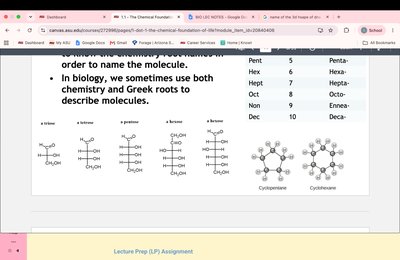
Example: The image above shows structural formulas for various hydrocarbons, including linear and cyclic forms. Double and triple bonds change the shape and function of molecules.
Hydrocarbons and Functional Groups
Hydrocarbons and Chemical Reactivity
Hydrocarbons consist entirely of carbon and hydrogen and are generally low in reactivity. The addition of functional groups increases their chemical reactivity and determines their properties.
Functional Groups: Groups of atoms that confer specific chemical properties (e.g., hydroxyl, carbonyl, amino, sulfhydryl, phosphate, methyl).
Hydrogen Bonds: Important for proper folding and function of molecules.
Isomers and Enantiomers
Structural Variations in Molecules
Isomers are molecules with the same chemical formula but different structures or bonds, leading to different chemical properties. Enantiomers are mirror-image isomers, important in biological systems.
Isomers: Same atoms, different arrangement.
Enantiomers: Mirror-image molecules (e.g., left and right hands).
Biological Macromolecules
Types and Functions
Biological macromolecules are large, complex molecules essential for life. They are typically polymers made from monomers.
Carbohydrates: Monomer is sugar; functions include energy storage and structural material.
Lipids: Monomer is fatty acid; functions include energy storage, membrane formation, and hormones.
Proteins: Monomer is amino acid; functions include enzymes, structural material, and signaling.
Nucleic Acids: Monomer is nucleotide; function is genetic information storage.
Macromolecule Reactions
Condensation and Hydrolysis
Macromolecules are synthesized and broken down by specific reactions.
Condensation (Dehydration Synthesis): Joins monomers, releases water, requires energy.
Hydrolysis: Breaks polymers into monomers, uses water, releases energy.
Lipids and Fatty Acids
Structure and Types
Lipids are hydrophobic, nonpolar molecules built from fatty acids. Fatty acids vary in saturation, affecting their physical properties and health implications.
Saturated Fats: No double bonds, straight shape, solid at room temperature, found in animal products.
Unsaturated Fats: Double bonds, bent shape, liquid at room temperature, found in plant products.
Cis vs Trans: Cis double bonds create kinks; trans do not, affecting health.
Lipid Types
Fats (Triglycerides): Three fatty acids linked to glycerol via ester linkages.
Phospholipids: Glycerol, phosphate group, two fatty acids; amphipathic, form membranes.
Steroids: Four-ring structure; includes cholesterol and hormones.
Waxes: Long fatty acid chains esterified to alcohols; hydrophobic.
Carbohydrates
Structure and Function
Carbohydrates are hydrated hydrocarbons, built from monosaccharides. They serve as energy storage, structural material, and cell identity markers.
Monosaccharides: Simple sugars; classified by number of carbons and location of carbonyl group.
Polysaccharides: Long chains; linked by glycosidic bonds.
Cell Identity: Glycoproteins and glycolipids serve as identification badges.
Energy Storage: Starch (plants), glycogen (animals).
Structural Material: Cellulose (plants), chitin (fungi, insects).
Proteins
Amino Acids and Structure
Proteins are composed of amino acids, which have a central carbon, amine group, carboxylic acid group, hydrogen atom, and variable side chain (R-group). The sequence and properties of amino acids determine protein structure and function.
Primary Structure: Sequence of amino acids.
Secondary Structure: Alpha helices and beta sheets formed by hydrogen bonding.
Tertiary Structure: 3D folding due to R-group interactions.
Quaternary Structure: Multiple polypeptide chains interacting.
Nucleic Acids
Nucleotides and Structure
Nucleic acids are polymers of nucleotides, each composed of a phosphate group, sugar (ribose or deoxyribose), and nitrogenous base. DNA is double-stranded and forms a double helix; RNA is single-stranded and can fold into secondary structures.
Phosphodiester Bonds: Link nucleotides via condensation reactions.
Orientation: 5’ to 3’ direction; DNA strands are antiparallel.
Base Pairing: A-T and G-C in DNA; A-U and G-C in RNA.
Summary Table
Macromolecule Comparison
Macromolecule | Monomer | Function | Example |
|---|---|---|---|
Carbohydrate | Sugar | Energy storage, structure | Potato, starch |
Lipid | Fatty acid | Energy storage, membrane, hormones | Fat cells, phospholipids |
Protein | Amino acid | Enzymes, structure, signaling | Hair, enzymes |
Nucleic Acid | Nucleotide | Genetic information | DNA, RNA |
Additional info: Academic context was added to clarify the structure and function of macromolecules, the importance of chemical bonds, and the role of functional groups in biological systems.
