 Back
The Chemistry of Life: Atoms, Elements, and Chemical Bonds
Study Guide - Smart Notes
 Tailored notes based on your materials, expanded with key definitions, examples, and context.
The Chemistry of Life
Introduction
Understanding the chemistry of life is foundational to biology. All living organisms are composed of matter, which is made up of atoms and elements. The interactions between these atoms and elements through chemical bonds give rise to the molecules essential for life.
Atoms & Elements Found in Living Systems
What is Matter?
Matter: Anything that takes up space and has mass. Examples include rocks, metals, oil, gases, and living organisms.
Living things are ultimately composed of non-living components.
Atoms and Elements
Atom: The smallest unit of an element that retains all the properties of that element. Atoms are the building blocks of matter.
Element: A substance that cannot be broken down into other substances by chemical reactions.
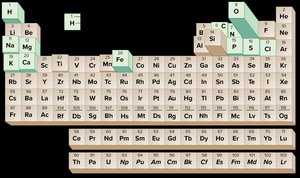
Elements Essential for Life
Essential elements: Chemical elements required for an organism's survival. Humans require 25 elements, while plants require 17.
Trace elements: Required in minute quantities (e.g., iron (Fe), iodine (I)).
Compounds and Emergent Properties
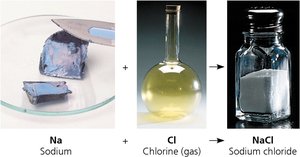
Compound: A substance consisting of two or more different elements combined in a fixed ratio (e.g., NaCl).
Compounds exhibit properties different from their constituent elements.
Atomic Structure
Subatomic Particles
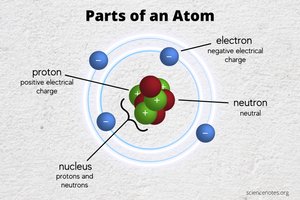
Neutrons: No electrical charge, mass ≈ 1.7×10⁻²⁴g, found in the nucleus.
Protons: Positive charge, mass ≈ 1.7×10⁻²⁴g, found in the nucleus.
Electrons: Negative charge, mass ≈ 1/2000th of a proton or neutron, found orbiting the nucleus.
1 Dalton = 1 atomic mass unit (amu).
Atomic Number, Mass Number, and Isotopes
Atomic number: Number of protons in the nucleus; defines the element.
Mass number: Sum of protons and neutrons in the nucleus.
Atomic mass: Approximate total mass of an atom (close to mass number).
Isotopes: Atoms of the same element with different numbers of neutrons.
Radioactive isotopes: Unstable isotopes that decay, emitting particles and energy.
Applications of Isotopes
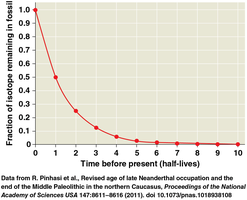
Radiometric dating: Uses the decay of radioactive isotopes to date fossils and rocks. The rate of decay is measured as the isotope's half-life.
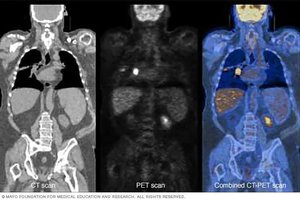
Radioactive tracers: Used in medicine to track atoms through metabolic processes (e.g., PET scans for cancer detection).
Electron Arrangement and Chemical Properties
Electron Energy Levels
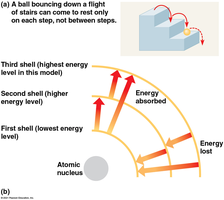
Electrons occupy energy levels (shells) around the nucleus. The further from the nucleus, the higher the energy.
Electrons can move between energy levels by absorbing or releasing energy in fixed amounts.
Electron Distribution and the Periodic Table
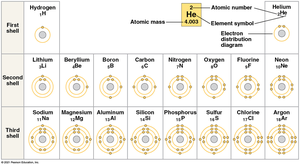
The chemical behavior of an atom is determined by the distribution of electrons in its shells, especially the outermost (valence) shell.
The periodic table arranges elements by increasing atomic number and electron configuration.
Valence Electrons and Chemical Behavior
Valence electrons: Electrons in the outermost shell; determine an atom's chemical properties and reactivity.
Orbital: A region in space where an electron is likely to be found.
Atoms interact to complete their valence shells, often forming chemical bonds.
The Nature of Chemical Bonds
Chemical Bonds
Atoms with incomplete valence shells can share or transfer electrons, forming chemical bonds that hold atoms together.
Covalent Bonds
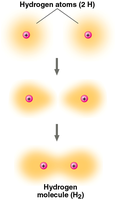
Covalent bond: Sharing of a pair of valence electrons between two atoms.
Each shared electron counts toward both atoms' valence shells.
Molecules are groups of atoms held together by covalent bonds.
Covalent bonds can be single, double, or triple, depending on the number of shared electron pairs.
Electronegativity and Bond Polarity
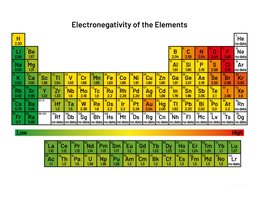
Electronegativity: An atom's attraction for electrons in a covalent bond.
Nonpolar covalent bond: Electrons are shared equally (e.g., H2, O2).
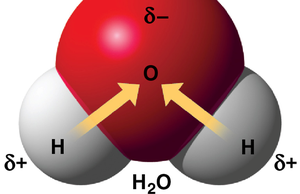
Polar covalent bond: Electrons are shared unequally, resulting in partial charges (e.g., H2O).
Ionic Bonds
Ionic bond: Formed when one atom transfers electrons to another, resulting in oppositely charged ions that attract each other.
Ionic compounds (salts) are often crystalline solids (e.g., NaCl).
Most salts are stable when dry but dissociate easily in water.
Form and Function of Molecules
Molecular Shape and Biological Function
A molecule’s shape is determined by the positions of its atoms’ orbitals.
Shape determines how molecules interact and recognize each other (e.g., morphine and endorphins bind the same brain receptors due to similar shapes).
Chemical Reactions
Making and Breaking Bonds
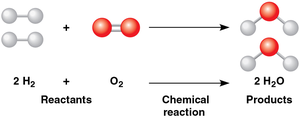
Chemical reactions: Processes that make and break chemical bonds, converting reactants into products.
Example:
Factors Influencing Reaction Rates
Temperature: Higher temperatures increase reaction rates by causing more frequent collisions.
Concentration: Higher concentrations of reactants increase reaction rates; accumulation of products can slow or reverse reactions.
Catalysts: Substances that increase reaction rates without being consumed. In biology, most catalysts are enzymes (proteins).
Reversibility and Chemical Equilibrium
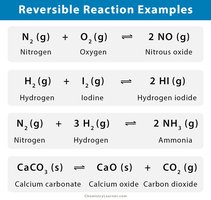
All chemical reactions are theoretically reversible; products can revert to reactants.
Chemical equilibrium: The point at which forward and reverse reactions occur at the same rate, and concentrations of reactants and products remain constant.
Additional info: This guide covers the foundational chemistry concepts necessary for understanding biological molecules and processes, including atomic structure, types of chemical bonds, and the principles of chemical reactions.
