 Back
The Chemistry of Life: Chemical Bonds and the Unique Properties of Water
Study Guide - Smart Notes
 Tailored notes based on your materials, expanded with key definitions, examples, and context.
Chemical Bonds in Biological Molecules
Types of Chemical Bonds
Chemical bonds are the forces that hold atoms together in molecules and compounds. The type of bond formed depends on the difference in electronegativity between the atoms involved.
Covalent Bonds: Atoms share electrons to achieve stability. Can be nonpolar or polar depending on electron sharing.
Ionic Bonds: Electrons are transferred from one atom to another, resulting in oppositely charged ions that attract each other.
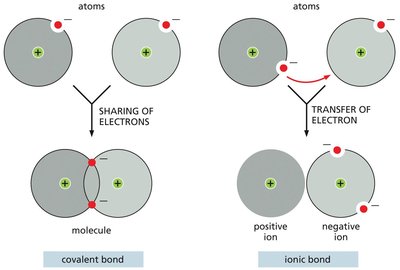
Electronegativity is a measure of an atom's ability to attract shared electrons. The greater the difference in electronegativity, the more polar the bond.
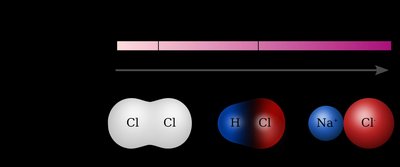
Nonpolar vs. Polar Covalent Bonds
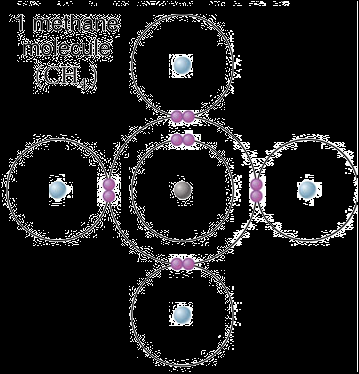
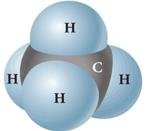
Nonpolar Covalent Bonds: Electrons are shared equally between atoms (e.g., H2, CH4), resulting in no charge difference across the molecule.
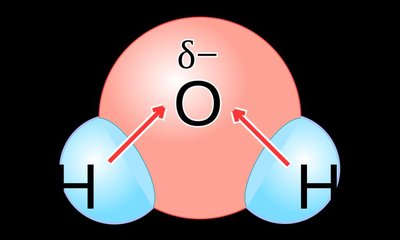
Polar Covalent Bonds: Electrons are shared unequally, creating partial positive (δ+) and partial negative (δ−) charges (e.g., H2O, NH3).
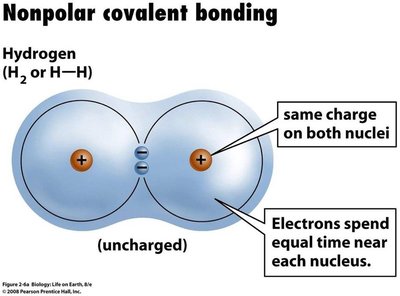
Determining Bond Type by Electronegativity Difference
If the difference is < 0.5: Nonpolar covalent
If the difference is 0.5–1.7: Polar covalent
If the difference is > 1.7: Ionic

Water: Structure and Properties
The Structure of Water
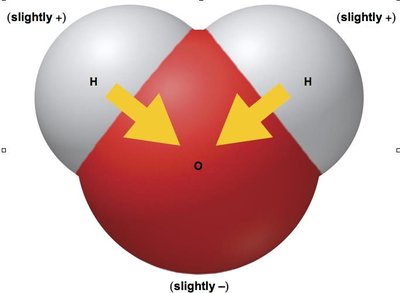
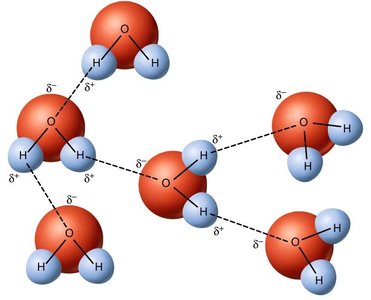
A water molecule (H2O) consists of two hydrogen atoms covalently bonded to one oxygen atom. The oxygen atom is more electronegative, pulling shared electrons closer and creating a polar molecule with partial charges.
Oxygen: Partial negative charge (δ−)
Hydrogen: Partial positive charge (δ+)
Shape: Bent or V-shaped, making the molecule asymmetrical and polar
Polarity of Water
Water's polarity arises from its polar covalent bonds and bent molecular shape. This polarity allows water molecules to form hydrogen bonds with each other and with other polar molecules.
Hydrogen Bonds
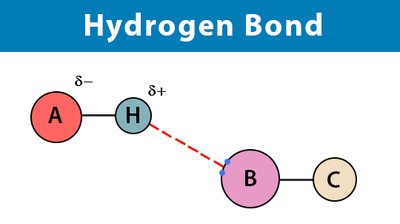
Hydrogen bonds are weak attractions between the partially positive hydrogen atom of one polar molecule and the partially negative atom (usually oxygen or nitrogen) of another. Although individually weak, collectively they have significant effects on the properties of water and biological molecules.
Hydrogen bonds are noncovalent (no electron sharing).
They are shown as dotted or dashed lines in diagrams.
Emergent Properties of Water
1. Cohesion and Adhesion
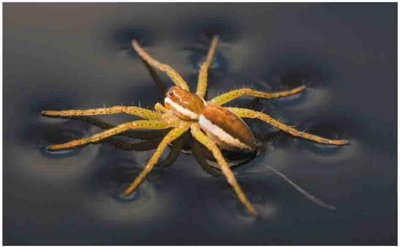
Cohesion: Water molecules stick to each other due to hydrogen bonding, resulting in high surface tension (e.g., water strider walking on water).
Adhesion: Water molecules stick to other polar substances, aiding processes like capillary action in plants.
2. High Specific Heat and Heat of Vaporization
Water can absorb or release large amounts of heat with only a slight change in its own temperature, stabilizing environments and organisms.
Evaporative cooling (e.g., sweating) helps regulate temperature in living organisms.
3. Ice Floats
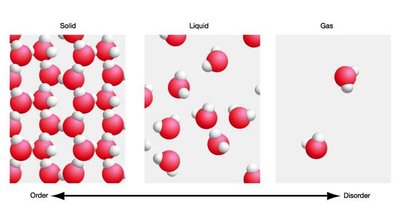
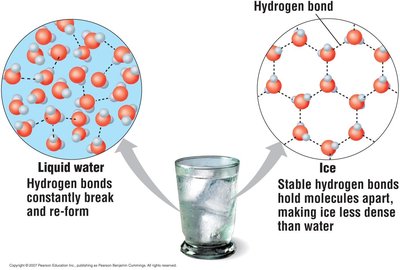
At low temperatures, water forms a crystalline structure maintained by hydrogen bonds, making ice less dense than liquid water.
This property insulates aquatic life in winter, as ice floats and forms a protective layer on water bodies.
4. Water as a Solvent
Water dissolves many substances, especially polar and ionic compounds, by surrounding them and separating their ions or molecules.
Hydrophilic substances (water-loving) dissolve in water; hydrophobic substances (water-fearing) do not.
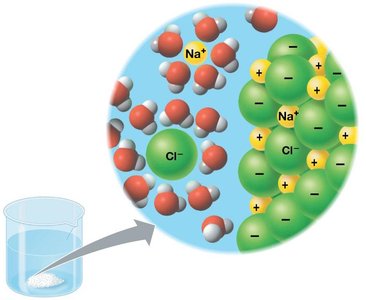
Hydrophilic vs. Hydrophobic Substances
Hydrophilic: Polar or ionic molecules that interact well with water (e.g., salts, sugars, proteins).
Hydrophobic: Nonpolar molecules that do not interact with water (e.g., oils, fats). These molecules are important in forming biological membranes.
Biological Importance of Hydrogen Bonds
Hydrogen bonds stabilize the structure of DNA (holding the two strands together).
They are crucial for the folding and function of proteins.
Key Terms and Concepts
Polarity: The distribution of electrical charge over the atoms joined by the bond.
Hydrogen Bond: A weak bond between a hydrogen atom and an electronegative atom.
Hydrophilic: Water-attracting, usually polar or ionic.
Hydrophobic: Water-repelling, usually nonpolar.
Summary Table: Types of Bonds and Their Properties
Bond Type | Electron Sharing/Transfer | Relative Strength | Example |
|---|---|---|---|
Covalent (Nonpolar) | Equal sharing | Strong | H2, CH4 |
Covalent (Polar) | Unequal sharing | Strong | H2O, NH3 |
Ionic | Electron transfer | Strong (in dry conditions) | NaCl |
Hydrogen Bond | No sharing/transfer | Weak (but important in large numbers) | Between H2O molecules, DNA strands |
Practice and Application
Be able to draw and label a water molecule, indicating the polar covalent bonds and partial charges.
Explain why water is polar both structurally and chemically.
Describe the emergent properties of water and their biological significance.
Identify whether a molecule is hydrophilic or hydrophobic based on its structure.
Recognize the importance of hydrogen bonds in biological macromolecules such as proteins and DNA.
