 Back
The Chemistry of Life: Water, Carbon, Isomers, and Functional Groups
Study Guide - Smart Notes
 Tailored notes based on your materials, expanded with key definitions, examples, and context.
Chemistry of Life
Introduction
Understanding the chemical basis of life is essential for studying biology. The unique properties of water, the versatility of carbon, the significance of isomers, and the role of functional groups are foundational concepts that explain the structure and function of biological molecules.
Water: The Wonder Molecule
Structure and Bonding in Water
Water's unique properties arise from its molecular structure and the interactions between its molecules.
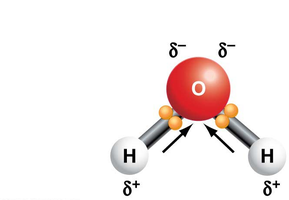
Polar Covalent Bonds: The oxygen atom in water is more electronegative than hydrogen, creating a partial negative charge on oxygen and partial positive charges on hydrogens.
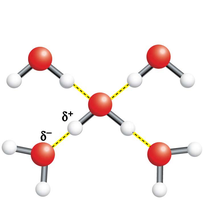
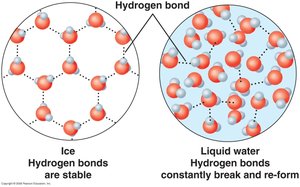
Hydrogen Bonds: The polarity of water molecules allows them to form hydrogen bonds with each other, which are weaker than covalent bonds but crucial for water's properties.
Emergent Properties of Water
Water exhibits four emergent properties that are critical for life, largely due to hydrogen bonding:
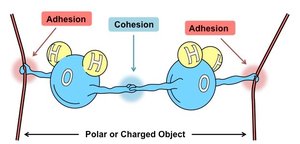
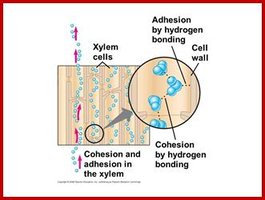
Cohesion: Water molecules stick together, creating surface tension. This property allows water to move as a column in plants and enables small insects to walk on water.
Adhesion: Water molecules can cling to other polar or charged substances, aiding in processes like capillary action in plants.
Expansion Upon Freezing: At 0°C, water forms a crystalline lattice, making ice less dense than liquid water. This allows ice to float, insulating aquatic life in cold climates.

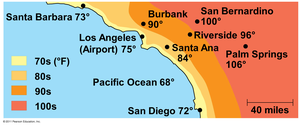
Moderation of Temperature: Water has a high specific heat, meaning it can absorb or release large amounts of heat with only slight changes in temperature. This property stabilizes environmental and organismal temperatures.

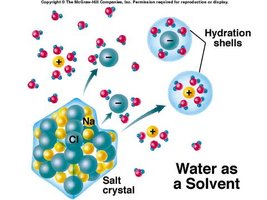
Versatility as a Solvent: Water's polarity allows it to dissolve many ionic and polar substances, making it an excellent solvent for biological reactions.
Carbon: The Backbone of Life
Properties of Carbon
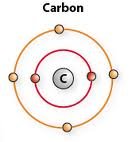
Carbon is the central element in organic molecules due to its ability to form four covalent bonds, allowing for a diversity of stable, complex structures.
Four Valence Electrons: Enables carbon to form single, double, or triple bonds with other atoms, including itself.
Complex Skeletons: Carbon can create chains, rings, and branched structures, forming the backbone of biological macromolecules.
Isomers and Their Biological Implications
Types of Isomers
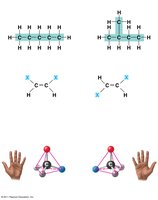
Isomers are compounds with the same molecular formula but different arrangements of atoms, leading to distinct properties.
Structural Isomers: Differ in the covalent arrangement of atoms.
Cis-Trans (Geometric) Isomers: Differ in spatial arrangement around a double bond or ring structure.
Enantiomers: Mirror images of each other, differing in spatial arrangement around an asymmetric carbon.
Biological Implications of Isomers
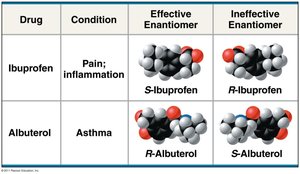
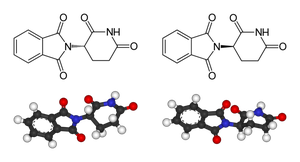
Isomers can have drastically different biological activities. For example, enantiomers are critical in pharmaceuticals, where one enantiomer may be therapeutically active and the other inactive or harmful.
Drug | Condition | Effective Enantiomer | Ineffective Enantiomer |
|---|---|---|---|
Ibuprofen | Pain; inflammation | S-Ibuprofen | R-Ibuprofen |
Albuterol | Asthma | R-Albuterol | S-Albuterol |
Example: Thalidomide, a sedative, caused severe birth defects when one enantiomer was used. Today, it is used with caution for specific diseases.
Functional Groups in Biological Molecules
Key Functional Groups
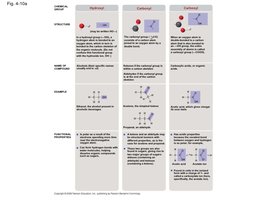
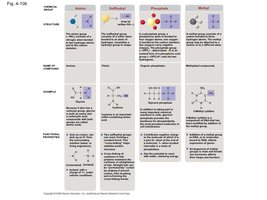
Functional groups are specific groups of atoms within molecules that have characteristic properties and reactivities. They play a major role in the structure and function of biological molecules.
Hydroxyl (-OH)
Carbonyl (C=O)
Carboxyl (-COOH)
Amino (-NH2)
Sulfhydryl (-SH)
Phosphate (-PO4)
Methyl (-CH3)
Building Large Biological Molecules
Polymerization
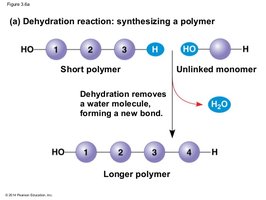
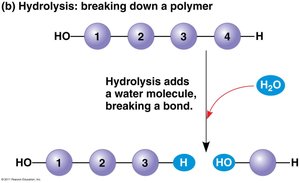
Small organic molecules (monomers) can be linked together to form larger, complex molecules (polymers) through chemical reactions.
Condensation (Dehydration) Reactions: Join monomers by removing a water molecule, forming a new bond.
Hydrolysis Reactions: Break polymers into monomers by adding a water molecule, breaking a bond.

Summary: The chemistry of water, carbon, isomers, and functional groups underpins the structure and function of all biological molecules, making these concepts essential for understanding life at the molecular level.
