 Back
The Chemistry of Living Things: Foundations for General Biology
Study Guide - Smart Notes
 Tailored notes based on your materials, expanded with key definitions, examples, and context.
The Chemistry of Living Things
Introduction to Chemistry in Biology
Chemistry is fundamental to understanding biological processes because all living things are composed of matter, which is made up of elements and energy. The study of chemistry in biology focuses on the structure, properties, and interactions of atoms and molecules that make up living organisms and their environments.
Matter: Anything that has mass and occupies space; composed of elements.
Elements: Pure substances that cannot be broken down into simpler substances by chemical means. Examples include oxygen, carbon, and hydrogen.
Energy: The capacity to do work; essential for all biological activities.
Example: The periodic table organizes all known elements by increasing atomic number, providing essential information about their properties.
Atoms: The Building Blocks of Matter
Structure of Atoms
Atoms are the smallest functional units of elements. They consist of a central nucleus containing protons and neutrons, surrounded by shells of electrons.
Protons: Positively charged particles found in the nucleus; determine the atomic number.
Neutrons: Neutral particles in the nucleus; contribute to atomic mass.
Electrons: Negatively charged particles in shells around the nucleus; have negligible mass.
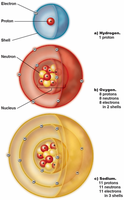
Example: A sodium atom has 11 protons, 11 electrons, and 12 neutrons.
Electron Configuration and Chemical Properties
Electron Shells and Reactivity
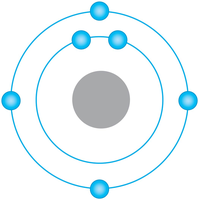
The arrangement of electrons in shells around the nucleus determines an atom’s chemical properties and reactivity. Atoms are most stable when their outermost shell is full.
Atoms with incomplete outer shells tend to react with other atoms to achieve stability by sharing, gaining, or losing electrons.
The periodic table provides information about electron distribution and chemical behavior.
Isotopes and Radioactivity
Isotopes and Their Uses
Isotopes are atoms of the same element with different numbers of neutrons, resulting in different atomic masses. Some isotopes are unstable (radioisotopes) and emit radiation.
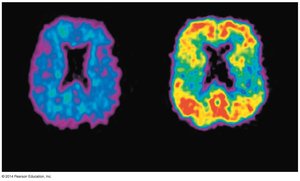
Radioisotopes: Used in dating fossils (e.g., carbon-14), medical imaging, cancer treatment, and as power sources for implants.
Radioactive tracers are used in biological research and medical diagnosis to track chemical processes in organisms.
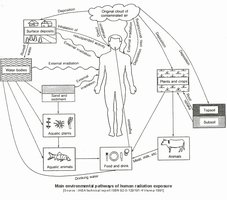
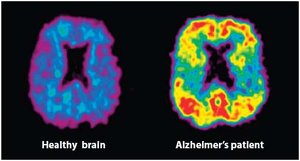
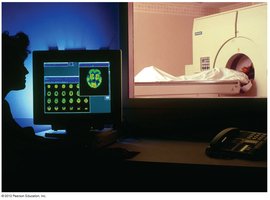
Additional info: Uncontrolled exposure to radioisotopes can damage DNA and proteins, leading to health risks.
Chemical Bonds and Molecules
Types of Chemical Bonds
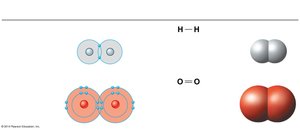
Atoms combine to form molecules through chemical bonds, which are attractive forces holding atoms together. The main types of chemical bonds are covalent, ionic, and hydrogen bonds.
Covalent Bonds: Atoms share electrons to fill their outer shells. Can be nonpolar (equal sharing) or polar (unequal sharing).
Ionic Bonds: Formed when one atom donates electrons to another, resulting in oppositely charged ions that attract each other.
Hydrogen Bonds: Weak attractions between polar molecules, especially important in water and biological macromolecules.
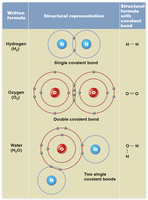
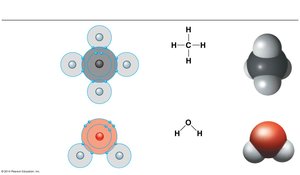
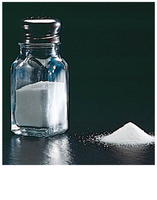
Example: Table salt (NaCl) forms from the ionic bond between sodium (Na+) and chloride (Cl-) ions.
Water: Essential for Life
Properties of Water
Water is a polar molecule, meaning it has regions of partial positive and negative charge due to unequal sharing of electrons in its covalent bonds. This polarity leads to hydrogen bonding, giving water unique properties essential for life.
Solvent: Dissolves many substances, facilitating chemical reactions in cells.
Temperature Regulation: Absorbs and retains heat, helping maintain stable body temperature.
Density: Ice is less dense than liquid water, so it floats.
Cohesion and Adhesion: Water molecules stick to each other and to other surfaces.
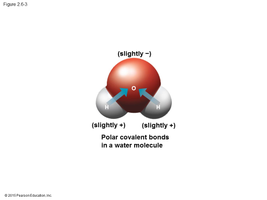
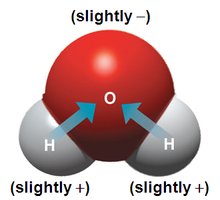
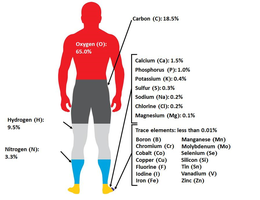
Example: Water makes up 60% of body weight and is the main component of blood, cells, and extracellular fluid.
Acids, Bases, and pH
pH and Biological Systems
The pH scale measures the concentration of hydrogen ions (H+) in a solution, indicating its acidity or basicity. Biological systems require a stable pH, maintained by buffers.
Acids: Substances that donate H+ ions to solutions (pH < 7).
Bases: Substances that accept H+ ions or release OH- ions (pH > 7).
Buffers: Chemicals that resist changes in pH by accepting or donating H+ ions.
Example: Carbonic acid (H2CO3) acts as a buffer in blood, maintaining pH around 7.4.
$\mathrm{H_2CO_3 \rightleftharpoons HCO_3^- + H^+}$
Organic Molecules in Living Organisms
Types and Functions of Organic Molecules
Organic molecules are carbon-based compounds essential for life. They include carbohydrates, lipids, proteins, and nucleic acids, each with specific structures and functions.
Carbohydrates: Energy sources and structural components (e.g., glucose, starch, cellulose).
Lipids: Long-term energy storage, cell membrane structure, and signaling (e.g., fats, phospholipids, steroids).
Proteins: Polymers of amino acids with diverse functions, including enzymes, structural support, and transport.
Nucleic Acids: Store and transmit genetic information (DNA and RNA).
Example: Glucose (C6H12O6) is a monosaccharide and the main energy source for cells.
Macromolecules: Structure and Synthesis
Polymers and Their Formation
Cells build large molecules (macromolecules) from smaller units (monomers) through dehydration synthesis (removal of water) and break them down by hydrolysis (addition of water).
Dehydration Synthesis: Joins monomers to form polymers by removing water.
Hydrolysis: Breaks polymers into monomers by adding water.
Carbohydrates
Structure and Function
Carbohydrates are composed of carbon, hydrogen, and oxygen. They are classified by the number of sugar units: monosaccharides (simple sugars), disaccharides, and polysaccharides.
Monosaccharides: Single sugar units (e.g., glucose, fructose, ribose).
Disaccharides: Two monosaccharides linked together (e.g., sucrose, lactose).
Polysaccharides: Long chains of monosaccharides (e.g., starch, glycogen, cellulose).
Example: Starch stores energy in plants; glycogen stores energy in animals; cellulose provides structural support in plants.
Lipids
Types and Functions
Lipids are hydrophobic molecules important for energy storage, membrane structure, and signaling. They include triglycerides, phospholipids, and steroids.
Triglycerides: Glycerol bonded to three fatty acids; store energy in adipose tissue.
Phospholipids: Major component of cell membranes; have hydrophilic heads and hydrophobic tails.
Steroids: Four-ring structures; include cholesterol and hormones like estrogen and testosterone.
Proteins
Structure and Function
Proteins are polymers of amino acids joined by peptide bonds. Their function depends on their complex structure, which is organized into four levels:
Primary Structure: Sequence of amino acids.
Secondary Structure: Alpha helices and beta sheets stabilized by hydrogen bonds.
Tertiary Structure: Three-dimensional folding due to various interactions.
Quaternary Structure: Association of multiple polypeptide chains.
Denaturation: Loss of protein structure (and function) due to heat or pH changes.
Enzymes: Proteins that act as biological catalysts, speeding up chemical reactions without being consumed.
Nucleic Acids
DNA, RNA, and ATP
Nucleic acids store and transmit genetic information. They are polymers of nucleotides, each containing a sugar, a phosphate group, and a nitrogenous base.
DNA (Deoxyribonucleic Acid): Double-stranded; bases are adenine (A), thymine (T), cytosine (C), and guanine (G).
RNA (Ribonucleic Acid): Single-stranded; bases are adenine (A), uracil (U), cytosine (C), and guanine (G).
ATP (Adenosine Triphosphate): Universal energy carrier; releases energy when its phosphate bonds are broken.
$\mathrm{ATP + H_2O \rightarrow ADP + P_i + \text{energy}}$
Example: ATP hydrolysis provides energy for cellular work through phosphorylation of other molecules.
