 Back
The Chromosomal Basis of Inheritance
Study Guide - Smart Notes
 Tailored notes based on your materials, expanded with key definitions, examples, and context.
Chapter 15: The Chromosomal Basis of Inheritance
Big Idea: Chromosomes are made of genes that determine heredity
Chromosomes are structures within cells that contain DNA, the molecule that carries genetic information. Genes, which are segments of DNA, are located on chromosomes and are responsible for the inheritance of traits from one generation to the next.
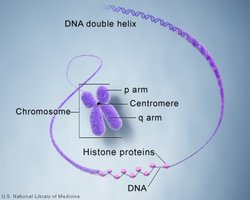
Concept 15.1: Mendelian Inheritance and Chromosome Behavior
The Chromosome Theory of Inheritance
The chromosome theory of inheritance states that genes are located on chromosomes, and the behavior of chromosomes during meiosis accounts for inheritance patterns. This theory was developed after biologists noticed parallels between Mendel's 'hereditary units' and chromosome behavior during cell division.
Mendel’s hereditary units: Theoretical factors proposed by Mendel to explain inheritance.
Chromosome theory: Developed by Sutton, Boveri, and others around 1902, linking chromosomes to inheritance.
Thomas Hunt Morgan: Provided the first solid evidence associating a specific gene with a specific chromosome using fruit flies (Drosophila melanogaster).
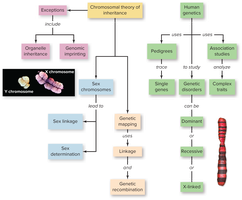
Genes and Chromosomes: Physical Evidence
Fluorescent tagging techniques allow scientists to visualize the location of specific genes on chromosomes, providing direct evidence of the physical basis of inheritance.
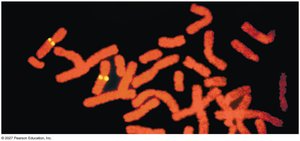
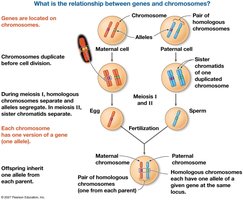
Relationship Between Genes and Chromosomes
Genes are located on chromosomes, and each chromosome carries many genes. During meiosis, homologous chromosomes separate, ensuring that offspring inherit one set of chromosomes from each parent. This process explains Mendel’s laws of segregation and independent assortment.
Alleles: Different versions of a gene found at the same locus on homologous chromosomes.
Meiosis: The process by which homologous chromosomes (and thus alleles) are separated into gametes.
Morgan’s Experiments with Fruit Flies
Model Organism: Drosophila melanogaster
Morgan used fruit flies for genetic studies due to their short generation time, high offspring numbers, and simple chromosome structure (four pairs of chromosomes).
Wild type: The normal phenotype commonly found in nature (e.g., red eyes in fruit flies).
Mutant phenotype: Traits that differ from the wild type (e.g., white eyes).
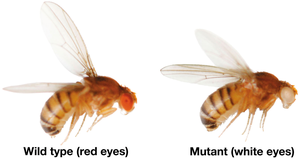
Scientific Inquiry: Eye Color Inheritance in Fruit Flies
Morgan crossed a white-eyed male with a red-eyed female. All F1 offspring had red eyes, but in the F2 generation, only males had white eyes. This led to the conclusion that the gene for eye color is located on the X chromosome.
X-linked inheritance: Traits determined by genes on the X chromosome.
Hemizygous: Males have only one X chromosome, so a single recessive allele will be expressed.
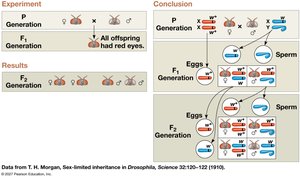
The Chromosomal Basis of Mendel’s Laws
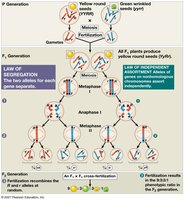
Mendel’s law of segregation and law of independent assortment can be explained by the behavior of chromosomes during meiosis. Homologous chromosomes separate during meiosis I, and different chromosome pairs assort independently.
Law of segregation: Each gamete receives only one allele of each gene.
Law of independent assortment: Alleles of different genes assort independently if they are on different chromosomes.
Concept 15.2: Sex-Linked Genes and Inheritance Patterns
Sex Chromosomes and Sex Determination
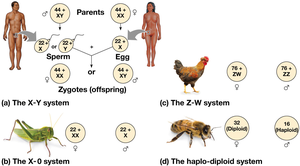
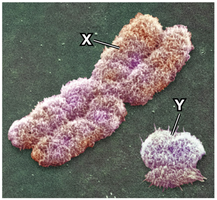
Sex chromosomes (X and Y in humans) determine an individual’s sex. The X-Y system is found in mammals, but other systems exist in different organisms.
X-Y system: Males are XY, females are XX (humans, most mammals).
X-0 system: Males have one X, females have two X (some insects).
Z-W system: Females are ZW, males are ZZ (birds, some fish).
Haplo-diploid system: Males are haploid, females are diploid (bees, ants).
Sex-Linked Genes
Genes located on sex chromosomes are called sex-linked genes. X-linked genes are found on the X chromosome, while Y-linked genes are found on the Y chromosome. X-linked recessive disorders are more common in males due to their single X chromosome.
Y-linked genes: Only present on the Y chromosome; few in number.
X-linked genes: Present on the X chromosome; many more than Y-linked genes.
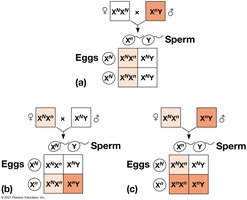
Inheritance of X-Linked Genes
For a recessive X-linked trait to be expressed, females need two copies of the allele (homozygous), while males need only one (hemizygous). This explains why X-linked disorders are more common in males.
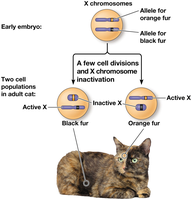
X Inactivation in Female Mammals
In female mammals, one of the two X chromosomes in each cell is randomly inactivated during embryonic development, forming a Barr body. This leads to mosaicism for X-linked traits in heterozygous females.
Barr body: The condensed, inactive X chromosome in female cells.
Mosaicism: Presence of two or more populations of cells with different genotypes in one individual.
Concept 15.3: Linked Genes and Genetic Recombination
Linked Genes
Genes located near each other on the same chromosome tend to be inherited together and are called linked genes. However, genetic recombination can separate linked genes, producing new combinations of traits.
Genetic recombination: Production of offspring with combinations of traits differing from either parent.
Parental types: Offspring with a phenotype matching one of the parents.
Recombinant types: Offspring with new combinations of traits.
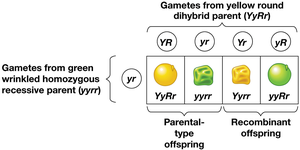
Recombination of Linked Genes: Crossing Over
Crossing over during meiosis can break the physical connection between genes on the same chromosome, resulting in recombinant chromosomes and increased genetic diversity.
Abnormalities in Chromosome Number and Structure
Nondisjunction and Aneuploidy
Nondisjunction occurs when homologous chromosomes fail to separate during meiosis, leading to gametes with abnormal chromosome numbers. Fertilization involving these gametes results in aneuploidy, where offspring have an abnormal number of chromosomes.
Monosomy: Only one copy of a particular chromosome.
Trisomy: Three copies of a particular chromosome.
Alterations of Chromosome Structure
Chromosome breakage can lead to structural changes:
Deletion: Loss of a chromosomal segment.
Duplication: Repetition of a segment.
Inversion: Reversal of a segment within a chromosome.
Translocation: Movement of a segment to a nonhomologous chromosome.
Human Conditions Due to Chromosomal Alterations
Alterations in chromosome number and structure can cause various syndromes. Some aneuploidies are survivable and result in characteristic symptoms.
Down syndrome (Trisomy 21): Caused by three copies of chromosome 21; risk increases with maternal age.
Klinefelter syndrome (XXY): Males with an extra X chromosome.
Turner syndrome (XO): Females with only one X chromosome; the only viable monosomy in humans.
Condition | Chromosomal Basis | Symptoms |
|---|---|---|
Down syndrome | Trisomy 21 | Developmental delays, characteristic facial features |
Klinefelter syndrome | XXY | Mild symptoms, often sterile males |
Turner syndrome | XO | Sterile females, short stature |
Additional info: The frequency of Down syndrome increases with maternal age, but the biological reason is not fully understood.
