 Back
The Chromosomal Basis of Inheritance: Sex-Linked Genes and X Inactivation
Study Guide - Smart Notes
 Tailored notes based on your materials, expanded with key definitions, examples, and context.
Sex Chromosomes and Determination of Sex
Structure and Function of Sex Chromosomes
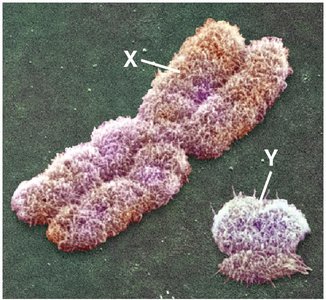
Sex chromosomes play a crucial role in determining the biological sex of an organism. In humans and other mammals, there are two types of sex chromosomes: the larger X chromosome and the smaller Y chromosome. Individuals with two X chromosomes (XX) are typically female, while those with one X and one Y chromosome (XY) are male. Short homologous regions at the ends of the X and Y chromosomes allow them to pair during meiosis in males, behaving like homologous chromosomes.
X chromosome: Contains about 1,100 genes, many unrelated to sex determination.
Y chromosome: Contains about 78 genes coding for approximately 25 proteins, mostly related to sex determination.
Variations in Sex Determination Systems
Different organisms use various systems for sex determination:
X-0 System: Found in some insects; females are XX, males are X (only one X chromosome).
Z-W System: Found in birds, some fishes, and some insects; females are ZW, males are ZZ.
Haplo-Diploid System: Found in bees and ants; females are diploid (from fertilized eggs), males are haploid (from unfertilized eggs).
The SRY Gene and Sex Determination
The SRY gene (sex-determining region of Y) is located on the Y chromosome and is essential for the development of testes. Its presence leads to male development, while its absence results in female development.
Inheritance Patterns of Sex-Linked Genes
X-Linked and Y-Linked Genes
Genes located on the sex chromosomes are called sex-linked genes. X-linked genes are found on the X chromosome, while Y-linked genes are found on the Y chromosome. The X chromosome carries many genes unrelated to sex, whereas Y-linked genes are mostly involved in male development.
Inheritance of X-Linked Genes
X-linked genes display unique inheritance patterns due to the difference in sex chromosome composition between males (XY) and females (XX). Recessive X-linked traits are more commonly expressed in males because they have only one X chromosome (hemizygous), while females must have two copies of the recessive allele (homozygous) to express the trait.
Carrier females: Heterozygous females (one normal and one recessive allele) are carriers and can pass the trait to their children.
Expression in males: Males need only one copy of the recessive allele to express the trait.
Examples of X-Linked Disorders
Color blindness: Mostly X-linked; affected males inherit the mutant allele from their mothers.
Duchenne muscular dystrophy: Caused by the absence of an X-linked gene for the muscle protein dystrophin; leads to progressive muscle weakness.
Hemophilia: Absence of one or more proteins required for blood clotting; results in prolonged bleeding.
Inheritance Patterns Illustrated
The inheritance of X-linked traits can be visualized using Punnett squares:
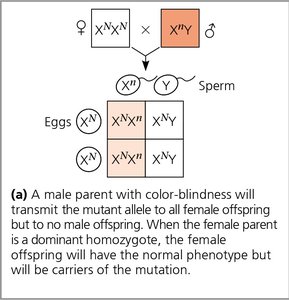
Male parent with color-blindness: All female offspring will be carriers, no male offspring will inherit the mutant allele if the mother is homozygous dominant.
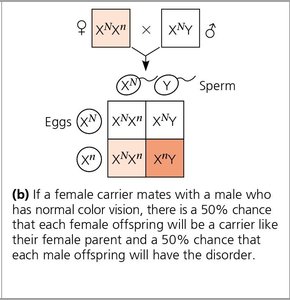
Female carrier and normal male: 50% chance for female offspring to be carriers, 50% chance for male offspring to have the disorder.
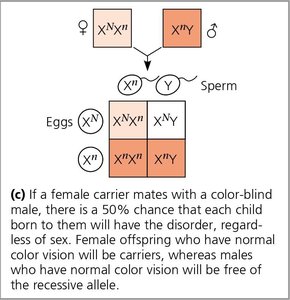
Female carrier and color-blind male: 50% chance for each child to have the disorder, regardless of sex.
X Inactivation in Female Mammals
Mechanism of X-Chromosome Inactivation
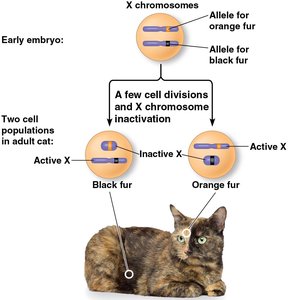
In female mammals, one of the two X chromosomes in each cell is randomly inactivated during embryonic development, forming a dense structure called a Barr body. This process, known as dosage compensation, ensures that females have only one functional X chromosome per cell.
XIST gene: Produces an RNA molecule that coats the X chromosome, leading to its inactivation.
Barr body: The condensed, inactive X chromosome.
Genetic Mosaicism
Females heterozygous for X-linked genes become genetic mosaics, with some cells expressing one allele and others expressing the alternate allele. This phenomenon is illustrated in calico cats, where random X inactivation leads to patches of different fur colors.
Summary Table: Sex Chromosome Systems
System | Female Genotype | Male Genotype | Example Organisms |
|---|---|---|---|
X-Y | XX | XY | Humans, mammals |
X-0 | XX | X | Some insects |
Z-W | ZW | ZZ | Birds, some fishes, insects |
Haplo-Diploid | Diploid | Haploid | Bees, ants |
Key Terms and Concepts
Sex-linked gene: Gene located on either sex chromosome.
Hemizygous: Having only one allele for a gene (as in males for X-linked genes).
Carrier: Heterozygous individual who can pass a recessive allele to offspring.
Barr body: Inactive X chromosome in female cells.
Genetic mosaic: Individual with cells expressing different alleles due to X inactivation.
Relevant Equations
Probability of inheriting an X-linked recessive disorder:
For sons of carrier mothers:
For daughters of carrier mothers: (carrier), (affected, unless father is affected)
Additional info:
Genetic mosaicism can also occur in humans, leading to variable expression of X-linked traits.
X inactivation is random in each cell, so the pattern of expression can differ between individuals.
