 Back
BackThe Chromosomal Basis of Inheritance: Structure, Function, and Genetic Analysis
Study Guide - Smart Notes
 Tailored notes based on your materials, expanded with key definitions, examples, and context.
The Chromosomal Basis of Inheritance
Chromosome Theory of Inheritance
The chromosome theory of inheritance states that genes are located on chromosomes, and these chromosomes are the vehicles for genetic transmission from one generation to the next. Each chromosome contains many genes, and their specific locations are called loci.
Genes are found at specific loci on chromosomes.
Each chromosome can carry dozens to thousands of genes, depending on its size.
Chromosomes are passed from parents to offspring, ensuring continuity of genetic information.
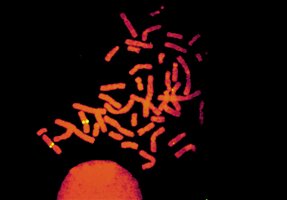
Sex Chromosomes and Autosomes
Humans have two types of chromosomes: autosomes and sex chromosomes.
Autosomes are non-sex chromosomes
Sex chromosomes determine an individual's biological sex.
Humans have 44 autosomes (22 pairs) and 2 sex chromosomes (X and Y).
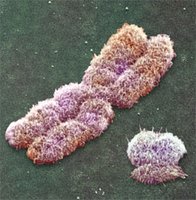
The X chromosome is much larger than the Y chromosome and contains more genes.
X and Y chromosomes are mostly non-homologous but share some regions to allow pairing during meiosis.
Sex Determination in Humans
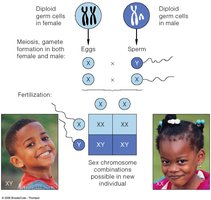
Sex determination in humans is based on the combination of sex chromosomes inherited from the parents. The presence of the SRY gene (also called TDF, testis-determining factor) on the Y chromosome initiates male development.
Females: 44 autosomes + XX
Males: 44 autosomes + XY
The sperm genotype determines the sex of the offspring.
The SRY gene triggers the development of male characteristics.
Sex-Linked Genes and Inheritance Patterns
Sex-Linked Genes
Genes located on the sex chromosomes (especially the X chromosome) exhibit unique inheritance patterns. The X chromosome contains about 1000 genes, most unrelated to sexual characteristics, while the Y chromosome has about 30 genes, many involved in male fertility.
Males are hemizygous for most X and Y genes, having only one copy.
This leads to sex-linked inheritance, where traits appear linked to gender.
X-Linked Inheritance
X-linked inheritance refers to genes located on the X chromosome. Alleles are shown as superscripts on the X. Since the Y chromosome lacks most of these alleles, males express recessive X-linked traits if they inherit the allele.
X-linked recessive traits are more common in males.
Females with one recessive allele are carriers; males with one recessive allele express the trait.
Example: Red/Green Color Blindness
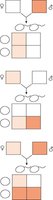
Red/green color blindness is a classic example of an X-linked recessive trait. It is more common in males because they have only one X chromosome.
About 8% of males in the US are affected.
Pedigree analysis can be used to track inheritance patterns in families.

Pedigree Analysis
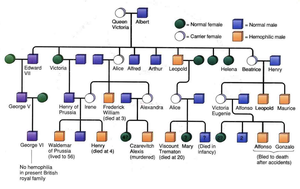
Pedigrees are diagrams that show the inheritance of traits across generations. They are useful for tracking X-linked disorders such as hemophilia B in royal families.
Squares represent males, circles represent females.
Shaded symbols indicate affected individuals.
Y-Linked Inheritance
Y-linked inheritance involves genes found only on the Y chromosome. These traits are passed from father to son and only affect males.
Example: Some forms of male infertility are Y-linked.
X Inactivation in Female Mammals
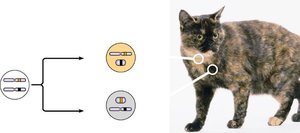
In female mammals, one of the two X chromosomes in each cell is randomly inactivated during early embryonic development. This process ensures dosage compensation between males and females.
Results in mosaic expression of X-linked genes.
Example: Tortoiseshell cats display patches of different fur colors due to X inactivation.
Chromosomal Mutations
Aneuploidy
Aneuploidy is the presence of an abnormal number of chromosomes in a cell. It often results from errors during meiosis, specifically nondisjunction, where chromosomes fail to separate properly.
Monosomy: One copy of a chromosome (instead of two).
Trisomy: Three copies of a chromosome (instead of two).
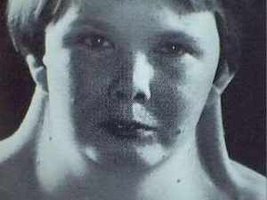
Example: Down syndrome (trisomy 21).
Aneuploidy can be detected using a karyotype, an image showing all chromosomes arranged by size.
Meiotic Nondisjunction
Nondisjunction occurs when homologous chromosomes or sister chromatids fail to separate during anaphase I or II of meiosis, leading to gametes with abnormal chromosome numbers.
Results in gametes with n+1 or n-1 chromosomes.
Fertilization with these gametes leads to aneuploid offspring.
Structural Chromosomal Mutations
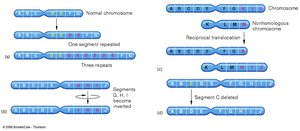
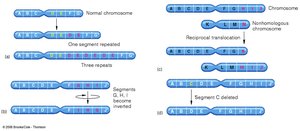
Structural mutations involve changes in the arrangement of genetic material within chromosomes. There are four main types:
Translocation: A segment moves to a different chromosome.
Inversion: A segment is reversed within the chromosome.
Duplication: A segment is repeated.
Deletion: A segment is lost.
Causes include errors during crossing over and exposure to radiation or carcinogens.
Transposable Elements
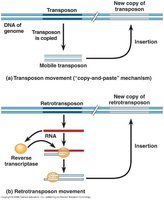
Transposable elements, or "jumping genes," are DNA segments that can move within the genome. They can cause mutations and promote unequal crossover events during meiosis.
Transposons can disrupt gene function or regulation.
They contribute to genetic diversity and evolution.
Chromosomal Basis of Mendel’s Laws
Law of Segregation and Law of Independent Assortment
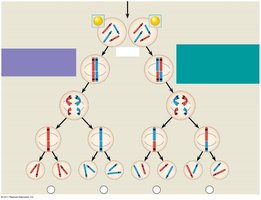
Mendel’s laws are explained by the behavior of chromosomes during meiosis. The law of segregation states that the two alleles for each gene separate during gamete formation. The law of independent assortment states that alleles of genes on nonhomologous chromosomes assort independently.
These laws predict the ratios of offspring phenotypes in genetic crosses.
Deviations from expected ratios can indicate gene linkage or chromosomal abnormalities.
Gene Linkage and Mapping
Linked genes are located close together on the same chromosome and tend to be inherited together. Crossing over during meiosis can separate linked genes, and the frequency of recombination can be used to create linkage maps.
The closer two genes are, the less likely they are to be separated by crossing over.
Linkage maps show the relative positions of genes on a chromosome.
Chi Square Statistical Test
The chi square test is used to compare observed genetic ratios to expected ratios. It helps determine whether deviations are due to chance or indicate a significant difference.
Null hypothesis: Differences between observed and expected ratios are due to chance.
If the calculated chi square value is less than the critical value at P=0.05, the null hypothesis is supported.
Degrees of freedom (DOF) = number of classes - 1.
Formula:
Where O = observed value, E = expected value.
Summary Table: Chromosomal Disorders
The following table summarizes common chromosomal disorders, their causes, and the chromosomes involved.
Disorder | Cause | Chromosomes |
|---|---|---|
Down Syndrome | Extra copy of chromosome 21 (trisomy 21) | 21 |
Patau Syndrome | Extra copy of chromosome 13 | 13 |
Edward's Syndrome | Extra copy of chromosome 18 | 18 |
Triple X Syndrome | Extra X chromosome in females | XXX |
Turner Syndrome | Missing X in females | X |
Klinefelter Syndrome | Extra X chromosome in males | XXY |
XYY Syndrome | Extra Y chromosome in males | XYY |
Cri-du-Chat Syndrome | Deletion on chromosome 5 | 5 |
Fragile X Syndrome | Duplication on X | X |
Acute Myelogenous Leukemia | Translocation between chromosomes 9 and 22 | 9, 22 |
Additional info: This guide covers the core concepts of the chromosomal basis of inheritance, including sex determination, sex-linked inheritance, chromosomal mutations, and the genetic analysis tools used to study inheritance patterns. It is suitable for exam preparation in a college-level biology course.
