 Back
The Chromosomal Basis of Inheritance: Study Notes
Study Guide - Smart Notes
 Tailored notes based on your materials, expanded with key definitions, examples, and context.
Chapter 15: The Chromosomal Basis of Inheritance
Introduction
This chapter explores how Mendelian inheritance is physically grounded in the behavior of chromosomes. It covers the historical development of the chromosome theory of inheritance, the discovery of sex-linked genes, genetic linkage and recombination, chromosomal alterations, and exceptions to standard Mendelian inheritance.
Concept 15.1: Mendelian Inheritance and Chromosome Behavior
Historical Foundations
Mendel’s hereditary units were theoretical until parallels were drawn between their behavior and that of chromosomes during meiosis.
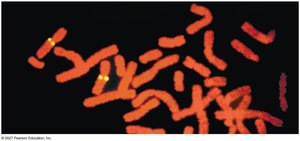
The chromosome theory of inheritance was developed around 1902 by Sutton, Boveri, and others, proposing that genes are located on chromosomes.
Experimental Evidence: Thomas Hunt Morgan
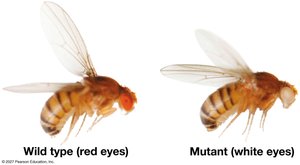
Morgan used Drosophila melanogaster (fruit flies) for genetic studies due to their short generation time, high offspring number, and only four chromosome pairs.
He distinguished between wild type (common phenotype) and mutant phenotypes (alternative traits).
The first mutant discovered was a white-eyed fly, compared to the wild-type red-eyed fly.
Gene-Chromosome Correlation
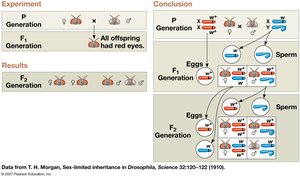
Morgan’s crosses showed that the white-eyed trait was inherited in a pattern consistent with the X chromosome, supporting the chromosome theory of inheritance.
Females (XX) and males (XY) differ in their sex chromosomes, explaining sex-linked inheritance patterns.
Relationship Between Genes and Chromosomes
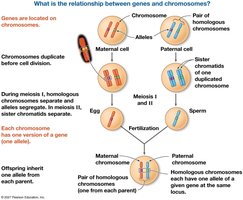
Genes are located on chromosomes, which duplicate and segregate during meiosis, ensuring inheritance of genetic material.
Concept 15.2: Sex-Linked Genes and Inheritance Patterns
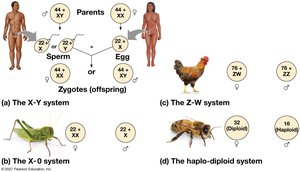
Sex Chromosomes and Determination
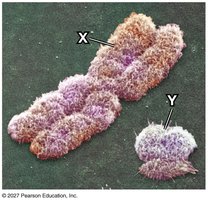
Humans have two types of sex chromosomes: X (large) and Y (small).
XX individuals typically develop female characteristics; XY individuals develop male characteristics.
Other sex determination systems exist, such as X-0 (insects), Z-W (birds), and haplo-diploid (bees).
Sex-Linked Genes
Sex-linked genes are located on either sex chromosome.
Y-linked genes are few and mostly related to male sex determination (e.g., SRY gene).
X-linked genes are numerous and can affect traits unrelated to sex.
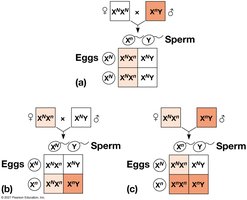
Inheritance of X-Linked Genes
Recessive X-linked traits are more common in males (hemizygous) than females (homozygous).
Examples include color blindness, Duchenne muscular dystrophy, and hemophilia.
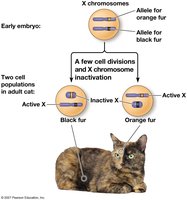
X Inactivation in Female Mammals
One X chromosome in each female cell is randomly inactivated, forming a Barr body.
Females heterozygous for X-linked genes are genetic mosaics.
The XIST gene is involved in X inactivation.
Concept 15.3: Linked Genes and Genetic Recombination
Linked Genes
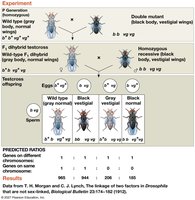
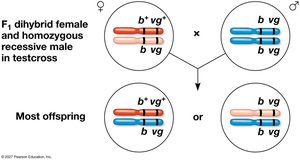
Genes located near each other on the same chromosome tend to be inherited together (linked genes).
Morgan’s experiments with fruit flies showed that linked genes do not assort independently.
Genetic Recombination
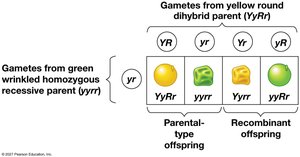
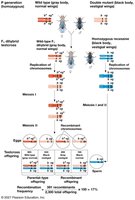
Nonparental (recombinant) phenotypes arise due to crossing over during meiosis, which breaks the physical connection between linked genes.
A 50% recombination frequency indicates genes are on different chromosomes (unlinked).
Genetic Mapping
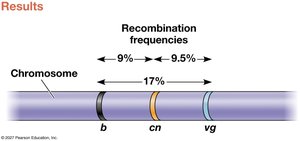
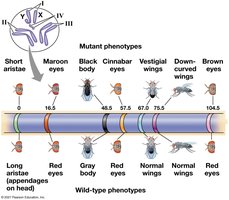
Linkage maps are constructed using recombination frequencies; 1 map unit = 1% recombination frequency.
Genes far apart on the same chromosome can appear genetically unlinked.
Concept 15.4: Chromosomal Alterations and Genetic Disorders
Abnormal Chromosome Number
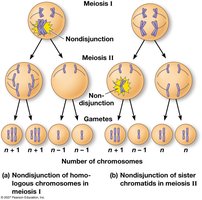
Nondisjunction is the failure of homologous chromosomes or sister chromatids to separate properly during meiosis.
Aneuploidy results from abnormal chromosome numbers (e.g., monosomy, trisomy).
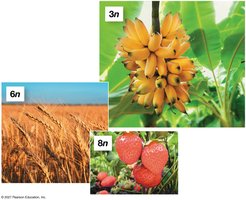
Polyploidy is the presence of more than two complete sets of chromosomes, common in plants.
Alterations of Chromosome Structure
Chromosome breakage can cause:
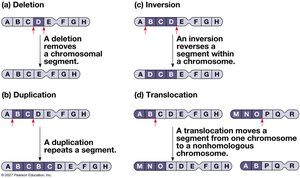
Deletion: loss of a segment
Duplication: repeat of a segment
Inversion: reversal of a segment
Translocation: movement of a segment to another chromosome
Human Disorders Due to Chromosomal Alterations
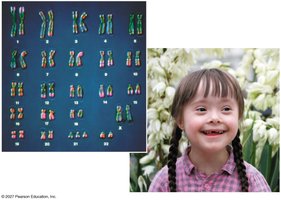
Down syndrome (trisomy 21): three copies of chromosome 21; risk increases with maternal age.
Klinefelter syndrome: XXY males; Turner syndrome: XO females.
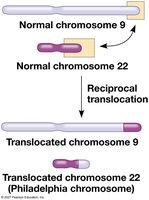
Cri du chat: deletion on chromosome 5; CML: translocation between chromosomes 9 and 22.
Concept 15.5: Exceptions to Standard Mendelian Inheritance
Genomic Imprinting
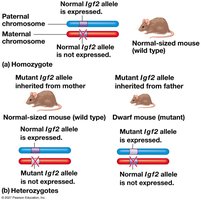
Some genes are expressed in a parent-of-origin-specific manner due to genomic imprinting.
Imprinting involves DNA methylation and affects a small fraction of genes, often critical for development.
Example: Only the paternal allele of the Igf2 gene is expressed in mice.
Inheritance of Organelle Genes
Extranuclear genes are found in mitochondria and chloroplasts and are inherited maternally.
Defects in mitochondrial genes can cause diseases affecting energy production (e.g., mitochondrial myopathy).
Techniques are being developed to prevent transmission of mitochondrial disorders.

Appendix: Scientific Skills Exercise – Chi-Square Test
Using the Chi-Square Test in Genetics
The chi-square test is used to determine if observed genetic ratios differ significantly from expected ratios.
Formula: , where o is observed and e is expected.
Testcross Offspring | Expected (e) | Observed (o) | Deviation (o-e) | (o-e)2 | (o-e)2/e |
|---|---|---|---|---|---|
A–B– | 220 | 220 | 0 | 0 | 0 |
aaB– | 210 | 210 | 0 | 0 | 0 |
A–bb | 231 | 231 | 0 | 0 | 0 |
aabb | 239 | 239 | 0 | 0 | 0 |
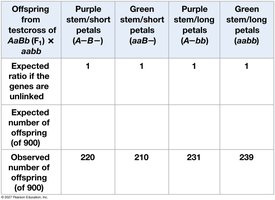
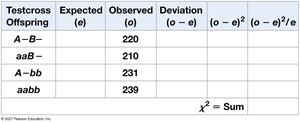

Additional info: The chi-square test is a standard statistical method in genetics for hypothesis testing regarding inheritance patterns.
