 Back
The Chromosomal Basis of Inheritance: Study Guide
Study Guide - Smart Notes
 Tailored notes based on your materials, expanded with key definitions, examples, and context.
The Chromosomal Basis of Inheritance
Chromosome Theory of Inheritance
The chromosome theory of inheritance connects Mendelian genetics to the physical behavior of chromosomes during meiosis. Mendelian genes have specific loci (positions) on chromosomes, and chromosomes undergo segregation and independent assortment. The behavior of chromosomes during meiosis accounts for Mendel’s laws of segregation and independent assortment.
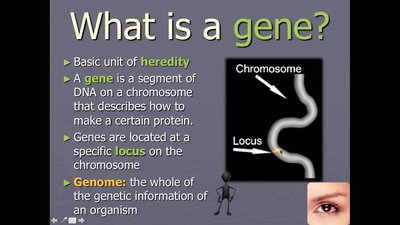
Gene: A segment of DNA on a chromosome that codes for a specific protein.
Locus: The specific location of a gene on a chromosome.
Genome: The complete set of genetic information in an organism.
Genes and Chromosomes
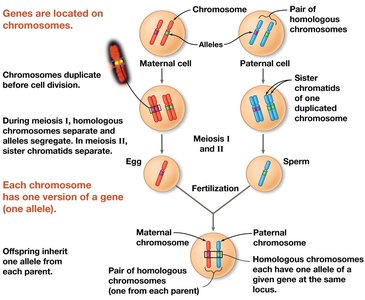
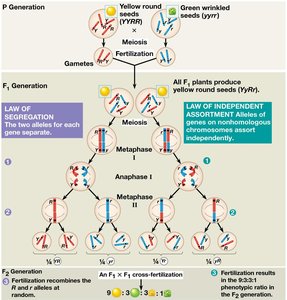
Genes are located on chromosomes, which duplicate before cell division. During meiosis I, homologous chromosomes separate and alleles segregate. In meiosis II, sister chromatids separate. Each chromosome has one version of a gene (one allele), and offspring inherit one allele from each parent.
Homologous chromosomes: Chromosome pairs, one from each parent, that have the same genes at the same loci.
Allele: Different versions of a gene.
Historical Evidence: Thomas Hunt Morgan
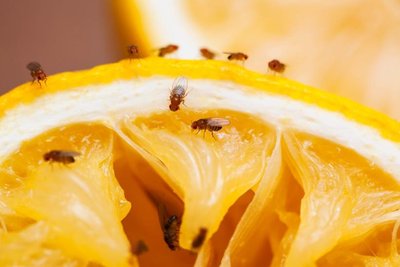
The first solid evidence associating a specific gene with a specific chromosome came from the work of Thomas Hunt Morgan in the early 1900s. Morgan used the fruit fly Drosophila melanogaster as a model organism for genetic studies due to its short generation time, high offspring number, and only four pairs of chromosomes.
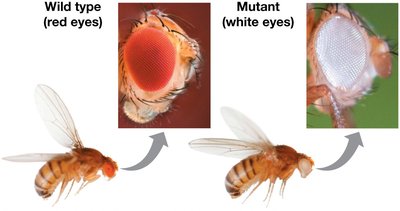
Wild-type phenotype: The normal, most common phenotype in a population.
Mutant phenotype: Traits that differ from the wild-type.
Morgan's Experiments: Eye Color in Fruit Flies
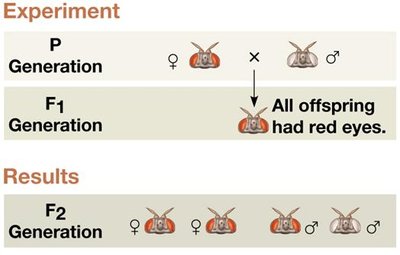
Morgan discovered a mutant phenotype (white eyes) in fruit flies, which differed from the wild-type (red eyes). His experiments showed that the red eye trait was dominant over the white eye trait.
Dominant trait: The trait that appears in the F1 generation when two different alleles are present.
Recessive trait: The trait that is masked in the F1 generation but can appear in the F2 generation.
Sex Determination Systems
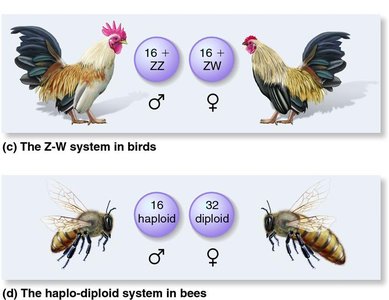
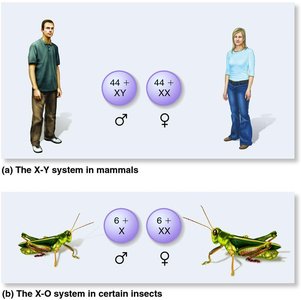
Sex determination varies among organisms. In mammals, the XY system is used, while other systems include the ZW system in birds, the XO system in certain insects, and the haplo-diploid system in bees.
Sex chromosomes: Chromosomes that determine the sex of an organism (e.g., X and Y in mammals).
Autosomes: Chromosomes that are not sex chromosomes.
Sex Chromosome Composition in Model Organisms
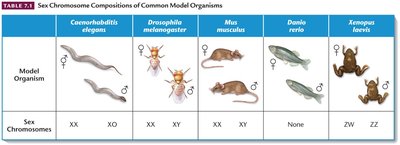
Different model organisms have varying sex chromosome compositions, which influence their sex determination mechanisms.
Model Organism | Sex Chromosomes |
|---|---|
Caenorhabditis elegans | XX (female), XO (male) |
Drosophila melanogaster | XX (female), XY (male) |
Mus musculus | XX (female), XY (male) |
Danio rerio | None |
Xenopus laevis | ZW (female), ZZ (male) |
The Chromosomal Basis of Mendel’s Laws
The segregation and independent assortment of chromosomes during meiosis explain Mendel’s laws. The law of segregation states that the two alleles for each gene separate during gamete formation. The law of independent assortment states that alleles of genes on nonhomologous chromosomes assort independently.
Law of Segregation: Each gamete receives only one allele of each gene.
Law of Independent Assortment: Genes on different chromosomes are inherited independently.
Sex-Linked Genes and Disorders
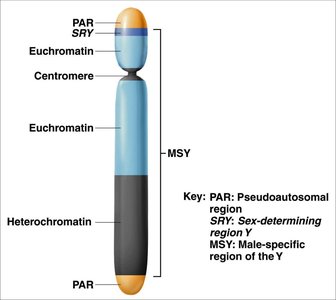
Genes located on sex chromosomes are called sex-linked genes. X-linked genes are found on the X chromosome, while Y-linked genes are found on the Y chromosome. Males are hemizygous for X-linked genes, making them more susceptible to X-linked recessive disorders.
Hemizygous: Having only one allele for a gene, as in males for X-linked genes.
Sex-linked disorders: Disorders caused by mutations in genes on the sex chromosomes, such as color blindness, hemophilia, and Duchenne muscular dystrophy.
Color Blindness: An Example of X-Linked Disorder
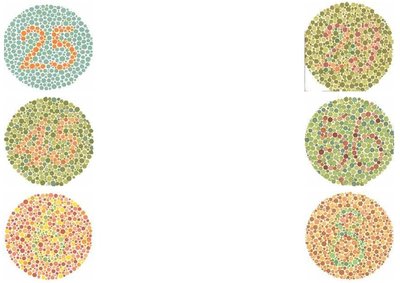
Red-green color blindness is a common X-linked disorder. Males are more frequently affected because they have only one X chromosome. Females are less likely to be affected unless they inherit two copies of the mutant allele.
Inheritance pattern: If a man has color blindness and a woman is not a carrier, none of their children will be colorblind. If the woman is a carrier, 50% of sons and 50% of daughters may be affected or carriers.
X Inactivation in Female Mammals
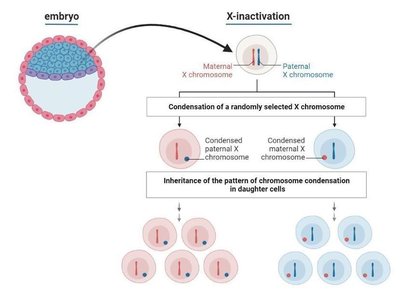
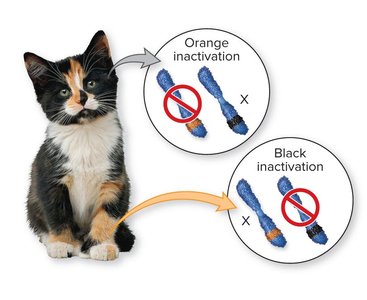
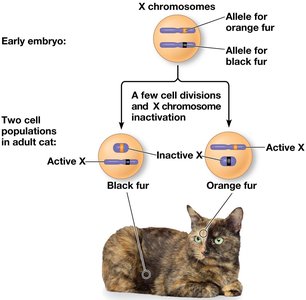
In female mammals, one of the two X chromosomes in each cell is randomly inactivated during embryonic development, forming a Barr body. This prevents double dosing of gene products. Females heterozygous for X-linked genes are mosaics, expressing different alleles in different cells.
Barr body: The condensed, inactive X chromosome in female cells.
Xist gene: Encodes an RNA that initiates X inactivation.
X Inactivation and Mosaicism: Tortoiseshell Cats
Tortoiseshell and calico cats are classic examples of X inactivation. If one X chromosome has an allele for orange fur and the other for black fur, random inactivation leads to mosaic color patterns.
Mosaicism: Presence of two or more populations of cells with different genotypes in one individual.
Linked Genes and Genetic Recombination
Genes located close together on the same chromosome are called linked genes and tend to be inherited together. The probability of a crossover event between linked alleles is proportional to the distance between the genes. Crossover events can be used to map the relative positions of genes.
Linked genes: Genes located near each other on the same chromosome.
Genetic recombination: The production of offspring with combinations of traits different from those found in either parent due to crossing over.
Alterations of Chromosome Number and Structure
Large-scale chromosomal alterations can cause genetic disorders. Nondisjunction occurs when chromosomes fail to separate properly during meiosis, resulting in aneuploidy (abnormal chromosome number). Common types include monosomy (one copy) and trisomy (three copies), such as Down syndrome (trisomy 21).
Nondisjunction: Failure of chromosome pairs to separate properly during meiosis.
Aneuploidy: Abnormal number of chromosomes in a cell.
Polyploidy: Condition in which an organism has more than two complete sets of chromosomes; common in plants.
Sex Chromosome Abnormalities
Abnormalities in sex chromosome number can lead to various syndromes, such as Triplo-X (XXX), Klinefelter syndrome (XXY), Jacobs syndrome (XYY), and Turner syndrome (XO).
Name of Condition | Chromosomes | Symptoms | Incidence |
|---|---|---|---|
Triplo-X | XXX | Tall stature, menstrual irregularities | 1 in 1500 females |
Klinefelter syndrome | XXY | Sexual underdevelopment, long limbs | 1 in 750 males |
Jacobs syndrome | XYY | Tall stature, acne, speech problems | 1 in 1000 males |
Turner syndrome | XO | Short stature, infertility | 1 in 2000 females |
Alterations of Chromosome Structure
Breakage of a chromosome can lead to four types of structural changes: deletion (removes a segment), duplication (repeats a segment), inversion (reverses orientation of a segment), and translocation (moves a segment to another chromosome). These changes can have significant effects on phenotype and viability.
Deletion: Loss of a chromosomal segment.
Duplication: Repetition of a chromosomal segment.
Inversion: Reversal of a segment within a chromosome.
Translocation: Movement of a segment from one chromosome to another.
Example: A diploid embryo homozygous for a large deletion is likely missing essential genes and is typically lethal. Duplications and translocations are also often harmful, while inversions may alter gene expression and cause reproductive problems.
----------------------------------------
