 Back
BackThe Compound Light Microscope: Structure and Function
Study Guide - Smart Notes
 Tailored notes based on your materials, expanded with key definitions, examples, and context.
The Compound Light Microscope
Introduction
The compound light microscope is an essential tool in biology for observing cells and microscopic structures. Understanding its parts and their functions is fundamental for laboratory work and scientific inquiry.
Major Components and Their Functions
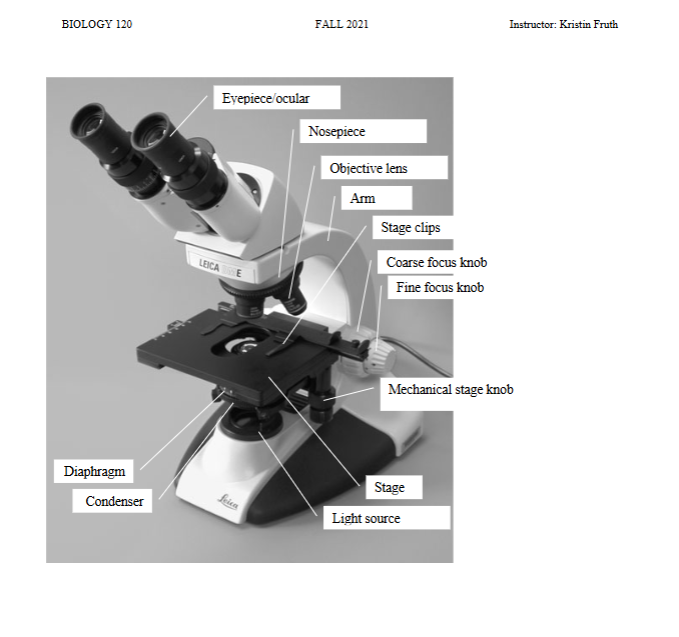
Eyepiece/Ocular: The lens at the top that you look through, typically with 10x magnification.
Nosepiece: Holds the objective lenses and rotates to change magnification.
Objective Lens: Provides different levels of magnification (e.g., 4x, 10x, 40x, 100x).
Arm: Supports the tube and connects it to the base; used for carrying the microscope.
Stage: The flat platform where the slide is placed for observation.
Stage Clips: Hold the slide in place on the stage.
Mechanical Stage Knob: Allows precise movement of the slide on the stage.
Coarse Focus Knob: Moves the stage up and down for general focusing.
Fine Focus Knob: Allows for fine-tuning the focus for a sharp image.
Diaphragm: Adjusts the amount of light that reaches the specimen.
Condenser: Focuses light onto the specimen for clearer viewing.
Light Source: Provides illumination, usually from below the stage.
How to Use a Compound Light Microscope
Place the slide on the stage and secure it with the stage clips.
Select the lowest power objective lens and use the coarse focus knob to bring the specimen into view.
Adjust the diaphragm and condenser for optimal lighting.
Switch to higher power objectives as needed, using the fine focus knob for clarity.
Example: Observing Onion Cells
When viewing a stained onion epidermal cell, start with the 4x objective to locate the cells, then switch to 10x or 40x for detailed observation of cell walls, nuclei, and other organelles.
Additional info:
The compound light microscope is covered in detail in Chapter 6: A Tour of the Cell, as it is a primary tool for cell biology. Mastery of microscope parts and their functions is foundational for laboratory skills in biology.
