Back
BackThe Cytoskeleton and Unique Features of Plant Cells
Study Guide - Smart Notes
 Tailored notes based on your materials, expanded with key definitions, examples, and context.
The Cytoskeleton
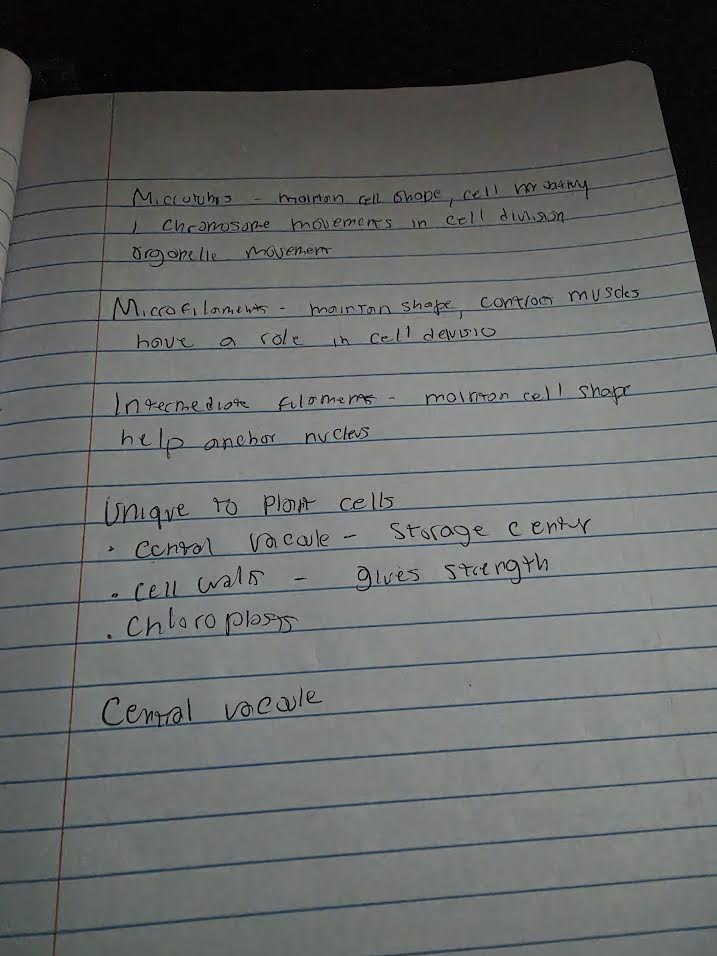
Microtubules
Microtubules are hollow rods composed of tubulin proteins that are a key component of the cytoskeleton in eukaryotic cells. They play several essential roles:
Maintain cell shape: Provide structural support and resist compression.
Cell motility: Form the structural basis for cilia and flagella, enabling movement.
Chromosome movements in cell division: Make up the mitotic spindle, which separates chromosomes during mitosis and meiosis.
Organelle movement: Serve as tracks for the movement of organelles, such as vesicles, via motor proteins.
Microfilaments (Actin Filaments)
Microfilaments are thin, solid rods made of actin protein. They are the thinnest elements of the cytoskeleton and have several functions:
Maintain cell shape: Bear tension and help support the cell’s structure.
Contraction in muscles: Interact with myosin for muscle contraction.
Role in cell division: Form the contractile ring during cytokinesis in animal cells.
Intermediate Filaments
Intermediate filaments are fibrous proteins coiled into cables. They are more permanent than microtubules and microfilaments and serve the following functions:
Maintain cell shape: Provide mechanical support for the cell.
Anchor nucleus and other organelles: Help position the nucleus and other organelles within the cell.
Unique Features of Plant Cells
Central Vacuole
The central vacuole is a large, membrane-bound sac found in plant cells. It serves as the main storage center for water, ions, nutrients, and waste products. The vacuole also helps maintain turgor pressure, which is essential for structural support in plants.
Cell Wall
The cell wall is a rigid layer that surrounds the plasma membrane of plant cells. It is primarily composed of cellulose and provides:
Strength and rigidity: Maintains the shape of the cell and prevents excessive water uptake.
Protection: Shields the cell from mechanical damage and pathogens.
Chloroplasts
Chloroplasts are the organelles responsible for photosynthesis in plant cells. They contain the pigment chlorophyll, which captures light energy to convert carbon dioxide and water into glucose and oxygen.
Photosynthesis: The process by which plants produce their own food using light energy.
Summary Table: Cytoskeletal Elements and Plant Cell Features
Structure | Main Function(s) | Unique to Plant Cells? |
|---|---|---|
Microtubules | Maintain shape, cell motility, chromosome movement, organelle movement | No |
Microfilaments | Maintain shape, muscle contraction, cell division | No |
Intermediate Filaments | Maintain shape, anchor nucleus | No |
Central Vacuole | Storage, structural support | Yes |
Cell Wall | Strength, protection | Yes |
Chloroplast | Photosynthesis | Yes |