 Back
BackThe Darwinian Revolution: Challenging Traditional Views of Life and Evolution
Study Guide - Smart Notes
 Tailored notes based on your materials, expanded with key definitions, examples, and context.
Concept 22.1: The Darwinian Revolution Challenged Traditional Views of a Young Earth Inhabited by Unchanging Species
Introduction to Darwin and Evolutionary Biology
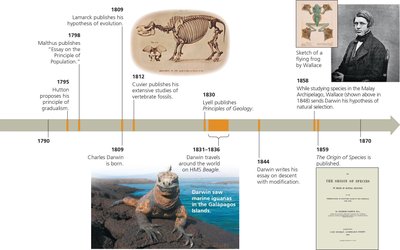
Charles Darwin's work fundamentally changed our understanding of the diversity of life on Earth. His observations and hypotheses, published in The Origin of Species, established the foundation for evolutionary biology. Darwin's ideas were shaped by the intellectual context of his time, his travels, and the work of other scientists.
Key Observations About Life
Adaptation: Organisms are well suited for life in their environments, which include both other organisms and physical surroundings.
Unity of Life: Many shared characteristics among organisms highlight the unity of life.
Diversity of Life: There is a rich diversity of species, each with unique features.
Darwin sought to explain these observations, leading to the conclusion that life evolves over time. Evolution is defined as descent with modification, where species accumulate differences from their ancestors as they adapt to different environments. It can also be described as a change in the genetic composition of a population across generations.
Evolution as Pattern and Process
Pattern: The observable evolutionary changes in life, supported by data from biology, geology, physics, and chemistry.
Process: The mechanisms (such as natural selection) that cause evolutionary change.
Evolution serves as a unifying theory in biology, connecting a wide range of observations about the living world. Scientific theories like evolution are continually tested against new data and observations.
Historical Perspectives on Species and Classification
Scala Naturae and Early Classification
Before Darwin, Greek philosophers such as Aristotle viewed species as fixed and unchanging. Aristotle proposed the scala naturae (scale of nature), a ladder of increasing complexity with each form of life occupying a specific rung. This view aligned with the Old Testament, which held that species were individually created and perfect.
Carolus Linnaeus: Developed the binomial system for naming species (e.g., Homo sapiens) and a nested classification system grouping similar species into genera, families, and higher categories. Linnaeus did not attribute similarities among species to evolution, but to patterns of creation.
Darwin later argued that classification should reflect evolutionary relationships, noting that the Linnaean system often grouped organisms in ways consistent with their evolutionary history.
Ideas About Change Over Time
The Fossil Record and Geology
Fossils, the preserved remains or traces of organisms, are primarily found in sedimentary rocks. These rocks form in layers (strata), with each stratum representing a different period in Earth's history. Fossils in deeper strata are generally older and more different from current life forms.
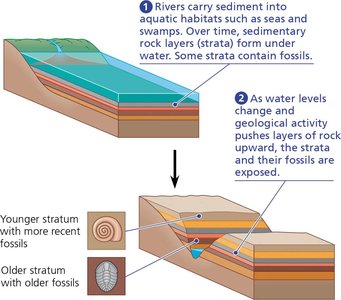
Paleontology: The study of fossils, largely developed by Georges Cuvier, who observed that older strata contained more dissimilar fossils and that extinctions were common. Cuvier attributed changes in the fossil record to catastrophic events, not evolution.
Gradualism: James Hutton and Charles Lyell proposed that geological features result from slow, continuous processes. Lyell argued that these processes operate at the same rate today as in the past, implying that Earth is much older than previously thought.
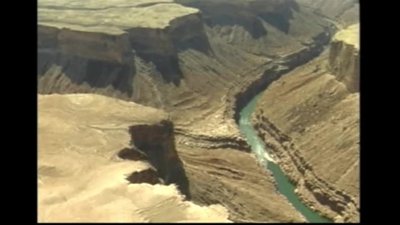
Darwin was influenced by these ideas, reasoning that slow, gradual processes could also explain biological change over long periods.
Lamarck’s Hypothesis of Evolution
Jean-Baptiste de Lamarck was one of the first to propose a mechanism for evolution. He suggested that:
Use and Disuse: Body parts used extensively become larger and stronger; those not used deteriorate.
Inheritance of Acquired Characteristics: Traits acquired during an organism's life could be passed to offspring (e.g., giraffes stretching their necks).
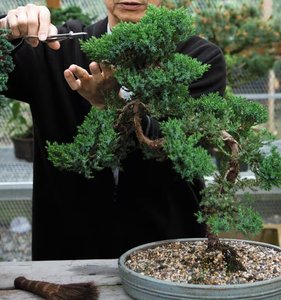
Modern genetics has shown that acquired traits are not inherited in this way. For example, pruning a bonsai tree does not result in offspring with a similar shape.
Lamarck's recognition that adaptation and evolutionary change could explain the fit between organisms and their environments was important, even though his proposed mechanism was incorrect.
Summary Table: Key Figures and Concepts in Early Evolutionary Thought
Name | Contribution | Key Idea |
|---|---|---|
Aristotle | Scala naturae | Species are fixed and arranged by complexity |
Carolus Linnaeus | Classification system | Binomial nomenclature; nested hierarchy |
Georges Cuvier | Paleontology | Catastrophism; extinction events |
James Hutton & Charles Lyell | Geology | Gradualism; uniformitarianism |
Jean-Baptiste Lamarck | Evolutionary hypothesis | Use and disuse; inheritance of acquired traits |
Charles Darwin | Evolution by natural selection | Descent with modification |
Concept Check
How did Hutton’s and Lyell’s ideas influence Darwin’s thinking about evolution? Hutton and Lyell proposed that geological changes occur gradually over long periods, suggesting that Earth is much older than previously believed. This allowed Darwin to consider that biological evolution could also occur gradually over vast timescales.
Are Cuvier’s explanation of the fossil record and Lamarck’s hypothesis of evolution scientific? Both are scientific because they are testable hypotheses. Cuvier’s catastrophism and Lamarck’s inheritance of acquired traits can be evaluated by examining fossil evidence and conducting experiments, respectively.
