 Back
BackThe Discovery and Structure of DNA as the Genetic Material
Study Guide - Smart Notes
 Tailored notes based on your materials, expanded with key definitions, examples, and context.
DNA as the Genetic Material
The Search for the Genetic Material
Early in the 20th century, scientists debated whether DNA or protein was the hereditary material. Proteins, with their structural diversity, were initially favored. However, experiments with bacteria and viruses provided crucial evidence that DNA is the molecule of inheritance.
Evidence That DNA Can Transform Bacteria
Frederick Griffith's 1928 experiment with Streptococcus pneumoniae demonstrated the phenomenon of transformation. He found that nonpathogenic bacteria could become pathogenic when mixed with heat-killed pathogenic bacteria, suggesting that a 'transforming principle' was responsible for transferring genetic information.
Transformation: A change in genotype and phenotype due to the assimilation of external DNA by a cell.
Pathogenic (S) strain: Has a capsule, causes disease.
Nonpathogenic (R) strain: Lacks a capsule, does not cause disease.
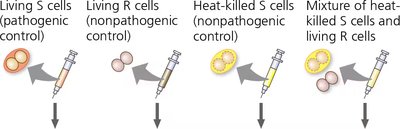
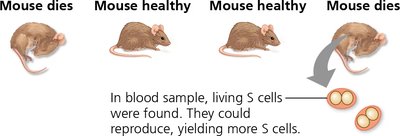
Conclusion: The R strain was transformed into the S strain by an unknown heritable substance from the dead S cells, later identified as DNA.
Evidence That Viral DNA Can Program Cells
Bacteriophages (phages) are viruses that infect bacteria. The Hershey-Chase experiment (1952) used radioactive labeling to show that DNA, not protein, is the genetic material injected by phages into bacteria, directing the production of new viruses.
Bacteriophage structure: Composed of DNA (or RNA) and a protein coat.
Key finding: Only DNA enters the bacterial cell and directs viral replication.
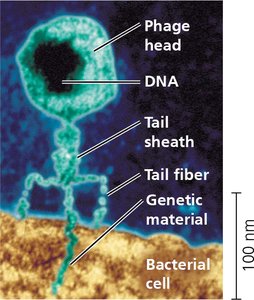
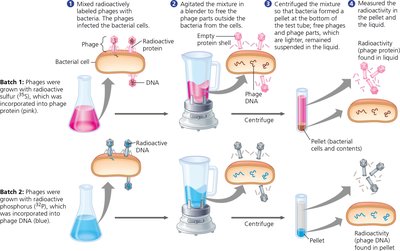
Conclusion: DNA is the hereditary material in phages, as only labeled DNA was found inside infected cells and passed on to progeny phages.
The Structure of DNA
DNA Composition and Chargaff's Rules
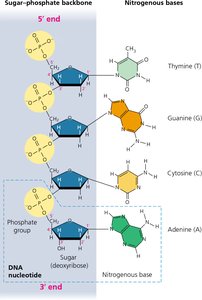
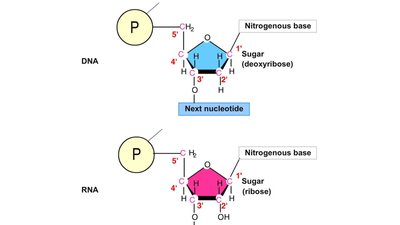
DNA is a polymer of nucleotides, each consisting of a nitrogenous base, a deoxyribose sugar, and a phosphate group. Erwin Chargaff discovered that DNA composition varies between species and that the amount of adenine (A) equals thymine (T), while guanine (G) equals cytosine (C).
Nucleotide structure: Base (A, T, G, C), deoxyribose sugar, phosphate group.
Chargaff's rules: %A = %T and %G = %C in any DNA sample.
Example: In sea urchin DNA, A = 32.8%, T = 32.1%, G = 17.7%, C = 17.3%.
Source of DNA | Adenine | Guanine | Cytosine | Thymine |
|---|---|---|---|---|
Sea urchin | 32.8 | 17.7 | 17.3 | 32.1 |
Salmon | 29.7 | 20.8 | 20.4 | 29.1 |
Wheat | 28.1 | 21.8 | 22.7 | ? |
E. coli | 24.7 | 26.0 | ? | ? |
Human | 30.4 | ? | ? | 30.1 |
Ox | 29.0 | ? | ? | ? |
Average % |
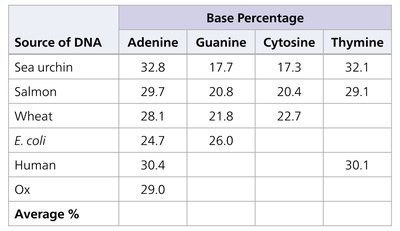
Application: Chargaff's rules allow prediction of base composition in unknown DNA samples.
Building the Structural Model of DNA
X-ray Crystallography and the Double Helix
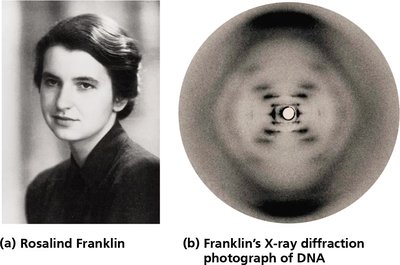
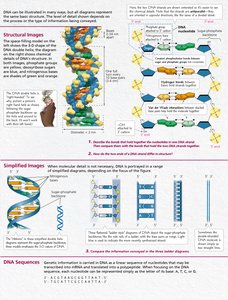
Rosalind Franklin's X-ray diffraction images revealed that DNA is helical, with a uniform diameter and repeating structure. Watson and Crick used these data, along with Chargaff's rules, to build a double helix model with antiparallel sugar-phosphate backbones and specific base pairing.
Antiparallel strands: The two DNA strands run in opposite directions (5' to 3' and 3' to 5').
Double helix: Two strands twisted around each other, with bases paired in the interior.
Base Pairing and the Uniformity of the Double Helix
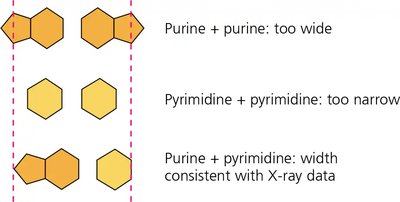
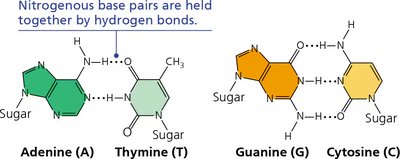
The double helix has a uniform diameter because a purine (A or G, two rings) always pairs with a pyrimidine (T or C, one ring). This pairing is stabilized by hydrogen bonds: A pairs with T (two hydrogen bonds), and G pairs with C (three hydrogen bonds).
Pyrimidines: Cytosine (C), Thymine (T) – single ring
Purines: Adenine (A), Guanine (G) – double ring
Base pairing: A–T and G–C
Key Point: The sequence of bases along a DNA strand encodes genetic information, while the base-pairing rules ensure accurate replication and transmission of genetic material.
Summary Table: Key Discoveries in DNA as Genetic Material
Scientist(s) | Experiment | Key Finding |
|---|---|---|
Griffith | Transformation in S. pneumoniae | Heritable substance (DNA) can transform bacteria |
Hershey & Chase | Phage infection of E. coli | DNA, not protein, is the genetic material |
Chargaff | Base composition analysis | %A = %T, %G = %C; DNA composition varies by species |
Franklin | X-ray diffraction | DNA is a double helix with regular structure |
Watson & Crick | Model building | Double helix structure explains replication and heredity |
Conclusion
The discovery of DNA as the genetic material and the elucidation of its double helix structure were foundational to modern biology. These advances explained how genetic information is stored, replicated, and transmitted, setting the stage for molecular genetics and biotechnology.
