 Back
BackThe Discovery of DNA as the Genetic Material
Study Guide - Smart Notes
 Tailored notes based on your materials, expanded with key definitions, examples, and context.
Genetics and the Search for Genetic Material
Introduction to Genetics
The field of genetics is the study of heredity and the variation of inherited characteristics. Its foundations were laid in the mid-1800s by Gregor Mendel, but the molecular nature of genetic material was not understood until the 20th century. Early geneticists debated whether DNA or protein was responsible for inheritance, as chromosomes contain both molecules.
DNA: Composed of four types of nucleotides (subunits).
Proteins: Composed of 20 different amino acids, allowing for greater diversity.
Evidence That DNA Is the Genetic Material
Griffith's Transformation Experiment (1928)
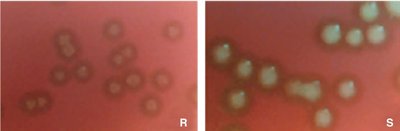
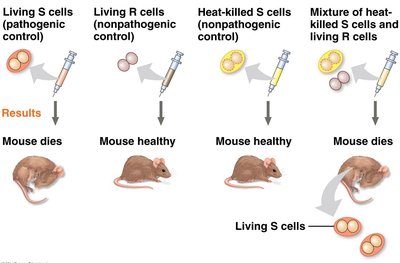
Frederick Griffith's experiments with Streptococcus pneumoniae provided the first evidence that a heritable substance could transfer genetic information between organisms. He worked with two bacterial strains:
Smooth (S) strain: Pathogenic, has a protective capsule, causes pneumonia in mice.
Rough (R) strain: Non-pathogenic, lacks capsule, does not cause disease.
Key Experimental Results
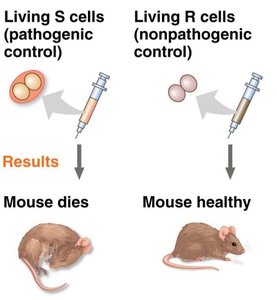
Injection of living S cells killed mice.
Injection of living R cells did not kill mice.
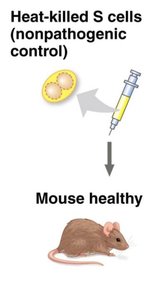
Injection of heat-killed S cells did not kill mice.
Injection of a mixture of heat-killed S cells and living R cells killed mice, and living S cells were recovered from the dead mice.
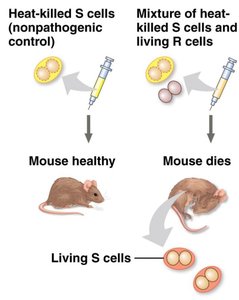
This phenomenon, where a non-pathogenic strain is converted into a pathogenic one by exposure to cell debris from the pathogenic strain, was termed transformation.
Avery, McCarty, and MacLeod's Experiment
In the 1940s, Oswald Avery, Maclyn McCarty, and Colin MacLeod identified DNA as the 'transforming principle.' They fractionated cell components from heat-killed S cells and found that only DNA could transform R cells into S cells. This provided strong evidence that DNA, not protein, was the genetic material.
Key Point: Only DNA from S cells induced transformation of R cells.
Hershey and Chase Experiment (1952)
Bacteriophage Structure and Function
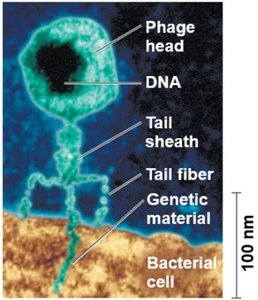
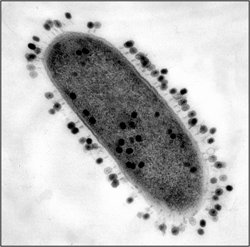
A bacteriophage (or phage) is a virus that infects bacteria. It consists of DNA enclosed in a protein coat. When a phage infects a bacterium, it injects its genetic material into the host cell, directing the cell to produce more viruses.
Experimental Design
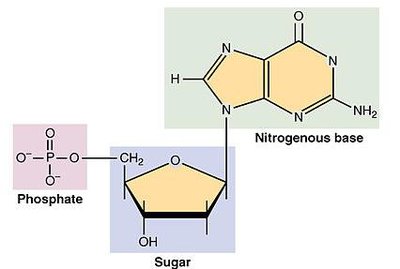
Hershey and Chase used the T2 phage to determine whether DNA or protein is the genetic material. They labeled phage DNA with radioactive phosphorus (32P) and phage protein with radioactive sulfur (35S), exploiting the fact that DNA contains phosphorus but not sulfur, and protein contains sulfur but not phosphorus.
Radioactive sulfur (35S): Labels protein only.
Radioactive phosphorus (32P): Labels DNA only.

Steps of the Experiment
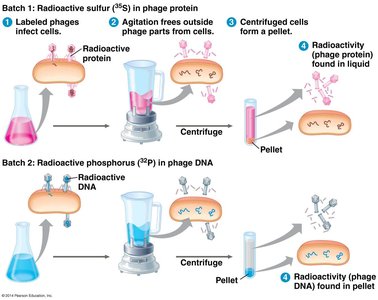
Grow phages in media containing either 35S or 32P to label proteins or DNA, respectively.
Allow labeled phages to infect E. coli bacteria.
Agitate the mixture to remove phage coats from the outside of the bacteria.
Centrifuge the mixture to separate bacterial cells (pellet) from the phage coats (supernatant).
Measure radioactivity in the pellet and supernatant to determine which component entered the cells.

Results and Conclusion
Radioactive phosphorus (32P, DNA) was found inside the bacterial cells (pellet).
Radioactive sulfur (35S, protein) remained outside the cells (in the supernatant).
Conclusion: DNA, not protein, is the genetic material that is injected by phages into bacteria to direct viral replication.
Key Terms and Concepts
Pathogenic bacteria: Bacteria that can cause disease in a host.
Transformation (in bacteria): The assimilation of external DNA into a cell, resulting in a genetic change.
Bacteriophage: A virus that infects bacteria, composed of DNA and a protein coat.
Summary Table: Key Experiments in Identifying DNA as Genetic Material
Experiment | Organism/System | Key Finding |
|---|---|---|
Griffith (1928) | Streptococcus pneumoniae (mice) | Transformation: Heritable substance can transfer pathogenicity |
Avery, McCarty, MacLeod (1944) | Streptococcus pneumoniae (in vitro) | DNA is the transforming principle |
Hershey & Chase (1952) | Bacteriophage T2, E. coli | DNA, not protein, is the genetic material |
Practice Questions
Which result from Griffith’s experiment is an example of transformation? Answer: Mouse dies after being injected with a mixture of heat-killed S and living R cells.
Into which component would radioactive sulfur be incorporated? Answer: Protein
Into which component would radioactive phosphorus be incorporated? Answer: DNA
What is meant by pathogenic bacteria? Answer: Bacteria that can cause disease in a host
How do we describe transformation in bacteria? Answer: Assimilation of external DNA into a cell
