 Back
BackThe Diversity of Angiosperms (Flowering Plants): Structure, Evolution, and Classification
Study Guide - Smart Notes
 Tailored notes based on your materials, expanded with key definitions, examples, and context.
Angiosperms: The Most Diverse Group of Land Plants
Introduction to Angiosperms
Angiosperms, or flowering plants, represent the most abundant and diverse group of land plants on Earth. They are found in nearly every terrestrial ecosystem, from prairies to forests, and display a remarkable variety of forms, colors, and ecological adaptations.
Definition: Angiosperms are vascular seed plants that produce flowers and fruits containing seeds.
Ecological Importance: They dominate most terrestrial habitats and are crucial for ecosystem functioning, providing food, oxygen, and habitat for countless organisms.
Diversity: With approximately 290,000 described species, angiosperms far outnumber other plant groups.
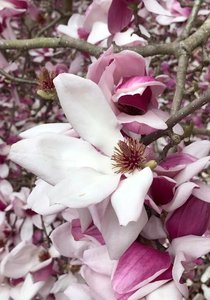
Major Groups of Land Plants and Angiosperm Diversity
Phylogeny and Classification
Land plants are classified into several major groups based on evolutionary relationships. Angiosperms are nested within the seed plants and are distinguished by their unique reproductive structures.
Bryophytes: Non-vascular plants including mosses, liverworts, and hornworts.
Lycophytes: Vascular plants with microphyll leaves (e.g., club mosses).
Ferns and Allies: Seedless vascular plants with megaphyll leaves.
Gymnosperms: Seed plants without flowers (e.g., conifers).
Angiosperms: Seed plants with flowers and fruits.
Species Diversity (approximate):
Group | Number of Species |
|---|---|
Mosses | 12,000 |
Liverworts | 9,000 |
Hornworts | 225 |
Lycophytes | 1,300 |
Ferns and Allies | 10,560 |
Gymnosperms | 1,080 |
Angiosperms | 290,000 |
Additional info: These numbers are constantly updated as new species are described.
Flower Structure and Function
Basic Flower Anatomy
Flowers are specialized reproductive structures composed of four main whorls, each derived from modified leaves. These structures facilitate sexual reproduction and the formation of seeds and fruits.
Calyx: The outermost whorl, consisting of sepals that protect the developing flower bud.
Corolla: The whorl of petals, often colorful and showy to attract pollinators.
Androecium: The male reproductive organs, composed of stamens (filament + anther).
Gynoecium: The female reproductive organs, composed of one or more pistils (carpels), each with stigma, style, and ovary.
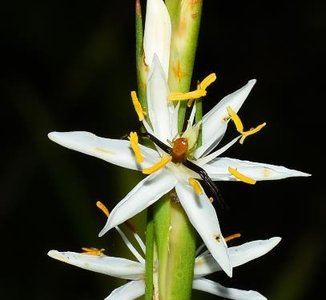
Evolution of the Pistil (Carpel)
The pistil evolved from megasporophylls, providing an additional protective layer for the developing embryo. The ovule develops into a seed, and the carpel matures into a fruit.
Ovule → Seed
Carpel → Fruit
Reproductive Biology of Angiosperms
Male and Female Gametophytes
Male Gametophyte (Pollen Grain): Contains a tube cell (forms pollen tube) and a generative cell (divides to form two sperm nuclei).
Female Gametophyte (Embryo Sac): Typically consists of 7 cells and 8 nuclei, including the egg cell, synergids, antipodals, and polar nuclei.
Pollination Mechanisms
Pollination is the transfer of pollen from the anther to the stigma. Angiosperms utilize a wide variety of vectors for pollination, including wind, water, insects, birds, and mammals. The structure, color, and scent of flowers often reflect their primary pollinators (pollination syndromes).
Wind Pollination: Flowers are often small, inconspicuous, and produce abundant pollen.
Animal Pollination: Flowers are typically colorful, scented, and produce nectar to attract pollinators.
Double Fertilization
Double fertilization is a unique feature of angiosperms. One sperm nucleus fertilizes the egg cell to form the zygote (2n), while the other fuses with the two polar nuclei to form the endosperm (3n), which nourishes the developing embryo.
Equation:
Equation:
Additional info: In gymnosperms, the female gametophyte (n) stores food, while in angiosperms, the endosperm (3n) serves this function.
Fruit Types and Seed Dispersal
Fruit Development and Classification
Fruits develop from the ovary after fertilization and aid in seed protection and dispersal. There are three major types of fruits:
Simple Fruits: Develop from a single ovary (e.g., cherry, tomato).
Aggregate Fruits: Develop from a single flower with multiple ovaries (e.g., strawberry).
Multiple Fruits: Develop from an inflorescence, where multiple flowers fuse into one structure (e.g., pineapple, breadfruit).
Monocots vs. Dicots: Comparative Morphology
Key Differences Between Monocots and Dicots
Angiosperms are traditionally divided into two main groups based on morphological and anatomical features: monocots and dicots (eudicots).
Character | Monocot | Dicot |
|---|---|---|
Cotyledons | One | Two |
Leaf Venation | Parallel | Reticulate (net-like) |
Root System | Fibrous | Tap root |
Vascular Bundles | Scattered | Arranged in a ring |
Floral Parts | Multiples of 3 | Multiples of 4 or 5 |
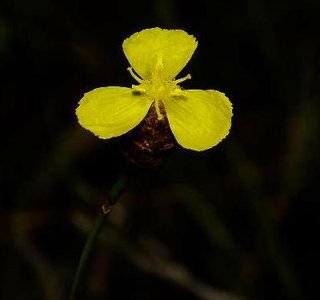
Examples of Monocots and Dicots
Monocots: Grasses, lilies, orchids, palms, corn.
Dicots: Roses, beans, oaks, sunflowers, maples.
Summary Table: Flowering Plant Structure and Life Cycle
Structure | Function |
|---|---|
Calyx (sepals) | Protects young flower |
Corolla (petals) | Attracts pollinators |
Androecium (stamens) | Produces pollen (male gametes) |
Gynoecium (pistils/carpels) | Produces ovules (female gametes) |
Fruit | Protects seeds and aids in dispersal |
Conclusion
Angiosperms are the most diverse and ecologically significant group of land plants. Their evolutionary innovations—flowers, fruits, and double fertilization—have enabled them to colonize a wide range of habitats and form complex relationships with animals and other organisms. Understanding their structure, reproduction, and classification is fundamental to the study of plant biology and ecology.
