 Back
21. The Diversity of Protists
Study Guide - Smart Notes
 Tailored notes based on your materials, expanded with key definitions, examples, and context.
The Diversity of Protists
Introduction to Protists
Protists are a diverse group of eukaryotic organisms that do not fit into the plant, animal, or fungal kingdoms. They are primarily single-celled, though some are multicellular, and they exhibit a wide range of structural and physiological complexity. Protists are found in various environments and play essential roles in ecological systems.
Characteristics of Protists
Eukaryotic Cells: Protists possess membrane-bound organelles, including a nucleus.
Diversity: Protists vary greatly in form, lifestyle, and mode of nutrition.
Not a Clade: Protists do not form a single evolutionary group (clade); instead, they are a collection of lineages within the domain Eukarya.
Reproduction in Protists
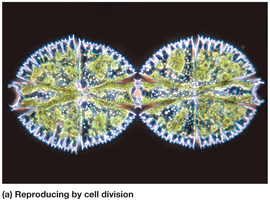
Protists reproduce using both asexual and sexual methods, allowing them to adapt to changing environmental conditions.
Asexual Reproduction: Most protists reproduce by binary fission, producing genetically identical offspring under favorable conditions.
Sexual Reproduction: In harsh environments, many protists undergo sexual reproduction, resulting in genetically diverse offspring.
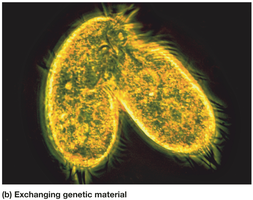
Genetic Exchange: Some protists exchange genetic material through processes like conjugation, which increases genetic diversity without producing new cells.
Nutrition in Protists
Protists exhibit diverse nutritional strategies, including ingestion, absorption, and photosynthesis.
Ingestion: Predatory protists use pseudopods or cilia to capture and engulf food, which is digested in food vacuoles.
Absorption: Some protists absorb nutrients directly from their environment, acting as decomposers or parasites.
Photosynthesis: Photosynthetic protists (algae) use chloroplasts to capture solar energy, producing oxygen and organic molecules.
Ecological and Human Impacts
Positive Impacts: Photosynthetic protists are crucial for oxygen production and form the base of aquatic food webs.
Negative Impacts: Some protists cause diseases in humans (e.g., malaria) and plants, while others are important decomposers or mutualists.
Major Groups of Protists
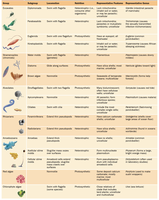
Modern classification of protists is based on genetic data, but traditional groupings are still used for convenience. The major groups include excavates, stramenopiles, alveolates, rhizarians, amoebozoans, red algae, and chlorophytes (green algae).
Group | Subgroup | Locomotion | Nutrition | Representative Features | Representative Example |
|---|---|---|---|---|---|
Excavates | Diplomonads | Swim with flagella | Heterotrophic | Two nuclei, lack mitochondria | Giardia |
Excavates | Parabasalids | Swim with flagella | Heterotrophic | Parabasal body, mutualists or parasites | Trichomonas |
Excavates | Euglenids | Swim with flagella | Photosynthetic or heterotrophic | Flexible pellicle, eyespot | Euglena |
Stramenopiles | Diatoms | Glide | Photosynthetic | Silica cell walls | Navicula |
Stramenopiles | Brown algae | Nonmotile | Photosynthetic | Multicellular, marine | Giant kelp |
Alveolates | Dinoflagellates | Swim with flagella | Photosynthetic or heterotrophic | Cellulose plates, bioluminescent | Ceratium |
Alveolates | Apicomplexans | Nonmotile | Parasitic | Complex life cycles | Plasmodium |
Alveolates | Ciliates | Move with cilia | Heterotrophic | Complex organelles | Paramecium |
Rhizarians | Foraminiferans | Extend thin pseudopods | Heterotrophic | Calcium carbonate shells | Globigerina |
Rhizarians | Radiolarians | Extend thin pseudopods | Heterotrophic | Silica shells | Actinomma |
Amoebozoans | Amoebas | Extend thick pseudopods | Heterotrophic | No shells | Amoeba |
Amoebozoans | Slime molds | Amoeboid movement | Heterotrophic | Plasmodial or cellular | Physarum |
Red algae | — | Nonmotile | Photosynthetic | Red pigments, multicellular | Chondrus |
Chlorophytes (Green algae) | — | Varied | Photosynthetic | Green pigments, uni- or multicellular | Ulva |
Excavates
Diplomonads: Have two nuclei and multiple flagella; some are parasites (e.g., Giardia).
Parabasalids: Anaerobic, flagellated, often mutualists or parasites (e.g., Trichomonas vaginalis).
Euglenids: Flexible, flagellated, some photosynthetic, possess eyespots for light detection.
Stramenopiles
Diatoms: Photosynthetic, encased in silica cell walls, important in aquatic ecosystems.
Brown Algae: Multicellular, marine, include kelps, source of commercial products like sodium alginate.
Alveolates
Dinoflagellates: Mostly photosynthetic, two flagella, some cause red tides and are bioluminescent.
Apicomplexans: Parasitic, nonmotile as adults, complex life cycles (e.g., Plasmodium causes malaria).
Ciliates: Move with cilia, highly complex, include Paramecium.
Rhizarians
Foraminiferans: Marine, chalky calcium carbonate shells, contribute to limestone deposits.
Radiolarians: Glassy silica shells, extend thin pseudopods.
Amoebozoans
Amoebas: Move and feed using thick pseudopods, some are predators or parasites.
Slime Molds: Decomposers, have complex life cycles with mobile and stationary stages.
Red Algae
Multicellular, contain red pigments, mostly marine, source of commercial products like carrageenan.
Chlorophytes (Green Algae)
Unicellular or multicellular, primarily freshwater, important for biofuel research.
Summary Table: Major Groups of Protists
The following table summarizes the main groups, their locomotion, nutrition, and representative features and examples.
Key Terms
Protist: Any eukaryote that is not a plant, animal, or fungus.
Pseudopod: Temporary projection of cytoplasm used for movement and feeding.
Flagellum: Long, whip-like structure used for movement.
Cilia: Short, hair-like structures used for movement.
Chloroplast: Organelle where photosynthesis occurs.
Endosymbiosis: Theory explaining the origin of eukaryotic organelles from prokaryotic cells.
Formulas and Equations
Photosynthesis (generalized):
Examples and Applications
Giardia: Causes waterborne disease in humans.
Plasmodium: Causes malaria, transmitted by mosquitoes.
Brown Algae: Source of sodium alginate, used in food and industry.
Chlorophytes: Investigated for renewable biofuel production.
Additional info: This guide expands on the provided lecture content with definitions, examples, and a summary table for clarity and exam preparation.
