 Back
The Eukaryotic Cell Cycle: Chromosomes, Cell Division, and Regulation
Study Guide - Smart Notes
 Tailored notes based on your materials, expanded with key definitions, examples, and context.
The Eukaryotic Cell Cycle
Overview of Chromosomes
The eukaryotic cell cycle is a fundamental process that governs cell growth, DNA replication, and cell division. Chromosomes are discrete units of genetic material, and their structure and function are central to understanding cell division and inheritance.
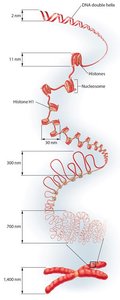
Chromatin: The complex of DNA and proteins (mainly histones) that forms chromosomes in eukaryotic cells.
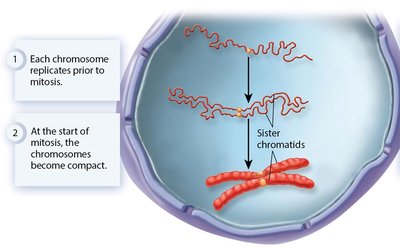
Chromosome Compaction: Chromosomes vary between loose (during interphase) and tight (during mitosis) compaction, facilitating DNA replication and segregation.
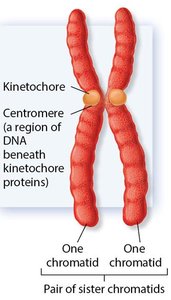
Sister Chromatids: After DNA replication, each chromosome consists of two identical sister chromatids joined at the centromere.
Homologous Chromosomes: In diploid cells, chromosomes exist in pairs (homologs), one from each parent, carrying the same genes but potentially different alleles.
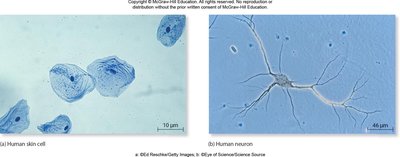
Variation in Morphology of Human Cells
Despite having identical genomes, different cell types in the human body (e.g., skin cells and neurons) exhibit distinct morphologies and functions due to differential gene expression and protein processing.
Gene Expression: Certain proteins may be produced in one cell type but not another, or in different amounts.
RNA Processing: The amino acid sequence of proteins can differ between cells due to alternative RNA splicing.
Protein Processing: Post-translational modifications can vary, affecting protein function in each cell type.
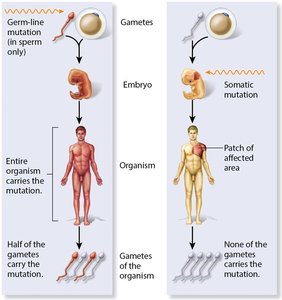
Germ-Line vs. Somatic Cells
Cells in the human body are classified as germ-line or somatic cells, each with distinct roles in inheritance and mutation propagation.
Germ-Line Cells: Give rise to gametes (egg and sperm); mutations here are heritable.
Somatic Cells: Constitute all other body cells; mutations affect only the individual and are not passed to offspring.
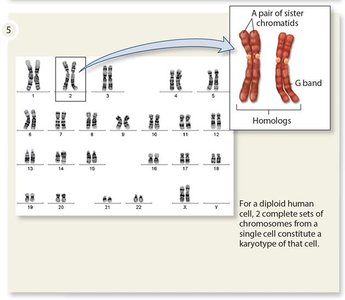
Karyotype and Sets of Chromosomes
A karyotype is a photographic representation of chromosomes, revealing their number, size, and form. Human somatic cells are diploid (2n), containing two sets of chromosomes (one from each parent), while gametes are haploid (1n).
Autosomes: Chromosomes 1-22, arranged by size.
Sex Chromosomes: X and Y; females are XX, males are XY.
Homologous Pairs: Each pair consists of homologs, which are similar but not identical due to minor DNA sequence differences.
The Eukaryotic Cell Cycle Phases
Interphase (G1, S, G2)
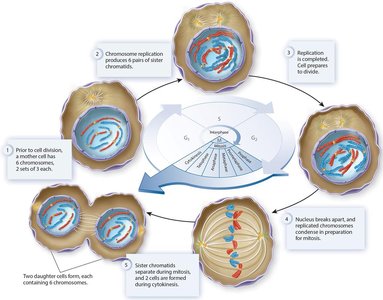
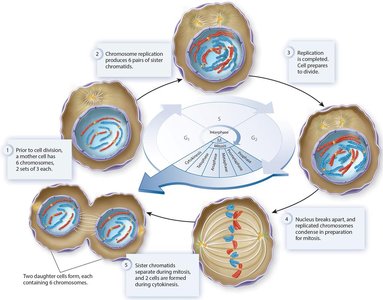
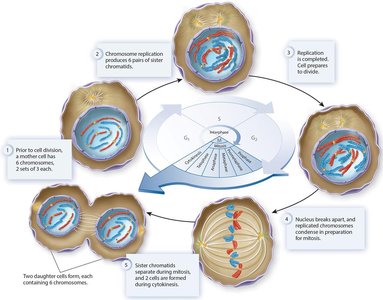
Interphase is the period of cell growth and preparation for division, consisting of three phases:
G1 Phase: Cell grows and synthesizes proteins.
S Phase: DNA is replicated, resulting in sister chromatids.
G2 Phase: Cell synthesizes proteins required for mitosis.
M Phase (Mitosis and Cytokinesis)
M phase includes mitosis (division of the nucleus) and cytokinesis (division of the cytoplasm), resulting in two genetically identical daughter cells.
Mitosis: Sorting and separation of chromosomes into two nuclei.
Cytokinesis: Physical separation of the daughter cells.
Regulation of the Cell Cycle
Cyclins and Cyclin-Dependent Kinases (CDKs)
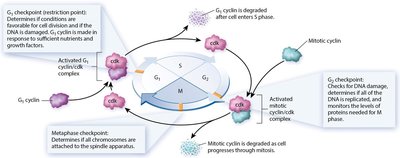
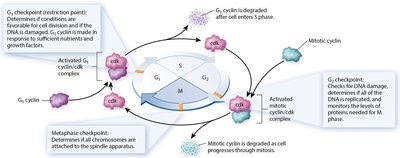
Progression through the cell cycle is regulated by cyclins and CDKs. Cyclins are proteins whose levels fluctuate during the cell cycle, activating CDKs, which phosphorylate target proteins to advance the cell cycle.
Cyclin-CDK Complex: Formation is required for cell cycle progression.
Kinase Activity: CDKs phosphorylate proteins, triggering transitions between cell cycle phases.
Cell Cycle Checkpoints
Three critical checkpoints ensure genome integrity and proper cell division:
G1 Checkpoint: Assesses cell size, nutrients, and DNA damage.
G2 Checkpoint: Ensures DNA replication is complete and checks for DNA damage.
Metaphase Checkpoint: Verifies proper chromosome attachment to the spindle apparatus.
Mitotic Cell Division
DNA Replication and Chromosome Compaction
Before mitosis, chromosomes are replicated during the S phase of interphase. At the start of mitosis, sister chromatids become highly compacted and visible under the microscope.
Centromere: Holds sister chromatids together and serves as the attachment site for kinetochore proteins.
Kinetochore: Protein complex essential for chromosome movement during mitosis.
The Mitotic Spindle
The mitotic spindle, composed of microtubules, organizes and sorts sister chromatids during cell division. Centrosomes duplicate during interphase, defining the poles of the spindle.
Microtubule Organizing Centers (MTOCs): Centrosomes serve as MTOCs.
Spindle Microtubules: Three types—kinetochore, polar, and astral microtubules.
Stages of Mitosis
Mitosis is divided into five stages:
Prophase: Chromatids condense, spindle forms, nuclear envelope begins to dissociate.
Prometaphase: Spindle fully forms, nuclear envelope fragments, kinetochores attach to microtubules.
Metaphase: Chromatids align at the metaphase plate.
Anaphase: Sister chromatids separate and move to opposite poles.
Telophase: Chromosomes decondense, nuclear envelope reforms.
Cytokinesis
Cytokinesis completes cell division by separating the two nuclei into distinct daughter cells.
Animal Cells: Formation of a cleavage furrow.
Plant Cells: Formation of a cell plate, which develops into a cell wall.
Result of Mitosis and Cytokinesis
The outcome is two daughter cells with the same chromosome number as the mother cell. If DNA replication is error-free, the daughter cells are genetically identical to the mother cell.
Summary Table: Cell Cycle Phases and Key Features
Phase | Main Events | Key Structures |
|---|---|---|
G1 | Cell growth, protein synthesis | Chromatin |
S | DNA replication | Sister chromatids |
G2 | Preparation for mitosis | Centrosomes, spindle proteins |
Mitosis | Nuclear division | Mitotic spindle, chromosomes |
Cytokinesis | Cytoplasmic division | Cleavage furrow (animal), cell plate (plant) |
Key Equations and Concepts
Diploid Number: (where is the number of chromosomes in one set)
Haploid Number:
Cell Cycle Regulation: Cyclin-CDK complex formation and checkpoint control
Example: In humans, somatic cells are diploid (2n = 46), while gametes are haploid (n = 23).
Additional info: The notes include expanded academic context and definitions to ensure completeness and clarity for exam preparation.
