 Back
Chapter 26
Study Guide - Smart Notes
 Tailored notes based on your materials, expanded with key definitions, examples, and context.
The Colonization of Land by Plants
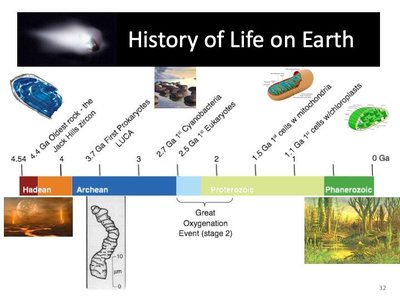
History of Life on Earth
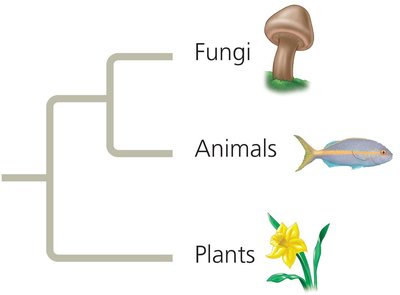
The colonization of land by plants was a pivotal event in Earth's history, transforming terrestrial environments and enabling the development of complex ecosystems. For over 2 billion years, Earth's land surface was lifeless, but within the last 500 million years, plants, fungi, and animals moved onto land, forming the first forests about 385 million years ago.
Cyanobacteria and protists likely existed on land 1.2 billion years ago.
Plants supply oxygen and are the ultimate source of most food eaten by land animals.
Fungi break down organic material and make chemical nutrients available to plants.
Plant Evolution and Major Groups
Plant Kingdom Classification
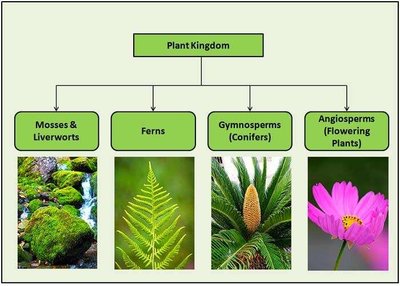
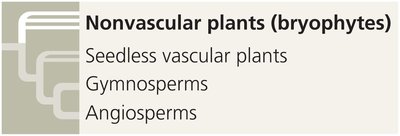
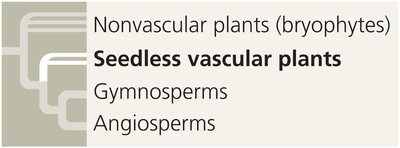
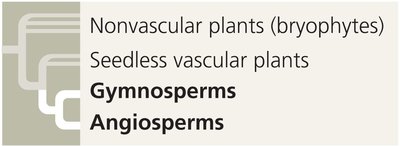
Plants are classified into several major groups based on evolutionary history and structural features. The main groups include mosses and liverworts, ferns, gymnosperms, and angiosperms.
Mosses & Liverworts: Nonvascular plants (bryophytes)
Ferns: Seedless vascular plants
Gymnosperms: Seed plants with "naked" seeds (conifers)
Angiosperms: Flowering plants with seeds enclosed in ovaries
Timeline of Plant Evolution
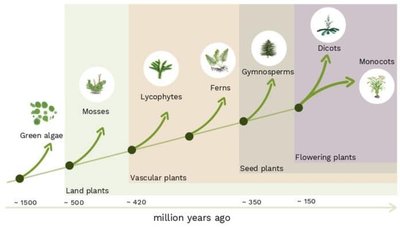
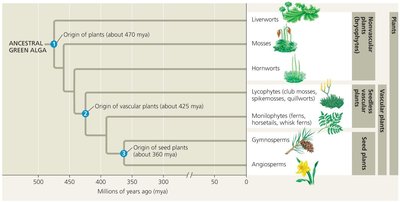
Plant evolution is marked by the emergence of key adaptations and diversification into various lineages.
Green algae are the closest relatives of land plants.
Land plants originated about 470 million years ago.
Vascular plants appeared about 425 million years ago.
Seed plants originated about 360 million years ago.
Flowering plants (angiosperms) diversified about 150 million years ago.
Key Adaptations for Life on Land
Derived Traits of Land Plants
Land plants evolved several key traits that enabled them to survive and thrive in terrestrial environments:
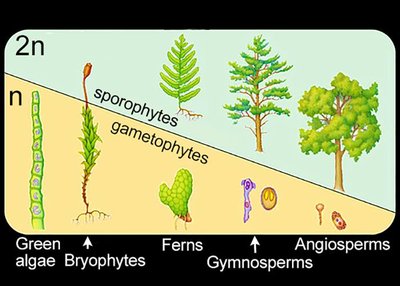
Alternation of generations: Life cycle alternates between haploid gametophyte and diploid sporophyte generations.
Multicellular, dependent embryos: Embryos are retained within female gametophyte tissue and receive nutrients via placental transfer cells.
Walled spores produced in sporangia: Spores are protected by sporopollenin, making them resistant to harsh environments.
Apical meristems: Regions of cell division at the tips of roots and shoots, enabling growth throughout life.
Cuticle: Waxy coating that prevents water loss and microbial attack.
Stomata: Specialized pores for gas exchange.
Bryophytes: Nonvascular Plants
Characteristics and Lineages
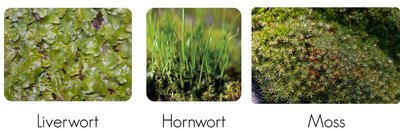
Bryophytes are small, nonwoody plants that lack vascular tissue. They include three main clades: liverworts, mosses, and hornworts.
Rhizoids: Root-like structures for anchorage, not water/mineral transport.
Gametophyte dominance: Gametophytes are larger and longer-living than sporophytes.
Moist habitats: Flagellated sperm require water for fertilization.
Seedless Vascular Plants
Evolution and Structure
Seedless vascular plants, such as ferns and lycophytes, were the first plants to grow tall due to the presence of vascular tissue.
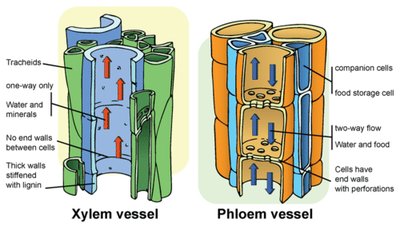
Xylem: Conducts water and minerals; contains tracheids strengthened by lignin.
Phloem: Distributes sugars, amino acids, and organic products.
Lignified tissue: Provides structural support for tall growth.
Roots and Leaves
Roots anchor plants and absorb water/nutrients, while leaves are the primary photosynthetic organs.
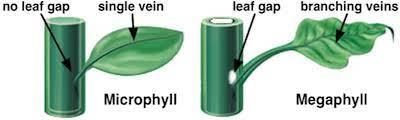
Microphylls: Small leaves with a single vein.
Megaphylls: Larger leaves with highly branched vascular systems.
Seed Plants: Gymnosperms and Angiosperms
Seeds and Pollen
Seed plants evolved adaptations that allowed them to colonize diverse terrestrial habitats.
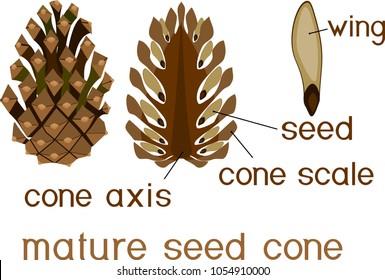
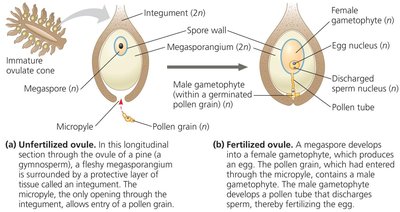
Seed: Embryo and food supply surrounded by a protective coat; can remain dormant and is dispersed by wind or animals.
Pollen: Male gametophyte surrounded by a protective wall; enables fertilization without water.
Ovule: Egg-producing female gametophyte surrounded by integument.
Gymnosperms
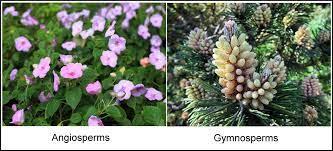
Gymnosperms have "naked" seeds not enclosed in chambers. They dominated land during the Mesozoic era and are still important in northern forests.
Conifers: Cone-bearing gymnosperms.
Adaptations: Thick cuticles, needle-like leaves, reduced water loss.
Angiosperms
Angiosperms are flowering plants with seeds enclosed in ovaries. They are the most diverse and widespread group of plants.
Flowers: Specialized for sexual reproduction; contain sepals, petals, stamens, and carpels.
Fruits: Develop from ovary wall; aid in seed dispersal.
Pollination: By insects, animals, or wind.
Summary Table: Major Plant Groups
Group | Vascular Tissue | Seeds | Flowers | Examples |
|---|---|---|---|---|
Bryophytes | No | No | No | Mosses, Liverworts, Hornworts |
Seedless Vascular Plants | Yes | No | No | Ferns, Lycophytes |
Gymnosperms | Yes | Yes | No | Conifers, Cycads |
Angiosperms | Yes | Yes | Yes | Flowering plants |
Key Terms and Concepts
Alternation of generations: Alternating haploid and diploid stages in plant life cycles.
Gametophyte: Haploid stage producing gametes.
Sporophyte: Diploid stage producing spores.
Vascular tissue: Xylem and phloem for transport and support.
Seed: Embryo, food supply, protective coat.
Pollen: Male gametophyte for fertilization without water.
Flower: Reproductive structure of angiosperms.
Fruit: Mature ovary aiding seed dispersal.
Important Equations
Plant life cycle alternation of generations:
Water and nutrient transport in xylem and phloem:
Example: Ferns are seedless vascular plants that reproduce via spores and have large, branched leaves (megaphylls).
Example: Conifers are gymnosperms with needle-like leaves and cones for seed production.
Example: Flowering plants (angiosperms) produce flowers and fruits, enabling efficient pollination and seed dispersal.
Additional info: The notes include inferred context to clarify evolutionary relationships and adaptations based on standard biology curriculum.
