 Back
The Evolution of Evolutionary Theory: From Pre-Darwinian Thought to Modern Evidence
Study Guide - Smart Notes
 Tailored notes based on your materials, expanded with key definitions, examples, and context.
The Evolution of the Theory of Evolution
Overview of Pre-Darwinian Thought
The development of evolutionary theory was shaped by a series of philosophical and scientific ideas prior to Darwin. Early concepts focused on the fixity of species and typological thinking, which were later challenged by evidence from geology, paleontology, and comparative biology.
Typological Thinking (Plato): Plato proposed that every organism has a perfect, unchanging 'type,' and variations are mistakes. Species were considered immutable.
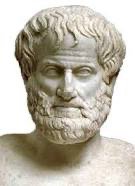
Aristotle’s Scala Naturae (Great Chain of Being): Aristotle organized living things in a hierarchical ladder of complexity, with humans at the top and inanimate matter at the bottom. Species were fixed and could only move up the ladder in complexity.
Lamarck’s Theory of Evolution
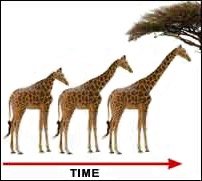
Jean-Baptiste Lamarck was the first to propose a formal theory of evolution, suggesting that organisms change over time through the inheritance of acquired characteristics.
Spontaneous Generation: Simple organisms arise at the bottom of the chain and become more complex over time.
Inheritance of Acquired Traits: Traits acquired during an organism’s lifetime (e.g., a giraffe stretching its neck) are passed to offspring.
Use and Disuse: Organs used frequently become enhanced, while those not used deteriorate.
Additional info: Lamarck’s ideas were later tested and refuted by experiments such as Weismann’s mouse tail experiment, which showed that acquired traits are not inherited.
Influences on Darwin
Key Figures and Their Contributions
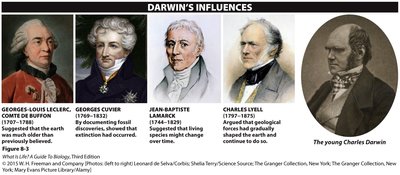
Several scientists and thinkers influenced Darwin’s formulation of natural selection by providing evidence and concepts from geology, paleontology, and population studies.
Georges-Louis Leclerc, Comte de Buffon: Founder of biogeography; proposed that similar environments have different organisms and that all quadrupeds descended from a few original forms.
Georges Cuvier: Demonstrated extinction through fossil evidence; believed in catastrophism, not evolution.
Charles Lyell: Advocated uniformitarianism—the idea that geological processes occur gradually over time, shaping Earth’s features and providing a vast timescale for evolution.
William Smith: Developed the Principle of Faunal Succession, observing that fossil assemblages succeed one another in a predictable order.
Thomas Malthus: Proposed that populations grow faster than resources, leading to competition and survival of the fittest.
Darwin’s Journey and Observations
The Voyage of the HMS Beagle
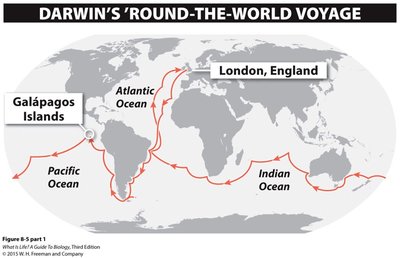
In 1831, Darwin embarked on a five-year voyage aboard the HMS Beagle, collecting specimens and making observations that would form the basis of his theory of evolution by natural selection.
Galápagos Islands: Darwin observed that species on different islands were similar but distinct, suggesting adaptation to local environments.
Fossil Evidence: Fossils of extinct animals resembled living species in the same region, indicating possible descent with modification.
Evidence for Evolution
Transitional Fossils
Transitional fossils provide evidence for evolutionary change by showing intermediate forms between ancestral and derived species.
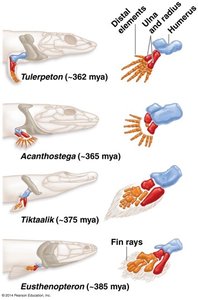
Tetrapod Limb Evolution: Fossils show gradual changes from finned aquatic animals to limbed terrestrial vertebrates.
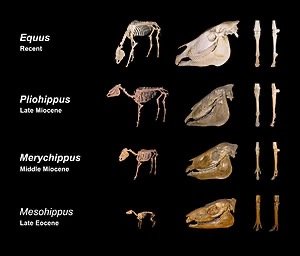
Horse Evolution: Fossil records document the transition from small, multi-toed ancestors to modern single-toed horses.
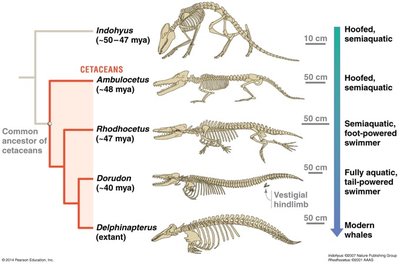
Whale Evolution: Fossils reveal the transition from land-dwelling ancestors to fully aquatic whales.
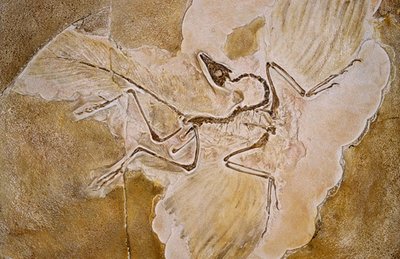
Archaeopteryx: A transitional fossil linking dinosaurs and birds.
Vestigial Traits
Vestigial traits are structures that have lost their original function but are retained from ancestors, providing evidence for evolution.
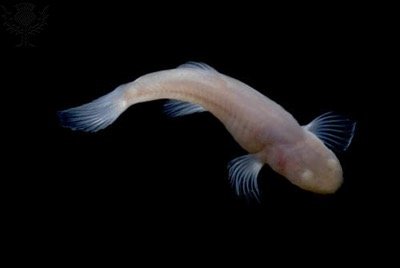
Examples: Human coccyx (tailbone), ostrich wings, pelvic bones in whales and snakes, and reduced eyes in cave fish.
Current Evidence for Evolutionary Change
Evolution is an ongoing process, observable in real time through:
Bacterial resistance to antibiotics
Insect resistance to pesticides
Weed resistance to herbicides
Changes in flowering time due to climate change
Descent from a Common Ancestor
Homologous Traits
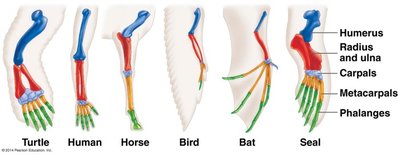
Homology refers to similarities among organisms due to shared ancestry. Homologies can be genetic, developmental, or structural.
Genetic Homology: Similar DNA sequences among related species.
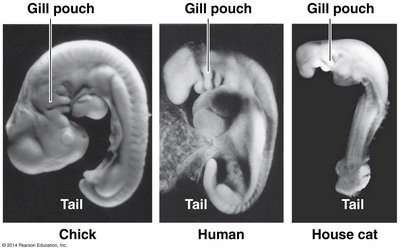
Developmental Homology: Similar embryonic development patterns (e.g., gill pouches in vertebrate embryos).
Structural Homology: Similar anatomical structures (e.g., forelimbs of vertebrates) adapted for different functions.
Testing Homologies
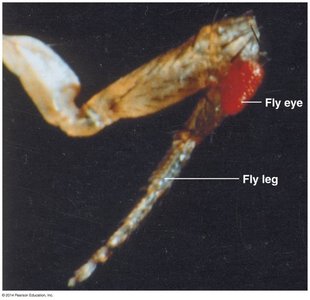
Experimental evidence supports homology, such as inserting a mouse gene homologous to a fruit fly eye gene into fly embryos, resulting in eye formation in new locations.
The Evolution Revolution
Paradigm Shift in Biology
Darwin’s theory of evolution by natural selection replaced the idea of unchanging species and typological thinking with population-level thinking and a testable scientific mechanism for biological diversity.
Descent with Modification: Populations change over time, and species are related by common ancestry.
Scientific Theory: Evolution by natural selection is supported by observation and experimentation.
