 Back
BackThe Evolution of Populations: Mechanisms and Evidence
Study Guide - Smart Notes
 Tailored notes based on your materials, expanded with key definitions, examples, and context.
The Evolution of Populations
Introduction to Population Evolution
Evolution at its most fundamental level occurs within populations, not individuals. While natural selection acts on individuals by influencing their survival and reproductive success, evolutionary change is observed as shifts in the genetic makeup of populations over generations. This process is known as microevolution, defined as a change in allele frequencies within a population across generations.
Population: A group of individuals of the same species living in the same area, interbreeding and sharing a common gene pool.
Microevolution: Small-scale evolutionary changes, typically described as changes in allele frequencies within a population.
Key mechanisms: Natural selection, genetic drift, and gene flow.
Example: The medium ground finch (Geospiza fortis) population on Daphne Major in the Galápagos Islands experienced a dramatic shift in beak size after a drought, illustrating evolution by natural selection.
Key Concepts in Population Evolution
Genetic variation is essential for evolution to occur.
The Hardy-Weinberg equation can be used to test whether a population is evolving.
Natural selection, genetic drift, and gene flow are the main mechanisms that alter allele frequencies.
Only natural selection consistently leads to adaptive evolution.
Case Study: Natural Selection in Galápagos Finches
During a severe drought, the population of medium ground finches was reduced. Birds with larger, deeper beaks were more likely to survive because they could eat the available large, hard seeds. Since beak depth is an inherited trait, the next generation had a higher average beak depth, demonstrating evolution by natural selection.
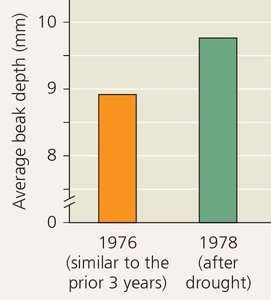
Key Point: Individual finches did not evolve larger beaks; rather, the proportion of large-beaked individuals increased in the population.
Mechanism: Selection favored alleles for larger beaks, increasing their frequency in the gene pool.
Mechanisms of Microevolution
Natural Selection: Differential survival and reproduction lead to changes in allele frequencies that improve adaptation to the environment.
Genetic Drift: Random changes in allele frequencies, especially significant in small populations.
Gene Flow: Movement of alleles between populations through migration, which can introduce new genetic variation.
Only natural selection consistently increases the degree of adaptation of organisms to their environment.
Types of Selection
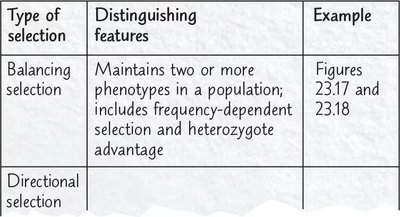
Different forms of selection can shape genetic variation in populations. These include balancing selection, directional selection, disruptive selection, stabilizing selection, sexual selection, and frequency-dependent selection. Some evolutionary changes may involve more than one type of selection.
Type of selection | Distinguishing features | Example |
|---|---|---|
Balancing selection | Maintains two or more phenotypes in a population; includes frequency-dependent selection and heterozygote advantage | Figures 23.17 and 23.18 |
Directional selection | Favors individuals at one end of the phenotypic range | Finch beak size after drought (see bar graph above) |
Genetic Variation: The Raw Material for Evolution
Genetic variation arises from mutations, gene duplication, and sexual reproduction. It is a prerequisite for evolution because it provides the diversity on which selection and other mechanisms can act.
Mutation: Changes in DNA sequence that can introduce new alleles.
Sexual reproduction: Shuffles alleles through recombination, independent assortment, and fertilization.
The Hardy-Weinberg Principle
The Hardy-Weinberg equation provides a mathematical model to study genetic variation in populations. It predicts genotype frequencies under the assumption that the population is not evolving.
Equation:
where and are the frequencies of two alleles at a locus.
Hardy-Weinberg equilibrium: The state in which allele and genotype frequencies remain constant from generation to generation in the absence of evolutionary influences.
Study Skills and Prerequisites
Distinguish between phenotype (observable traits) and genotype (genetic makeup).
Use a Punnett square to predict outcomes of genetic crosses.
Understand the effects of nucleotide-pair substitutions, insertions, and deletions on gene function (frameshift mutations).
Learning Objectives
Describe how genetic variation arises and why it is essential for evolution.
Use allele-frequency data to predict genotype frequencies using the Hardy-Weinberg equation.
Differentiate between the effects of natural selection, genetic drift, and gene flow on allele frequencies.
Explain how natural selection leads to adaptation.
Additional Resources
Interview with evolutionary biologists who studied Galápagos finches (contextual enrichment).

Additional info: Other types of selection (disruptive, stabilizing, sexual, frequency-dependent) and more detailed examples would be included in a full chapter. The table above is partially reconstructed based on the provided material.
