 Back
BackThe Evolution of Vertebrate Diversity
Study Guide - Smart Notes
 Tailored notes based on your materials, expanded with key definitions, examples, and context.
The Evolution of Vertebrate Diversity
Introduction to Vertebrate Evolution
Vertebrates have a rich evolutionary history spanning over 500 million years, resulting in more than 60,000 extant species. Scientists reconstruct vertebrate evolution using fossil records, genetic data, morphology, and developmental homologies. This chapter explores the major clades of vertebrates, their defining characteristics, and the evolutionary transitions that shaped their diversity.
Vertebrate Evolution and Diversity
Shared Derived Characters of Chordates
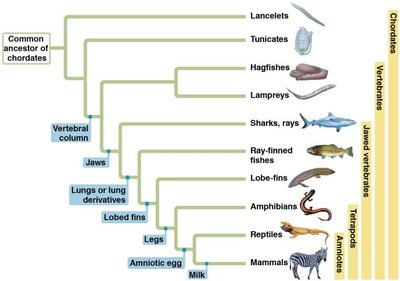
Chordates are defined by a set of shared derived characters, which help biologists classify major groups within the phylum. These characters include the notochord, dorsal hollow nerve cord, pharyngeal slits, and post-anal tail. The evolutionary relationships among chordates are depicted in a phylogenetic tree, highlighting the emergence of key adaptations.
Chordates include lancelets, tunicates, and vertebrates.
Vertebrates possess a vertebral column.
Jawed vertebrates evolved jaws from skeletal supports of pharyngeal slits.
Tetrapods are vertebrates with limbs and digits.
Amniotes possess an amniotic egg, allowing reproduction on land.
Mammals are characterized by hair and milk production.
Hagfishes and Lampreys: Jawless Vertebrates
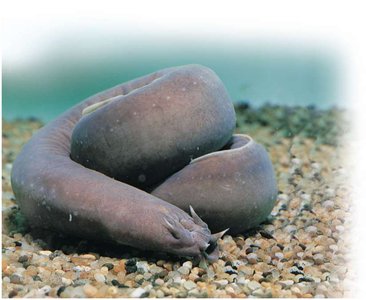
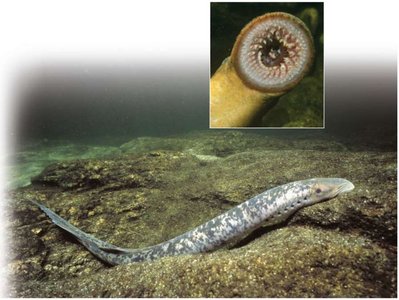
Hagfishes and lampreys represent the most primitive living vertebrates. They lack hinged jaws and paired fins, and their skeletons are composed of cartilage rather than bone.
Hagfishes are deep-sea scavengers that produce slime as a defense mechanism.
Lampreys are parasites as adults, using their rasping tongues to penetrate the sides of fish.
Both groups retain a notochord and have rudimentary vertebrae.
Jawed Vertebrates: Sharks, Ray-Finned Fishes, and Lobe-Finned Fishes
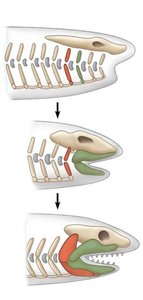
Jawed vertebrates first appeared about 440 million years ago, marking a significant evolutionary advancement. Jaws likely evolved from modifications of skeletal supports of the anterior pharyngeal slits, while the remaining slits became specialized for gas exchange.
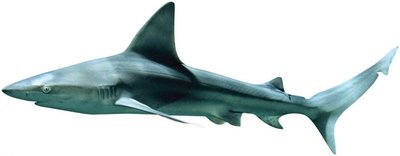
Chondrichthyans (sharks and rays) have a flexible skeleton made of cartilage.
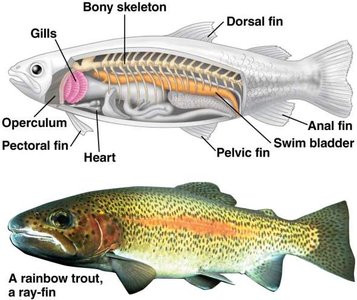
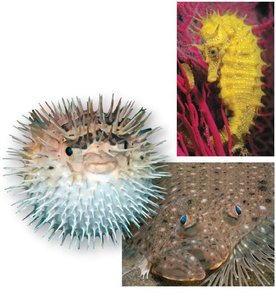
Ray-finned fishes (e.g., trout, tuna) possess a bony skeleton and are the most diverse group of vertebrates.
Lobe-finned fishes (e.g., coelacanths, lungfishes) have rod-shaped bones in their muscular fins, a key adaptation for the evolution of tetrapods.
Evolution of Tetrapods
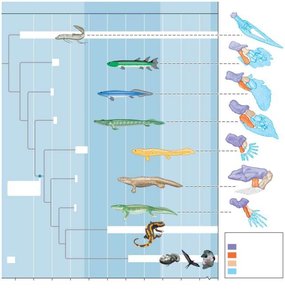
The transition from aquatic to terrestrial life was a pivotal event in vertebrate history. During the late Devonian period, lobe-finned fishes gave rise to tetrapods—vertebrates with limbs and feet adapted for supporting weight on land. Fossil discoveries have filled gaps in our understanding of this transition.
Tetrapods include amphibians, reptiles, and mammals.
Key adaptations include limbs with digits and changes in limb structure for terrestrial locomotion.
Amphibians: The First Tetrapods on Land
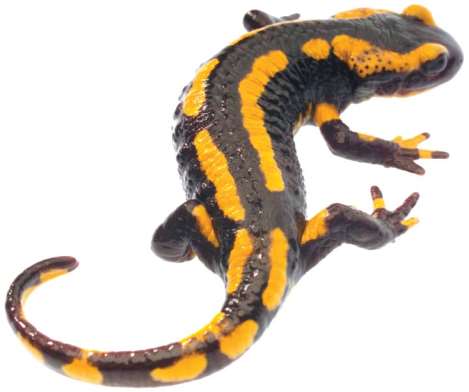
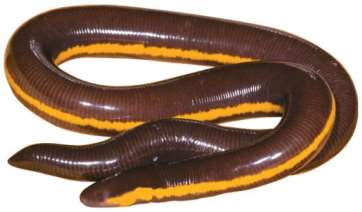
Amphibians were the first vertebrates to colonize land. They include salamanders, frogs, and caecilians. Amphibians typically have a dual life cycle, with aquatic larvae and terrestrial adults, and rely on moist skin for gas exchange.
Eggs are usually laid in water, and larvae undergo metamorphosis to become adults.
Amphibians are not fully adapted to terrestrial life due to their dependence on water for reproduction and skin respiration.
Reptiles: Amniotes with Terrestrially Adapted Eggs
Reptiles, including birds and mammals, are amniotes—tetrapods with an amniotic egg that allows reproduction away from water. The amniotic egg contains specialized membranes for protection, nutrition, and waste management.
Reptiles have scaly, keratinized skin and rely on lungs for respiration.
Most are ectothermic, absorbing external heat to regulate body temperature.
Membrane | Function |
|---|---|
Fluid-filled sac surrounding embryo | |
Amnion | |
Yolk sac | |
Chorion | |
Allantois | Provides nutrients |
Gas exchange | |
Waste disposal and gas exchange |
Birds: Feathered Reptiles Adapted for Flight
Birds are endothermic reptiles with numerous adaptations for flight, including feathers, lightweight bones, and efficient respiratory and circulatory systems. Birds evolved from small, bipedal dinosaurs called theropods.
Feathers may have initially evolved for insulation or courtship displays.
Birds display complex behaviors, especially during breeding.
Mammals: Amniotes with Hair and Milk
Mammals are endothermic amniotes characterized by hair and mammary glands. They have efficient respiratory and circulatory systems and differentiated teeth for various diets.
Monotremes are egg-laying mammals.
Marsupials give birth to underdeveloped young that complete development in a pouch.
Eutherians (placental mammals) give birth to fully developed young.
Primate Diversity and Hominin Evolution
Primate Adaptations
Primates evolved as small, arboreal mammals with adaptations for life in trees. These include limber joints, grasping hands and feet, a short snout, and forward-facing eyes for depth perception.
Primates are divided into three groups: lemurs/lorises/bush babies, tarsiers, and anthropoids (monkeys and apes).
Monkeys are further divided into New World (arboreal, prehensile tails) and Old World (some ground-dwelling, non-prehensile tails) groups.
Apes (including humans) have larger brains and more flexible behavior than other primates.
Hominin Evolution
The hominin branch includes species more closely related to humans than to chimpanzees. Paleoanthropology has revealed about 20 extinct hominin species, some of which coexisted. Key features distinguishing humans from other hominins are bipedalism and large brain size.
Bipedalism evolved before large brains.
The genus Homo is marked by increased brain size and tool use.
Homo erectus was the first to migrate out of Africa.
Neanderthals (Homo neanderthalensis) had larger brains than modern humans and used sophisticated tools.
All modern humans (Homo sapiens) trace their ancestry to Africa.
Recent Discoveries and Human Adaptations
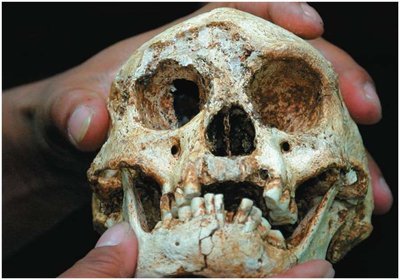
New fossil discoveries, such as Homo floresiensis, have raised questions about hominin diversity and evolutionary relationships. Human skin color variation is an adaptation to differing UV radiation levels, balancing the need to protect folate and synthesize vitamin D.
Darker skin protects against folate degradation near the equator.
Lighter skin enhances vitamin D synthesis in northern latitudes.
Ongoing Discovery of Animal Diversity
Thousands of new animal species are discovered each year, aided by improved access to remote areas and advanced mapping technologies. The total number of animal species remains an estimate due to the vast unexplored diversity.
