 Back
Chapter 5: The Four Major Classes of Biomolecules in Living Organisms
Study Guide - Smart Notes
 Tailored notes based on your materials, expanded with key definitions, examples, and context.
Biomolecules: The Molecules of Life
Overview of Biomolecules
Living organisms are composed of four main classes of large biological molecules, each with unique structures and functions. These macromolecules are essential for life and include carbohydrates, lipids, proteins, and nucleic acids. Understanding their structure and function is fundamental to biology.
Carbohydrates: Energy storage and structural support
Lipids: Energy storage, membrane structure, and signaling
Proteins: Catalysis, structure, transport, and regulation
Nucleic Acids: Information storage and transfer
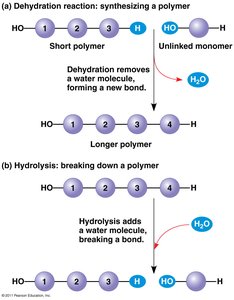
Additional info: Most biomolecules are polymers, built from repeating monomer units via dehydration reactions and broken down by hydrolysis.
Carbohydrates
Monosaccharides and Disaccharides
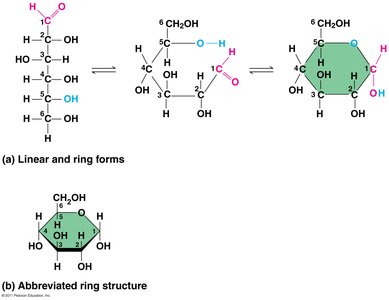
Carbohydrates are sugars and their polymers. Monosaccharides (simple sugars) are the basic units, such as glucose. Disaccharides are formed by joining two monosaccharides (e.g., lactose, sucrose, maltose).
Monosaccharides: Glucose (C6H12O6) is a primary energy source.
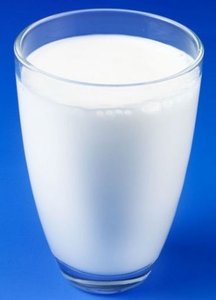
Disaccharides: Formed by dehydration synthesis (e.g., lactose in milk).
Polysaccharides: Energy Storage and Structure
Polysaccharides are long chains of monosaccharides. They serve as energy storage (starch, glycogen) or structural components (cellulose, chitin).
Starch: Energy storage in plants (amylose and amylopectin).
Glycogen: Energy storage in animals.
Cellulose: Structural component of plant cell walls; source of insoluble fiber in the human diet.
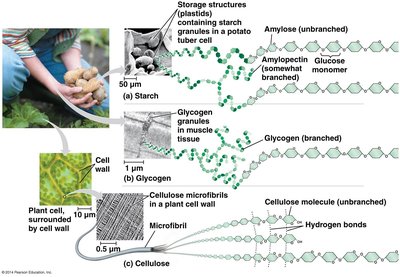
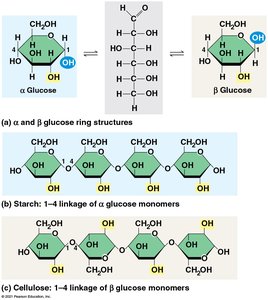
Additional info: The difference between starch and cellulose is the type of glucose linkage: alpha (starch) vs. beta (cellulose).
Lipids
Types and Properties of Lipids
Lipids are hydrophobic molecules, including fats, phospholipids, and steroids. They are not true polymers but are crucial for energy storage, membrane structure, and signaling.
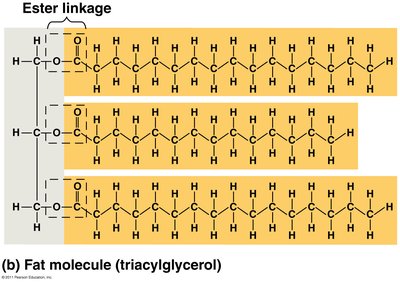
Fats (Triacylglycerols): Composed of glycerol and three fatty acids; used for long-term energy storage.
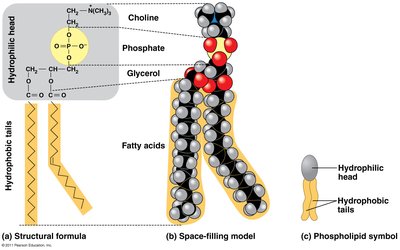
Phospholipids: Major component of cell membranes; amphipathic (hydrophilic head, hydrophobic tails).
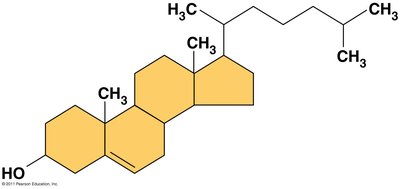
Steroids: Four fused rings; include cholesterol and hormones.
Saturated vs. Unsaturated Fats
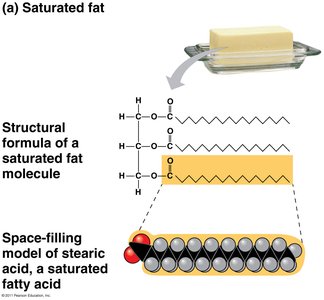
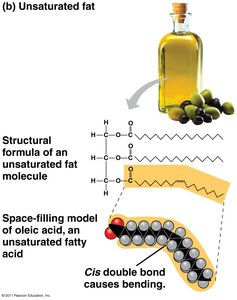
The properties of fats depend on the saturation of their fatty acid chains.
Saturated fats: No double bonds; solid at room temperature (e.g., butter).
Unsaturated fats: One or more double bonds; liquid at room temperature (e.g., olive oil). Cis double bonds cause bending.
Trans fats: Unsaturated fats with trans double bonds; associated with health risks.
Phospholipids and Steroids
Phospholipids are essential for cell membrane structure due to their amphipathic nature, forming bilayers. Steroids like cholesterol stabilize membranes and serve as hormones.
Proteins
Amino Acids and Peptide Bonds
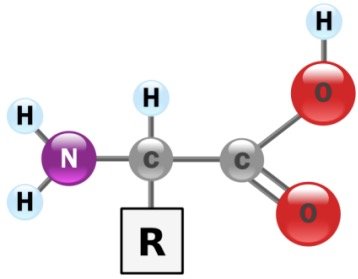
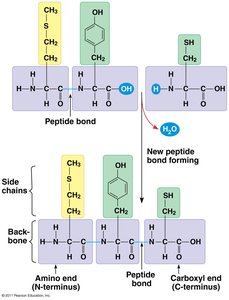
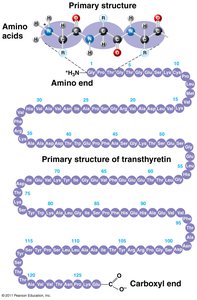
Proteins are polymers of amino acids, joined by peptide bonds. Each amino acid has a central carbon, amino group, carboxyl group, hydrogen, and a variable side chain (R group).
20 different amino acids are found in proteins, classified by side chain properties (nonpolar, polar, acidic, basic).
Peptide bonds are formed by dehydration reactions.
Protein Structure and Function
Proteins have diverse functions, including catalysis (enzymes), defense (antibodies), storage, transport, signaling (hormones), receptors, movement (motor proteins), and structure (collagen).
Primary structure: Sequence of amino acids
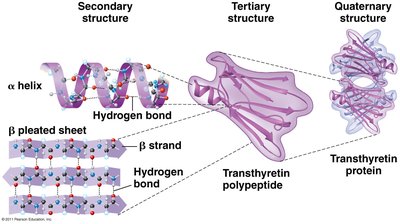
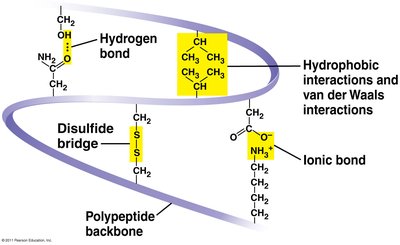
Secondary structure: Alpha helices and beta sheets, stabilized by hydrogen bonds
Tertiary structure: 3D folding due to side chain interactions
Quaternary structure: Association of multiple polypeptides
Protein Folding and Denaturation
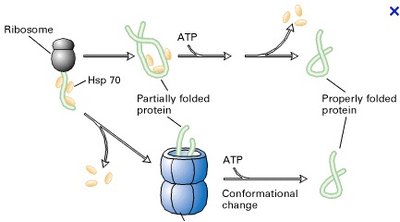
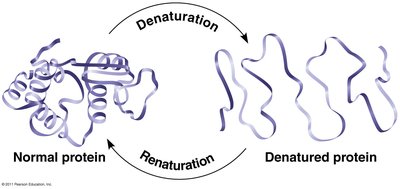
Protein conformation is influenced by the amino acid sequence and environmental factors (chemicals, heat). Chaperonins assist in proper folding. Denaturation disrupts structure and function, but some proteins can renature.
Protein Structure and Disease
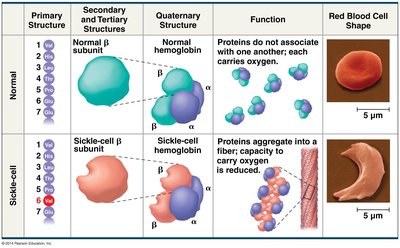
Changes in amino acid sequence can alter protein structure and function, as seen in sickle cell disease, where a single amino acid substitution in hemoglobin leads to abnormal red blood cell shape and impaired oxygen transport.
Nucleic Acids
Structure and Function
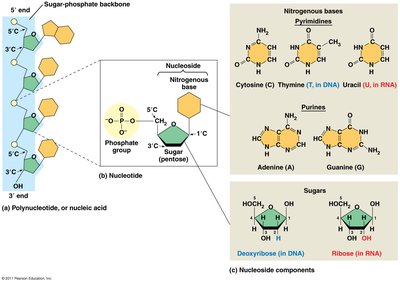
Nucleic acids (DNA and RNA) store and transmit genetic information. They are polymers of nucleotides, each consisting of a phosphate group, a five-carbon sugar (deoxyribose or ribose), and a nitrogenous base.
DNA: Stores genetic information; double helix structure
RNA: Involved in gene expression and protein synthesis
Base Pairing and Hydrogen Bonding
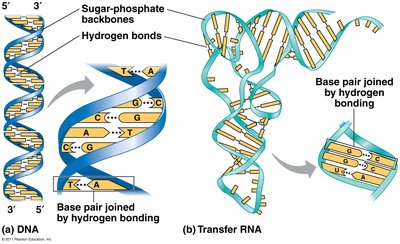
Nucleic acids are stabilized by hydrogen bonds between complementary bases: adenine (A) pairs with thymine (T, in DNA) or uracil (U, in RNA), and cytosine (C) pairs with guanine (G).
Additional info: The sequence of bases encodes genetic information, which is transcribed and translated to produce proteins.
