 Back
The Four Major Macromolecules of Life: Structure and Function
Study Guide - Smart Notes
 Tailored notes based on your materials, expanded with key definitions, examples, and context.
Biological Macromolecules: An Overview
Biological macromolecules are large, complex molecules essential for life. They include carbohydrates, lipids, proteins, and nucleic acids. Each class has unique structures and functions, but all are fundamental to cellular processes, structure, and heredity.
Polymers and Monomers: The Repeating Units of Life
Definition and Assembly
Polymers: Large molecules made of repeating subunits (monomers) linked by covalent bonds. Carbohydrates, proteins, and nucleic acids are polymers.
Monomers: The individual subunits that make up polymers.
Lipids: Do not form true polymers but are large and essential macromolecules.
Enzymes: Protein macromolecules that catalyze (speed up) chemical reactions, including the synthesis and breakdown of polymers.
Building and Breaking Down Polymers: Dehydration and Hydrolysis
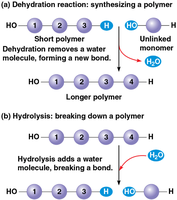
Dehydration Reaction: Enzyme-catalyzed process that joins monomers by removing a water molecule. Energy input is required.
Hydrolysis: Enzyme-catalyzed process that breaks polymers into monomers by adding a water molecule. Energy is released.
Carbohydrates: Fuel and Building Materials
Structure and Classification
Function: Serve as energy sources and structural materials.
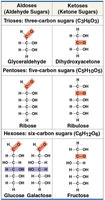
Monosaccharides: Simple sugars (e.g., glucose) with the general formula (CH2O)n. Classified by carbonyl group position (aldose or ketose) and carbon number (triose, pentose, hexose).
Disaccharides: Two monosaccharides joined by a dehydration reaction (e.g., maltose, sucrose).
Polysaccharides: Polymers of monosaccharides with storage (starch, glycogen) or structural (cellulose, chitin) roles.
Storage and Structural Polysaccharides
Starch: Plant storage polysaccharide, composed of glucose monomers with alpha-1,4 glycosidic bonds.
Glycogen: Animal storage polysaccharide, highly branched, stored in liver and muscle cells.
Cellulose: Plant structural polysaccharide, unbranched glucose chains with beta-1,4 glycosidic bonds, forms microfibrils.
Chitin: Structural polysaccharide in arthropod exoskeletons and fungal cell walls, similar to cellulose but with nitrogen groups.
Lipids: Diverse Hydrophobic Molecules
Structure and Types
Key Feature: Hydrophobic, do not form true polymers, cluster in water due to hydrophobic interactions.
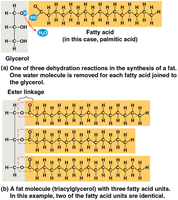
Fats (Triglycerides): Composed of glycerol and three fatty acids joined by ester linkages. Main function is energy storage.
Saturated Fatty Acids: No double bonds, straight chains, solid at room temperature.
Unsaturated Fatty Acids: One or more double bonds (cis or trans), kinked chains, liquid at room temperature (cis), or solid (trans).
Phospholipids: Glycerol, two fatty acids, and a phosphate group. Amphipathic (hydrophilic head, hydrophobic tails). Form cell membranes (bilayers).
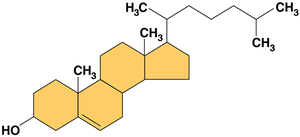
Steroids: Four fused carbon rings. Cholesterol is a key steroid in animal membranes and a precursor for hormones.
Proteins: Diverse Structures for Diverse Functions
Structure and Function
Functions: Enzymatic, defensive, storage, transport, hormonal, receptor, contractile/motor, and structural roles.
Monomers: Amino acids (20 types), each with a central carbon, amino group, carboxyl group, and unique R group.
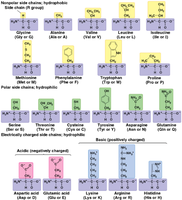
Peptide Bonds: Link amino acids via dehydration reactions, forming polypeptides.
Protein Structure Levels:
Primary: Linear amino acid sequence (coded by DNA).
Secondary: Coils and folds (alpha-helix, beta-sheet) via hydrogen bonds.
Tertiary: 3D shape from R group interactions (hydrogen bonds, ionic bonds, hydrophobic interactions, disulfide bridges).
Quaternary: Multiple polypeptides forming a functional protein (e.g., hemoglobin).
Denaturation: Loss of protein structure and function due to environmental changes (pH, temperature, etc.).
Structure Determination: X-ray crystallography, NMR spectroscopy, and bioinformatics.
Nucleic Acids: Hereditary Information
Structure and Function
Role: Store, transmit, and express genetic information.
Types: DNA (double helix, stores genetic code) and RNA (single-stranded, gene expression).
Monomers: Nucleotides (nitrogenous base, pentose sugar, phosphate group).
Polynucleotide Formation: Nucleotides linked by phosphodiester bonds, forming a sugar-phosphate backbone.
Base Pairing: DNA: A-T, G-C; RNA: A-U, G-C. Enables replication and gene expression.
Studying Macromolecules: Genomics and Proteomics
Modern Approaches
Bioinformatics: Computational analysis of biological data, especially gene and protein sequences.
Genomics: Study of entire genomes and gene interactions.
Proteomics: Study of all proteins (proteome) in a cell, tissue, or organism.
Summary Table: Key Characteristics of the Four Macromolecules
Macromolecule | Monomer | Bond Type | Uses | Large Molecule Examples | Additional Features |
|---|---|---|---|---|---|
Carbohydrates | Monosaccharide | Glycosidic linkage | Energy, structure | Starch, glycogen, cellulose, chitin | Classified by carbonyl position and carbon number |
Lipids | Fatty acids, glycerol (not true monomers) | Ester linkage | Energy storage, membranes, signaling | Triglycerides, phospholipids, steroids | Hydrophobic, not true polymers |
Proteins | Amino acid | Peptide bond | Catalysis, structure, transport, signaling | Enzymes, antibodies, hemoglobin, collagen | Four levels of structure, denaturation possible |
Nucleic Acids | Nucleotide | Phosphodiester bond | Genetic information storage and transfer | DNA, RNA | Base pairing, antiparallel strands (DNA) |
