 Back
BackThe History of Life on Earth: Key Events, Mechanisms, and Evidence
Study Guide - Smart Notes
 Tailored notes based on your materials, expanded with key definitions, examples, and context.
Chapter 25: The History of Life on Earth
Introduction
The history of life on Earth is marked by dramatic changes in the diversity and complexity of organisms. This chapter explores the origin of life, the fossil record, major evolutionary events, and the processes that have shaped the rise and fall of biological diversity over billions of years.
Macroevolution and the Fossil Record
Macroevolutionary Patterns
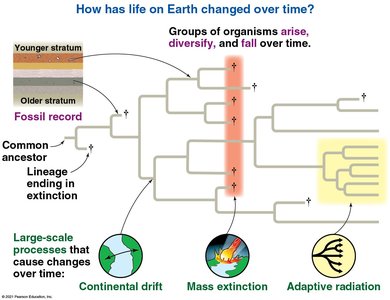
Macroevolution refers to broad evolutionary changes above the species level, such as the emergence of terrestrial vertebrates, mass extinctions, and the origin of key adaptations (e.g., flight).
The fossil record documents these changes, showing how groups of organisms arise, diversify, and sometimes go extinct.
Large-scale processes such as continental drift, mass extinction, and adaptive radiation drive these patterns.
CONCEPT 25.1: Origin of Life on Early Earth
Stages in the Origin of Life
Life may have originated through four main stages:
Abiotic synthesis of small organic molecules
Joining of these molecules into macromolecules
Packaging of molecules into protocells
Origin of self-replicating molecules
Synthesis of Organic Compounds
Earth formed about 4.6 billion years ago; early atmosphere was reducing, with little oxygen and abundant water vapor, methane, ammonia, and other gases.
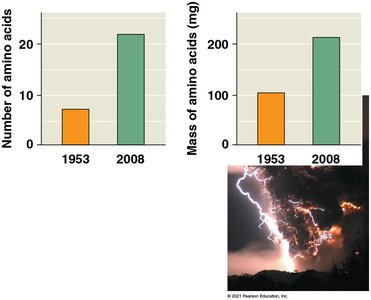
Experiments by Miller and Urey (1953) demonstrated that organic molecules could form abiotically under early Earth conditions.
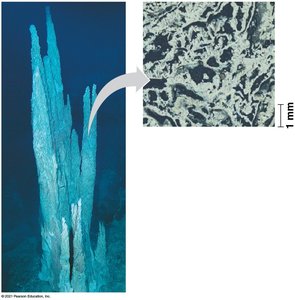
Recent evidence suggests volcanic eruptions and hydrothermal vents may have provided suitable environments for organic synthesis.
Abiotic Synthesis of Macromolecules
RNA monomers and polymers can form spontaneously on hot surfaces such as sand or clay.
These polymers may have acted as weak catalysts, facilitating further chemical reactions.
Protocells
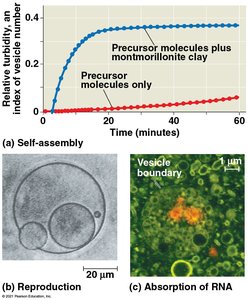
Protocells are membrane-bound droplets that maintain an internal chemistry distinct from their environment.
Lipids and organic molecules can spontaneously form vesicles; the presence of montmorillonite clay increases vesicle formation.
Protocells can grow, reproduce, and maintain homeostasis—key properties of life.
Self-Replicating RNA and the Origin of Heredity
RNA likely served as the first genetic material due to its catalytic properties (ribozymes) and ability to self-replicate.
Natural selection would favor RNA molecules with efficient replication.
Eventually, DNA replaced RNA as the genetic material due to its greater stability and accuracy in replication.
CONCEPT 25.2: The Fossil Record
Types of Fossils and Their Formation
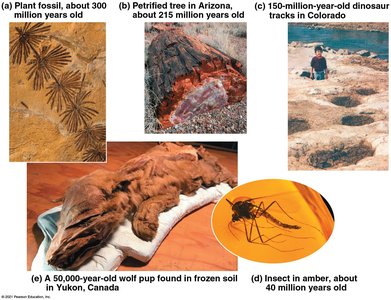
Most fossils are found in sedimentary rock layers (strata).
Other fossil types include mineralized organic matter, trace fossils (e.g., footprints), amber, and preserved remains in ice or bogs.
Limitations and Biases of the Fossil Record
The fossil record is incomplete—few organisms fossilize, many fossils are destroyed, and only a fraction have been discovered.
It is biased toward species that were abundant, widespread, existed for a long time, and had hard parts.
Dating Rocks and Fossils
Relative dating uses the order of fossils in strata to infer sequence but not actual age.
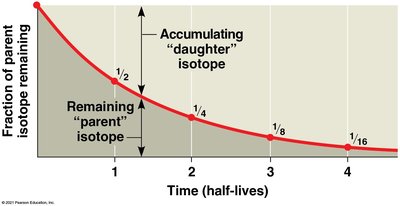
Radiometric dating determines age based on the decay of radioactive isotopes, using the concept of half-life.
$N(t) = N_0 \left(\frac{1}{2}\right)^{t/T_{1/2}}$
The Geologic Record
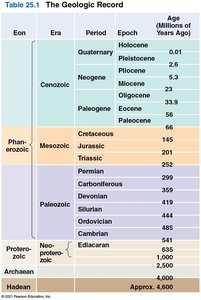
Earth's history is divided into four eons: Hadean, Archaean, Proterozoic, and Phanerozoic.
The Phanerozoic eon is subdivided into Paleozoic, Mesozoic, and Cenozoic eras, each marked by major extinction events.
Eon | Era | Period | Epoch | Age (Millions of Years Ago) |
|---|---|---|---|---|
Phanerozoic | Cenozoic | Quaternary | Holocene | 0.01 |
Phanerozoic | Mesozoic | Cretaceous | 145 | |
Phanerozoic | Paleozoic | Cambrian | 541 | |
Proterozoic | Neoproterozoic | Ediacaran | 635 | |
Archaean | 4,000 | |||
Hadean | Approx. 4,600 |
CONCEPT 25.3: Key Events in Life’s History
Major Events in the History of Life
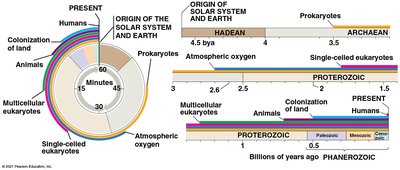
Origin of prokaryotes (3.5 billion years ago)
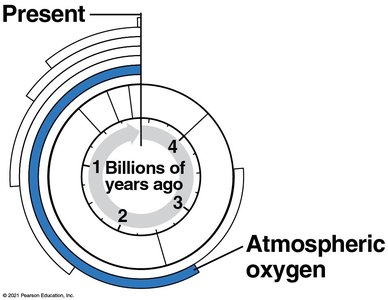
Photosynthesis and the oxygen revolution (2.7–2.4 billion years ago)
Origin of eukaryotes (1.8 billion years ago)
Origin of multicellularity (1.2 billion years ago)
Cambrian explosion (535–525 million years ago)
Colonization of land by plants, fungi, and animals (500 million years ago)
The Oxygen Revolution
Photosynthetic prokaryotes produced oxygen, which reacted with iron to form banded iron formations.
Once iron was saturated, oxygen accumulated in the atmosphere, causing the "oxygen revolution." This event led to the extinction of many anaerobic organisms and the rise of aerobic respiration.
Endosymbiosis and the Origin of Eukaryotes
Eukaryotes likely originated when a prokaryotic cell engulfed another cell, which became the mitochondrion (endosymbiosis).
Serial endosymbiosis suggests mitochondria evolved before plastids (e.g., chloroplasts).
Evidence includes similarities in membrane structure, DNA, and ribosomes between mitochondria/plastids and bacteria.
Multicellularity and the Cambrian Explosion
Multicellularity led to the diversification of algae, plants, fungi, and animals.
The Cambrian explosion saw the rapid appearance of most major animal phyla and complex body plans.
Colonization of Land
Prokaryotes colonized land 3.2 billion years ago; plants, fungi, and animals followed about 500 million years ago.
Adaptations such as waxy coatings and vascular systems in plants, and mutualisms with fungi, enabled terrestrial life.
CONCEPT 25.4: Speciation, Extinction, and Adaptive Radiation
Plate Tectonics and Continental Drift
Earth's crust is divided into plates that move over time, causing continents to drift, collide, or separate.
Continental drift alters habitats, climate, and promotes allopatric speciation.
Mass Extinctions
Five major mass extinctions have occurred, each eliminating over half of marine species and many terrestrial groups.
The Permian extinction (252 mya) and Cretaceous extinction (66 mya) are the most significant, with causes including volcanism and meteorite impacts.
Current extinction rates are much higher than background rates, raising concerns about a potential sixth mass extinction driven by human activity.
Consequences of Mass Extinctions
Recovery of diversity after mass extinctions can take millions of years.
Mass extinctions pave the way for adaptive radiations, where surviving groups diversify to fill ecological niches.
Adaptive Radiations
Adaptive radiation is the rapid evolution of many species from a common ancestor, often following mass extinction or the evolution of novel traits.
Examples include the diversification of mammals after the extinction of dinosaurs and the radiation of plants, insects, and tetrapods on land.
CONCEPT 25.5: Developmental Genes and Evolutionary Change
Developmental Genes and Body Form
Genes that control development (e.g., homeotic and Hox genes) influence the rate, timing, and spatial pattern of organismal growth.
Heterochrony refers to evolutionary changes in the timing or rate of developmental events, which can lead to significant morphological differences.
Paedomorphosis is the retention of juvenile features in the adult form due to changes in developmental timing.
Changes in Gene Sequence and Regulation
Duplication and mutation of developmental genes can produce new body forms.
Changes in gene regulation, rather than gene sequence, often underlie morphological evolution (e.g., stickleback fish spine development).
CONCEPT 25.6: Evolutionary Trends and Novelties
Evolutionary Novelties and Exaptations
Complex structures often evolve incrementally from simpler forms (e.g., the evolution of the eye).
Exaptations are structures that evolve for one function but are co-opted for another (e.g., feathers for insulation, later used for flight).
Evolutionary Trends
The fossil record can reveal trends, but these may be misleading if not all species are considered.
Species selection is analogous to natural selection at the species level—species that persist and diversify shape evolutionary trends.
Evolution is not goal-oriented; trends result from interactions with the environment and may change if conditions change.
