 Back
The History of Life on Earth: Major Events, Evidence, and Evolutionary Patterns Chapter 25
Study Guide - Smart Notes
 Tailored notes based on your materials, expanded with key definitions, examples, and context.
Chapter 25: The History of Life on Earth
Introduction
This chapter explores the major events in the history of life on Earth, the evidence provided by the fossil record, and the evolutionary processes that have shaped biodiversity over billions of years. It covers the origin of life, mass extinctions, adaptive radiations, and the genetic mechanisms underlying evolutionary change.
How Has Life on Earth Changed Over Time?
Macroevolution and the Fossil Record
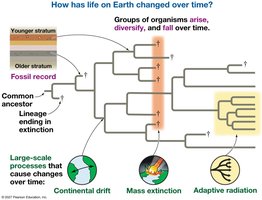
Macroevolution refers to large-scale evolutionary changes above the species level, occurring over long geological periods.
The fossil record provides evidence for the origin of major groups, mass extinctions, and the evolution of key adaptations (e.g., flight).
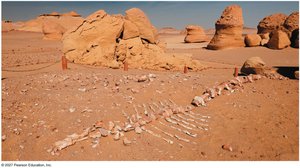
Fossils, such as those found in the Sahara Desert, document evolutionary transitions (e.g., whales from land to sea).
Concept 25.1: Conditions on Early Earth Made the Origin of Life Possible
Stages in the Origin of Life
Abiotic synthesis of small organic molecules
Formation of macromolecules from smaller molecules
Packaging of molecules into membrane-bound protocells
Origin of self-replicating molecules (likely RNA)
Early Earth was hot, with little free oxygen and an atmosphere rich in CO2, N2, water vapor, methane, and ammonia.
Experiments (e.g., Miller-Urey) demonstrated that organic molecules can form abiotically under early Earth conditions.
RNA is a plausible candidate for the first genetic material because it can both store information and catalyze reactions (ribozymes).
Concept 25.2: The Fossil Record Documents the History of Life
The Fossil Record
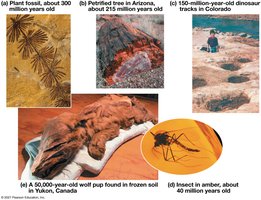
Fossils are preserved remains, impressions, or traces of past organisms, mostly found in sedimentary rock strata.
The fossil record is incomplete due to the rarity of fossilization and geological destruction.
Organisms with hard parts, wide distribution, and large populations are more likely to be fossilized.
Dating Fossils
Relative dating uses the position of fossils in rock layers to determine their relative ages (older vs. younger).
Radiometric dating estimates absolute ages using the predictable decay of radioactive isotopes.
Half-life is the time required for half of a radioactive parent isotope to decay into its daughter isotope.
(where n is the number of half-lives elapsed) 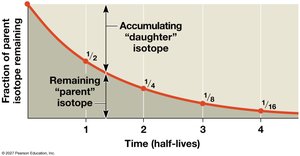
The Geologic Record
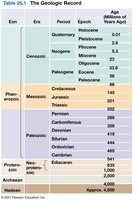
Earth's history is divided into eons, eras, periods, and epochs based on rock and fossil evidence.
Eon | Era | Period | Epoch | Age (Millions of Years Ago) |
|---|---|---|---|---|
Phanerozoic | Cenozoic | Quaternary | Holocene | 0.01 |
Phanerozoic | Mesozoic | Cretaceous | 145 | |
Phanerozoic | Paleozoic | Permian | 299 | |
Proterozoic | Neoproterozoic | Ediacaran | 541 | |
Archean | ~4,000 |
Transitional Fossils and Evolutionary Patterns
Transitional fossils show intermediate forms between ancestral and descendant groups (e.g., evolution of mammalian jaws and middle ear bones).
Concept 25.3: Key Events in Life’s History
Major Transitions in the History of Life
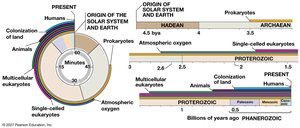
The Phanerozoic eon includes the Paleozoic, Mesozoic, and Cenozoic eras, separated by mass extinction events.
Stromatolites (layered prokaryotic communities) provide evidence of life 3.5 billion years ago.
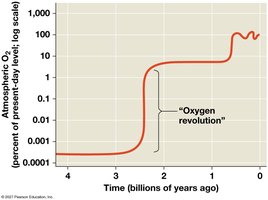
The oxygen revolution (~2.4 billion years ago) was caused by photosynthetic prokaryotes, leading to the accumulation of atmospheric O2.
The First Eukaryotes and Endosymbiosis
The earliest eukaryotic fossils date to about 1.8 billion years ago.
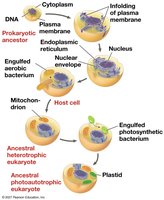
Eukaryotes likely arose via endosymbiosis, where a host cell engulfed aerobic prokaryotes (mitochondria) and, in some lineages, photosynthetic prokaryotes (chloroplasts).
Mitochondria and chloroplasts have their own DNA, bacteria-like ribosomes, and replicate like bacteria.
Origin of Multicellularity and the Cambrian Explosion
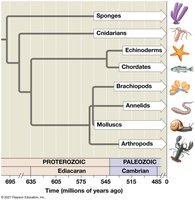
Multicellularity evolved independently in several eukaryotic lineages over 1 billion years ago.
The Cambrian explosion (~535 million years ago) saw rapid diversification of animal body plans and the appearance of most major animal groups.
Colonization of Land
Prokaryotes colonized land first, followed by plants, fungi, and animals about 500 million years ago.
Adaptations for terrestrial life included mechanisms to prevent water loss and reproduce away from water.
Concept 25.4: The Rise and Fall of Groups of Organisms
Speciation, Extinction, and Large-Scale Processes
Diversity is shaped by the balance between speciation (formation of new species) and extinction.
Major events influencing these rates include plate tectonics, mass extinctions, and adaptive radiations.
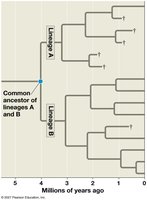
Plate Tectonics and Continental Drift
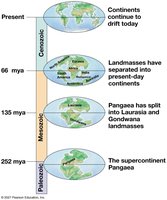
Earth's crust is divided into moving plates; their movement (continental drift) alters climate, habitats, and geographic isolation.
About 250 million years ago, all continents formed the supercontinent Pangaea.
Mass Extinctions
Mass extinction is the rapid loss of a large number of species worldwide due to environmental changes.
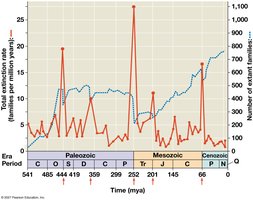
The fossil record documents five major mass extinctions in the past 500 million years, each associated with global disruptions (e.g., volcanism, asteroid impact).
The Permian Extinction
Occurred ~252 million years ago; caused by massive volcanism, CO2 increase, global warming, and ocean changes.
The Cretaceous-Paleogene (K-Pg) Extinction
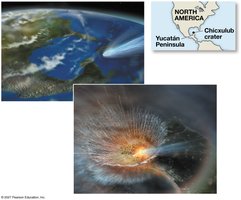
Occurred ~66 million years ago; caused by a large asteroid impact (Chicxulub crater), leading to the extinction of non-avian dinosaurs and many other species.
Evidence includes a worldwide iridium-rich layer and the impact crater in Mexico.
Are We in the Sixth Mass Extinction?
Current extinction rates are much higher than background rates, mainly due to human activities (habitat loss, overexploitation, climate change, pollution, invasive species).
Whether this constitutes a sixth mass extinction is under scientific debate.
Consequences of Mass Extinctions
Biodiversity recovery can take millions of years.
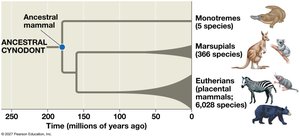
Extinction of dominant groups opens ecological opportunities for surviving lineages to diversify (adaptive radiation).
Adaptive Radiations
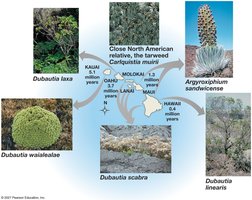
Adaptive radiation is the rapid diversification of a lineage into many species adapted to different ecological niches.
Often follows mass extinctions, colonization of new regions, or evolution of novel adaptations.
Concept 25.5: Developmental Genes and Evolution
Developmental Genes and Evolutionary Change
Developmental genes control the rate, timing, and location of changes during development.
Evolution can result from changes in gene sequence or gene regulation (when, where, and how much a gene is expressed).
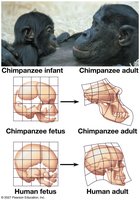
Heterochrony and Paedomorphosis
Heterochrony: Evolutionary change in the rate or timing of developmental events.
Paedomorphosis: Adults retain juvenile features of their ancestors due to changes in developmental timing.
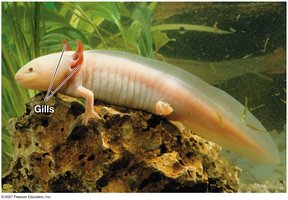
Homeotic Genes and Spatial Pattern
Homeotic genes (e.g., Hox genes) -determine where body structures develop during animal development.
Changes in the expression of these genes can alter the location or identity of body parts.
Changes in Gene Regulation
Evolutionary changes can result from differences in gene regulation, not just changes in protein-coding sequences.
Example: Stickleback fish have different body forms due to differences in gene expression, not protein sequence.
Concept 25.6: Evolution is Not Goal Oriented
Evolutionary Novelties and Trends
Evolution does not work toward a goal; new forms arise by modifying existing structures and pathways.
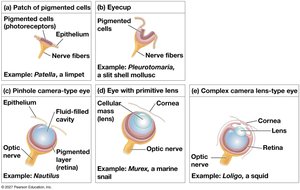
Complex structures (e.g., eyes) evolve through intermediate stages, each functional in its own right.
Exaptation: A trait that evolved for one function is later co-opted for a different function.
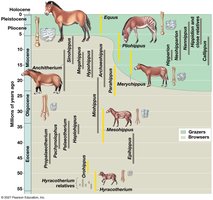
Evolutionary trends (e.g., horse evolution) reflect branching patterns, not a directed march toward a goal.
Additional info: This guide synthesizes and expands upon the provided lecture slides and textbook images, adding definitions, examples, and academic context for clarity and exam preparation.
