 Back
The History of Life on Earth: Geological and Biological Milestones
Study Guide - Smart Notes
 Tailored notes based on your materials, expanded with key definitions, examples, and context.
The History of Life on Earth
Overview of Earth's Timeline
The history of life on Earth is recorded in the fossil and geologic record, spanning over 4.6 billion years. Scientists use various metaphors, such as a calendar year or an analog clock, to help conceptualize the immense scale of geological time. Major events in Earth's history are divided into eons, eras, periods, and epochs, each marked by significant biological and geological changes.
Eons are the largest time divisions, followed by eras, periods, and epochs.
Key events include the origin of life, the rise of atmospheric oxygen, the emergence of eukaryotes, multicellularity, and the diversification of animal life.
Mass extinctions and continental drift have played crucial roles in shaping the diversity of life.
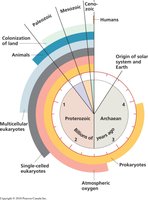
Geological Time Scale
The geological time scale organizes Earth's history into hierarchical units based on major events in the planet's physical and biological history. The main eons are the Hadean, Archaean, Proterozoic, and Phanerozoic.
Hadean Eon: Formation of Earth, no known life.
Archaean Eon: Origin of life, first prokaryotes, beginning of atmospheric oxygen.
Proterozoic Eon: Origin of eukaryotes, multicellular life, and early animal phyla.
Phanerozoic Eon: Visible life, including the Cambrian explosion and the rise of complex organisms.
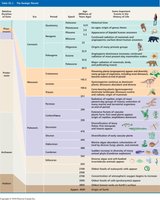
Dating Rocks and Fossils
Relative and Absolute Dating Methods
Understanding the age of rocks and fossils is essential for reconstructing Earth's history. Two main approaches are used: relative dating and absolute dating.
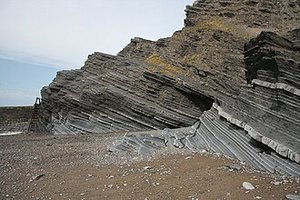
Relative dating: Uses the position of rock layers (strata) to determine the sequence of events. Lower layers are older than those above.
Absolute dating: Determines the actual age of rocks or fossils using radiometric techniques.
Radiometric dating: Based on the decay of radioactive isotopes. The half-life is the time required for half of the parent isotope to decay into the daughter isotope.
Common isotopes used: Carbon-14 (short-term), Uranium-238 to Lead-206 (long-term).
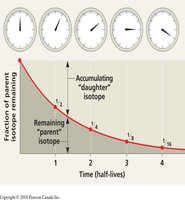
Equation for radioactive decay:
N: Amount of parent isotope remaining
N_0: Initial amount of parent isotope
t: Time elapsed
T_{1/2}: Half-life of the isotope
Major Eons and Biological Milestones
Hadean and Archaean Eons
The Hadean Eon marks Earth's formation and early tumultuous history, with no evidence of life. The Archaean Eon saw the origin of life, likely prokaryotic, and the beginning of atmospheric oxygen production by photosynthetic organisms (e.g., cyanobacteria).
Stromatolites: Layered structures formed by cyanobacteria, among the oldest known fossils.
Oxygen Revolution: Around 2.7 billion years ago, oxygen began to accumulate in the atmosphere, profoundly affecting life.

Proterozoic Eon
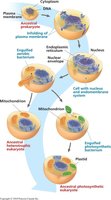
This eon is characterized by the emergence of eukaryotic cells, multicellularity, and the first animal phyla. The endosymbiotic theory explains the origin of mitochondria and chloroplasts as formerly free-living prokaryotes engulfed by ancestral eukaryotic cells.
Origin of Eukaryotes: Marked by the presence of membrane-bound organelles and complex cellular structures.
Endosymbiotic Theory: Mitochondria and chloroplasts originated from symbiotic relationships between ancestral eukaryotes and prokaryotes.
Phanerozoic Eon
The Phanerozoic Eon is the current eon, beginning with the Cambrian Explosion (~541 million years ago), which saw a rapid diversification of animal life. This eon includes the Paleozoic, Mesozoic, and Cenozoic eras, each marked by significant evolutionary events and mass extinctions.
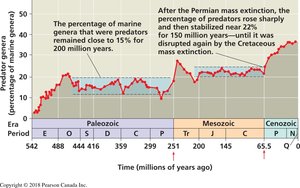
Cambrian Explosion: Sudden appearance of diverse animal phyla in the fossil record, including evidence of predator-prey interactions.
Colonization of Land: Plants, fungi, arthropods, and tetrapods adapted to terrestrial environments.
Human Evolution: Modern humans appeared only in the last fraction of Earth's history.
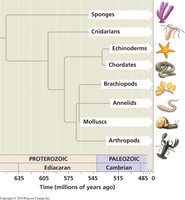
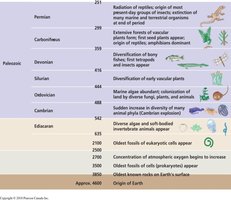
Plate Tectonics and Continental Drift
Movement of Continents
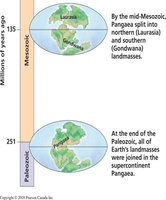
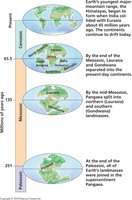
Earth's continents have shifted positions over geological time due to plate tectonics. The most notable configuration was Pangaea, a supercontinent that existed around 250 million years ago. The breakup of Pangaea led to the formation of modern continents and influenced the evolution and distribution of species.
Continental Drift: Movement of Earth's plates causes continents to shift, merge, and separate.
Allopatric Speciation: Physical separation of populations by continental drift can lead to the formation of new species.
Fossil evidence supports the historical connection of now-distant continents.
Mass Extinctions and Their Impact
Major Extinction Events
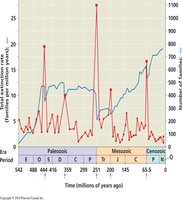
Earth has experienced five major mass extinction events, each resulting in the loss of more than 50% of species. These events were caused by dramatic environmental changes, such as volcanic activity, climate shifts, and asteroid impacts.
Extinction Event | Approximate Date (mya) | Main Cause | Impact |
|---|---|---|---|
Ordovician | 444 | Glaciation, sea level fall | Marine species loss |
Devonian | 359 | Unknown, possibly anoxia | Marine and terrestrial loss |
Permian | 251 | Volcanism, climate change | 96% marine species extinct |
Triassic | 201 | Volcanism, climate change | Marine and terrestrial loss |
Cretaceous | 66 | Asteroid impact | Dinosaurs extinct, mammals radiate |
The Permian and Cretaceous Extinctions
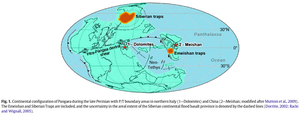
Permian Extinction: Marked the end of the Paleozoic era; caused by massive volcanic eruptions in Siberia, leading to global warming and ocean acidification.
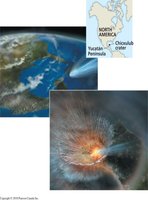
Cretaceous Extinction: Ended the Mesozoic era; likely caused by a meteorite impact (Chicxulub crater), resulting in climate disruption and the extinction of non-avian dinosaurs.
Consequences of Mass Extinctions
Mass extinctions drastically reduce biodiversity but also create opportunities for adaptive radiations, where surviving lineages diversify to fill ecological niches. For example, the extinction of dinosaurs allowed mammals to diversify and dominate terrestrial ecosystems.
Summary Table: Major Events in the History of Life
Time (mya) | Event |
|---|---|
~4600 | Origin of Earth |
~3500 | First prokaryotes (stromatolites) |
~2700 | Atmospheric oxygen increases |
~1800 | First eukaryotes |
~1200 | Multicellular eukaryotes |
~600 | First animals |
541 | Cambrian explosion |
~500 | Colonization of land |
251 | Permian extinction |
66 | Cretaceous extinction |
0.2 | Origin of modern humans |
Additional info: The calendar and clock metaphors are useful for visualizing the relative timing of major events in Earth's history. For example, if Earth's history were compressed into a single year, modern humans would appear only in the last minute of December 31st.
