 Back
BackThe History of Life on Earth – Study Notes (Campbell Biology Ch. 25)
Study Guide - Smart Notes
 Tailored notes based on your materials, expanded with key definitions, examples, and context.
The History of Life on Earth
Introduction
The history of life on Earth is a central theme in biology, integrating evidence from geology, paleontology, and molecular biology to reconstruct the origins and evolution of life. This chapter explores the conditions that made life possible, the geological principles used to interpret Earth's history, and the major events that have shaped biological diversity.
Concept 25.1: Conditions on Early Earth and the Origin of Life
Stages in the Origin of Life
Abiotic Synthesis of Small Organic Molecules: Simple molecules such as amino acids and nucleotides may have formed spontaneously under early Earth conditions.
Formation of Macromolecules: These small molecules joined to form proteins, nucleic acids, and other polymers.
Packaging into Protobionts: Aggregates of abiotically produced molecules surrounded by a membrane-like structure, capable of maintaining an internal environment.
Origin of Self-Replicating Molecules: The emergence of molecules, such as RNA, capable of self-replication was a key step toward life.
Key Question: If life originated in the past under certain conditions, could it arise today under similar circumstances?
The RNA World Hypothesis
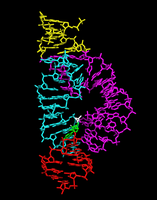
RNA is hypothesized to be the original genetic material due to its ability to store information, catalyze reactions (ribozymes), and self-replicate. This versatility suggests that early life may have relied on RNA before the evolution of DNA and proteins.
Shape Diversity: RNA molecules can fold into complex three-dimensional shapes, enabling diverse functions.
Catalysis: Some RNA molecules act as enzymes (ribozymes).
Self-Replication: Certain RNA sequences can replicate themselves under laboratory conditions.
Principles of Historical Geology
Types of Rock
Igneous Rock: Formed from cooled magma or lava (volcanic origin).
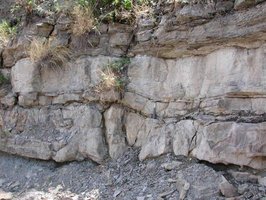
Sedimentary Rock: Formed by deposition and accumulation of material, often in water, creating layered structures.
Metamorphic Rock: Formed when existing rock is transformed by heat and pressure.
Uniformitarianism
The principle of uniformitarianism states that the geological processes observed today (e.g., volcanic activity, erosion, sediment deposition) have operated in the same way throughout Earth's history. This concept, proposed by James Hutton and popularized by Charles Lyell, supports the idea of an ancient Earth shaped by gradual processes rather than sudden catastrophes.
Steno's Laws (Principles of Stratigraphy)
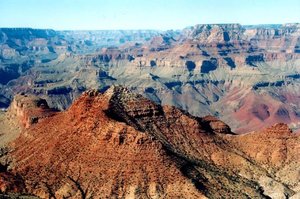
Principle of Superposition: In undisturbed sedimentary rock layers, the oldest layers are at the bottom and the youngest at the top.
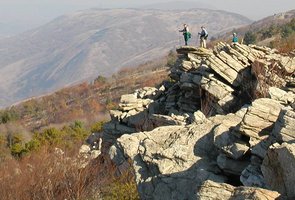
Principle of Original Horizontality: Sediments are originally deposited in horizontal layers; tilting, folding, or faulting occurs later.
Principle of Lateral Continuity: Layers of sediment initially extend laterally in all directions; they may be later truncated by erosion or other processes.
Principle of Intrusive Relationships: Igneous intrusions are younger than the rocks they cut through.
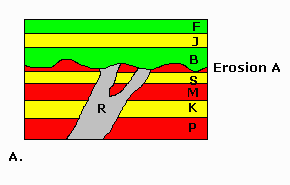
Interpreting Stratigraphic Diagrams
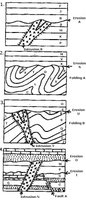
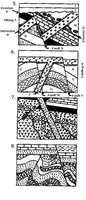
Stratigraphic diagrams are interpreted using Steno's laws to reconstruct the sequence of geological events, such as deposition, intrusion, folding, and erosion.
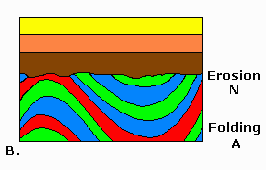
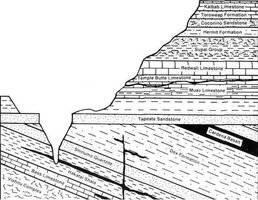
The Geological Time Scale
Divisions of Geological Time
The history of Earth is divided into eons, eras, periods, and epochs based on geological and paleontological evidence. Major boundaries are marked by significant changes in the fossil record, often associated with mass extinctions or major evolutionary events.
Eras: Precambrian, Paleozoic, Mesozoic, Cenozoic
Periods Associated with Dinosaurs: Triassic, Jurassic, Cretaceous (all within the Mesozoic Era)
Major Biological Features: Each era is characterized by dominant life forms and evolutionary innovations (e.g., the rise of mammals in the Cenozoic, dinosaurs in the Mesozoic, and marine invertebrates in the Paleozoic).
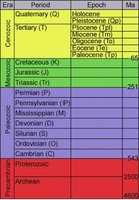
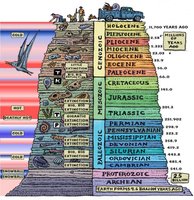
Plate Tectonics and Continental Drift
Plate Movements
Earth's lithosphere is divided into tectonic plates that move over the asthenosphere. Plate movements cause continental drift, sea floor spreading, faulting, subduction, and orogeny (mountain building). These processes have shaped the distribution of continents and oceans over geological time.
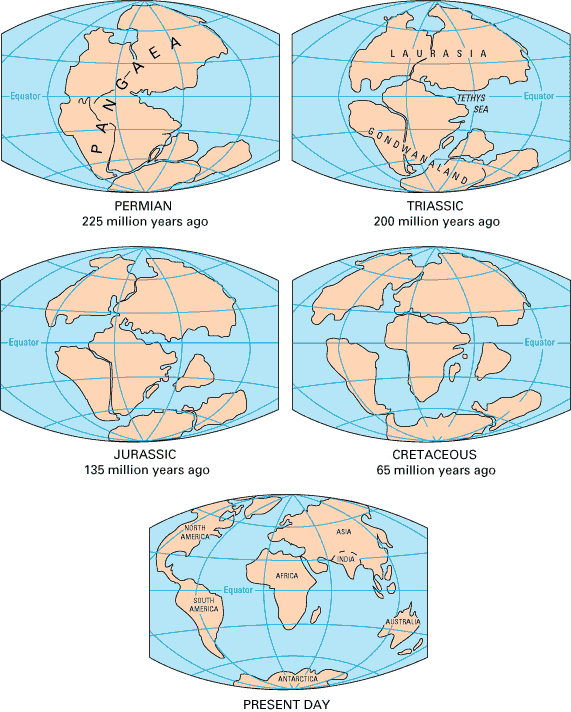
Paleomagnetism
When igneous rocks form, their magnetic minerals align with Earth's magnetic field. The orientation of these minerals provides evidence for past positions of the magnetic poles and supports the theory of plate tectonics.
Magnetic Striping: Parallel bands of magnetic orientation on the sea floor record reversals of Earth's magnetic field and the process of sea floor spreading.
Principles of Fossil Succession
Fossil Succession
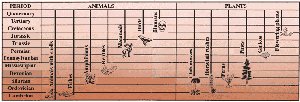
Fossils occur in a consistent, recognizable order within sedimentary rock layers worldwide. This principle allows geologists to correlate rock layers across different regions and reconstruct the history of life.
Biogeography and Fossil Evidence
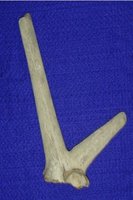
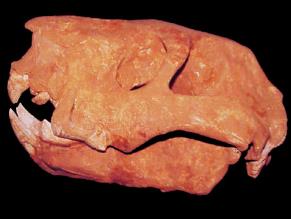
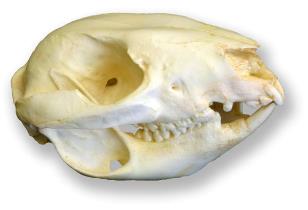
Living Fauna and Fossils: Modern species are often closely related to recent fossils found in the same region.
Geographic Patterns: Distinct regions have unique assemblages of living and fossil organisms, reflecting historical separation and evolutionary history (e.g., marsupials in Australia and Antarctica).
Radiometric Dating
Principles of Radiometric Dating
Radioactive Isotopes: Unstable isotopes decay at constant, measurable rates to form stable daughter elements.
Half-Life: The time required for half of the parent isotope in a sample to decay to its daughter product.
Radiometric dating provides absolute ages for rocks and fossils, complementing the relative ages determined by stratigraphy.
Carbon-14 Dating
Formation: C-14 is formed in the atmosphere and incorporated into living organisms.
Decay: After death, C-14 decays without replacement, allowing age determination for organic remains up to about 50,000 years old.
Limitations: Only useful for dating relatively recent, organic materials.
Index Fossils and Correlation
Index Fossils
Index fossils are species that were widespread but only existed for a short geological time. They are used to correlate the ages of rock layers across different regions.
Combining Dating Methods
Radiometric dating and index fossils are often used together to refine the geological time scale and improve the accuracy of age estimates for rocks and fossils.
Mass Extinctions
Major Mass Extinctions
There have been five major mass extinctions in Earth's history, each marked by a dramatic loss of species diversity.
Evidence includes abrupt changes in the fossil record, geochemical signatures, and global patterns of extinction.
Extinction of the Dinosaurs
The best-supported hypothesis for the extinction of the dinosaurs is the impact of a large asteroid or comet, evidenced by a worldwide iridium-rich layer and the Chicxulub crater in Mexico.
Additional info: Mass extinctions have played a critical role in shaping the course of evolution, often paving the way for the diversification of surviving groups.
