 Back
The Immune System: Innate and Adaptive Defenses in Animals
Study Guide - Smart Notes
 Tailored notes based on your materials, expanded with key definitions, examples, and context.
Immune System Overview
Introduction to Immunity
The immune system is a complex network of cells, tissues, and molecules that protects organisms from pathogens—agents such as bacteria, viruses, fungi, and parasites that cause disease. Immunity refers to the resistance or protection against these disease-causing agents, preventing repeated infections by the same pathogen.
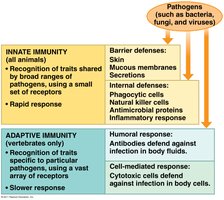
Innate immunity: Present in all animals; provides rapid, nonspecific defense against pathogens.
Adaptive immunity: Found only in vertebrates; provides specific, long-lasting defense and memory against particular pathogens.
Innate Immunity
General Features
Innate immunity is the first line of defense and is characterized by its rapid response and broad recognition of pathogen-associated molecular patterns (PAMPs). It does not provide long-lasting immunity.
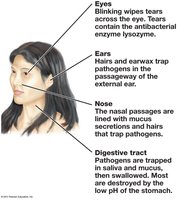
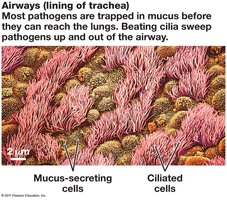
Physical barriers: Skin, mucous membranes, and secretions prevent pathogen entry.
Chemical barriers: Low pH, lysozyme in tears and saliva, and antimicrobial peptides.
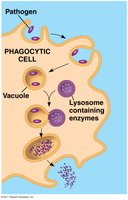
Cellular defenses: Phagocytic cells (e.g., neutrophils, macrophages), mast cells, and natural killer cells.
Innate Immunity in Invertebrates
Invertebrates rely solely on innate immunity. For example, insects have a chitinous exoskeleton and produce antimicrobial peptides. Hemocytes in hemolymph phagocytize pathogens.
Cells of the Innate Immune System
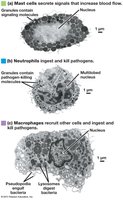
Mast cells: Release histamine, increasing blood flow and vessel permeability.
Neutrophils: Engulf and destroy pathogens.
Macrophages: Engulf pathogens and recruit other immune cells.
Toll-Like Receptors (TLRs)
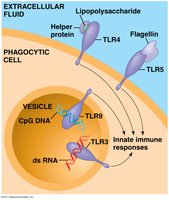
Toll-like receptors are pattern-recognition receptors on innate immune cells that detect conserved molecular patterns on pathogens, such as lipopolysaccharide, flagellin, CpG DNA, and double-stranded RNA. Activation of TLRs triggers innate immune responses.
Inflammatory Response
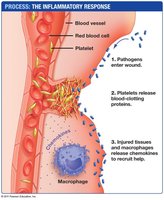
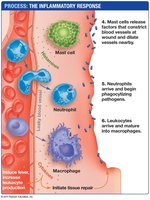
The inflammatory response is a multi-step process that occurs at sites of injury or infection. It involves the release of signaling molecules, recruitment of immune cells, and elimination of pathogens.
Platelets release clotting proteins.
Macrophages secrete chemokines to attract immune cells.
Mast cells release histamine, increasing blood vessel permeability.
Neutrophils and macrophages phagocytize pathogens.
Cytokines induce fever and tissue repair.
Adaptive Immunity
General Principles
Adaptive immunity is characterized by specificity, diversity, memory, and self-nonself recognition. It involves lymphocytes (B cells and T cells) that recognize specific antigens and mount tailored responses.
Specificity: Each component binds only to specific antigens.
Diversity: Can recognize a vast array of antigens.
Memory: Faster, stronger response upon re-exposure.
Self-nonself recognition: Does not attack the body's own molecules.
Lymphocytes and Immune Organs
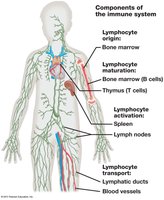
Lymphocytes are produced in the bone marrow and mature in either the bone marrow (B cells) or thymus (T cells). They circulate through blood, lymph nodes, spleen, and mucosal-associated lymphoid tissue (MALT).
Activation of Lymphocytes
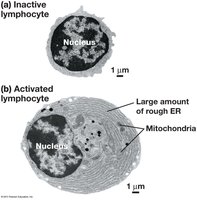
Lymphocytes are usually inactive until they encounter their specific antigen. Upon activation, they undergo dramatic changes, including increased cytoplasm and organelle content, and begin to proliferate.
B Cells vs. T Cells
B cells: Mature in bone marrow; produce antibodies.
T cells: Mature in thymus; involved in killing infected cells and regulating immune responses.
Clonal Selection Theory
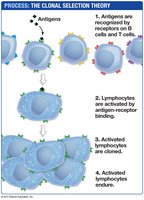
Each lymphocyte has unique receptors for a specific antigen. When a lymphocyte binds its antigen, it is activated, proliferates (clonal expansion), and some clones become memory cells for rapid future responses.
Antibody Structure and Classes
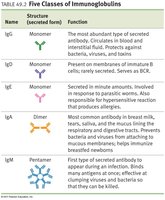
Antibodies (immunoglobulins) are produced by B cells and have variable (V) and constant (C) regions. There are five main classes, each with distinct functions:
Name | Structure | Function |
|---|---|---|
IgG | Monomer | Main antibody in blood; protects against bacteria, viruses, and toxins. |
IgD | Monomer | Present on B cell surfaces; acts as BCR. |
IgE | Monomer | Involved in allergic responses and defense against parasites. |
IgA | Dimer | Found in secretions (tears, saliva, mucus); protects mucosal surfaces. |
IgM | Pentamer | First antibody produced; effective at clumping pathogens. |
Antigen Recognition and Epitopes
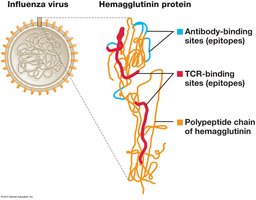
An epitope is the specific region of an antigen recognized by antibodies, B cell receptors (BCRs), or T cell receptors (TCRs). Each antigen can have multiple epitopes, each recognized by a different receptor.
Variable and Constant Regions
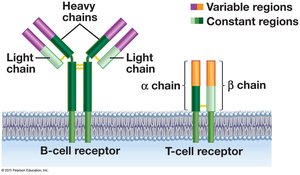
BCRs and TCRs have variable regions that determine antigen specificity and constant regions that define their class and function.
Antigen Presentation and Dendritic Cells
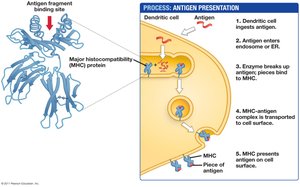
Dendritic cells ingest pathogens, process antigens, and present them on their surface using major histocompatibility complex (MHC) proteins. There are two classes of MHC:
MHC I: Present on all nucleated cells; present antigens to CD8+ T cells.
MHC II: Present on antigen-presenting cells; present antigens to CD4+ T cells.
T Cell Activation
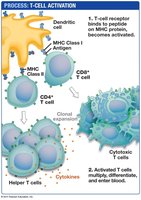
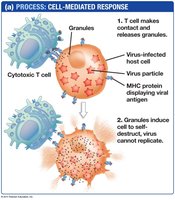
T cells are activated when they bind to antigen-MHC complexes on antigen-presenting cells. CD8+ T cells recognize MHC I, while CD4+ T cells recognize MHC II. Activated T cells proliferate and differentiate into effector and memory cells.
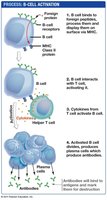
B Cell Activation
B cells are activated when they bind antigen, present it on MHC II, and receive help from activated CD4+ T cells. Activated B cells differentiate into plasma cells (antibody producers) and memory B cells.
Antibody Activity
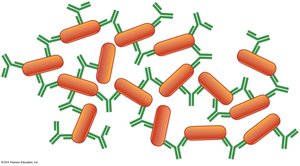
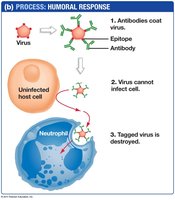
Antibodies bind to pathogens, neutralize them, and mark them for destruction by phagocytes (opsonization) or activation of the complement system.
Humoral vs. Cell-Mediated Response
Humoral response: Involves antibodies in body fluids; effective against extracellular pathogens.
Cell-mediated response: Involves cytotoxic T cells; effective against intracellular pathogens (e.g., viruses).
Immunological Memory and Vaccination
Primary and Secondary Immune Responses
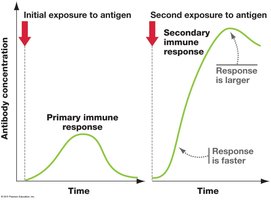
The primary immune response occurs upon first exposure to an antigen and is slower and weaker. The secondary response, mediated by memory cells, is faster and stronger upon subsequent exposures.
Vaccines
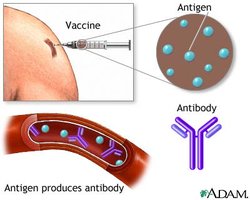
Vaccines introduce antigens from pathogens (inactivated, attenuated, or subunit) to stimulate the primary immune response and generate memory cells, providing long-term protection without causing disease.
Immune System Disorders and Pathogen Evasion
Pathogen Evasion
Some viruses, such as influenza and HIV, mutate rapidly and change their epitopes, making it difficult for memory cells to recognize them and for vaccines to be effective.
Allergies
Allergies are exaggerated immune responses to harmless antigens. Sensitized mast cells release histamine and other mediators, causing symptoms such as increased vascular permeability, smooth muscle contraction, and mucus secretion. Severe reactions can lead to anaphylactic shock.
