 Back
The Immune System: Innate and Adaptive Immunity(final exam)
Study Guide - Smart Notes
 Tailored notes based on your materials, expanded with key definitions, examples, and context.
Immune System Overview
Introduction to the Immune System
The human body is constantly exposed to pathogens such as bacteria, fungi, and viruses. To defend against these threats, it possesses a complex immune system that operates through multiple layers of defense. The immune system is divided into two main types: innate immunity and adaptive immunity.
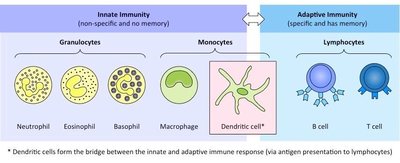
Innate Immunity: Provides a rapid, general defense against pathogens using a limited set of receptors.
Adaptive Immunity: Offers a slower, highly specific response using a vast array of receptors, and is found only in vertebrates.

Types of Immunity
Innate vs. Adaptive Immunity
Immunity can be classified as general (innate) or targeted (adaptive). Innate immunity is present in all animals and acts quickly, while adaptive immunity is specific to vertebrates and takes longer to respond.
Innate Immunity: Recognizes common features of pathogens and responds rapidly.
Adaptive Immunity: Recognizes unique features of individual pathogens and responds more slowly but with greater specificity.
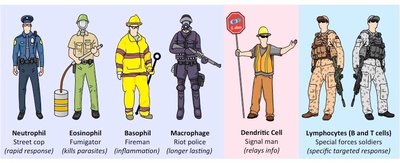
Innate Immunity
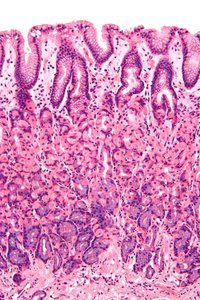
Barrier Defenses
The first line of defense includes physical and chemical barriers that prevent pathogens from entering the body.
Skin: Acts as a physical barrier.
Mucous membranes: Line the respiratory, urinary, and reproductive tracts, trapping and removing microbes.
Body fluids: Saliva, mucus, and tears contain antimicrobial substances.
Low pH: Skin and digestive system acidity inhibits bacterial growth.
Internal Defenses: Phagocytic Cells
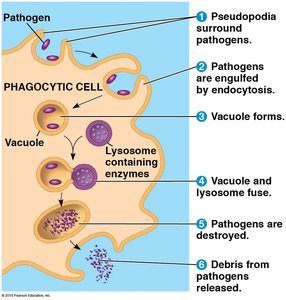
When pathogens breach barriers, internal defenses are activated. Phagocytic cells engulf and destroy pathogens.
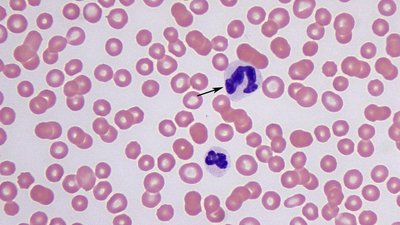
Neutrophils: Circulate in the blood and are attracted to infection sites.
Macrophages: Reside throughout the body and engulf pathogens.
Dendritic cells: Located on external tissues and help activate the adaptive immune system.
Other Innate Defenses
Natural killer cells: Release chemicals that induce cell death in infected cells.
Eosinophils: Attack large parasites by releasing chemicals that puncture cell membranes.
Basophils: Release histamine and heparin, contributing to inflammation.
Inflammatory Response
The inflammatory response is triggered by injury or infection.
Cytokines: Released by activated macrophages and neutrophils, promoting blood flow to the site.
Mast cells: Release histamine, causing blood vessels to dilate and become more permeable.
Enhanced blood flow: Delivers antimicrobial peptides to the site.
Local vs. systemic inflammation: Localized (pain, swelling) or systemic (fever).
Adaptive Immunity
Lymphocytes: B Cells and T Cells
Adaptive immunity relies on two types of lymphocytes:
B cells: Mature in bone marrow.
T cells: Mature in the thymus.
Antigen Recognition
Antigens: Substances that elicit a response from B or T cells.
Antigen receptors: Proteins on B and T cells that bind to specific antigens.
Epitope: The part of an antigen that binds to the receptor.
B Cell Receptors and Antibodies
B cell receptor: Y-shaped molecule with two identical heavy and two identical light chains.
Variable (V) region: Highly diverse, responsible for antigen specificity.
Antibodies: Soluble forms of the B cell receptor, secreted to neutralize pathogens.
T Cell Receptors and MHC
T cell receptor: Composed of α and β chains, with variable and constant regions.
MHC molecules: Host proteins that display antigen fragments on cell surfaces for T cell recognition.
Major Characteristics of Adaptive Immunity
Adaptive immunity is defined by four major characteristics:
Diversity: Millions of different antigen receptors are generated by recombination of gene segments (J, V, C parts).
Self-tolerance: Lymphocytes are tested for self-reactivity; self-reactive cells are eliminated or rendered nonfunctional.
Proliferation: Activated B and T cells multiply to form effector cells.
Immunological memory: Memory cells enable a faster, stronger response upon subsequent exposure to the same antigen.
Immune Responses
Humoral Response (B Cells)
In the humoral immune response, antibodies secreted by B cells neutralize or eliminate toxins and pathogens in body fluids.
Clonal selection: A single activated B cell produces thousands of identical plasma cells.
Antibody production: Plasma cells secrete large quantities of antibodies.
Pathogen neutralization: Antibodies mark pathogens for destruction or block their activity.
Cell-Mediated Response (T Cells)
Specialized T cells destroy infected host cells in the cell-mediated immune response.
Cytotoxic T cells: Recognize and kill infected cells displaying antigens via MHC molecules.
Immunological Memory
Primary response: First exposure to an antigen activates B and T cells.
Secondary response: Memory cells facilitate a faster, stronger, and longer-lasting response upon re-exposure.
Duration: Immunological memory can last for decades.
Immune System Disorders
Allergies
Allergies are exaggerated immune responses to harmless antigens (allergens).
Localized allergies: Plasma cells secrete antibodies specific for allergens, triggering histamine release.
Anaphylactic shock: Severe, life-threatening allergic reaction.
Treatment: Antihistamines and epinephrine.
Immune Rejection and Autoimmune Diseases
Immune rejection: Transplanted cells or tissues may be destroyed by the recipient's immune system.
Autoimmune diseases: The immune system attacks the body's own molecules (e.g., lupus, rheumatoid arthritis, type 1 diabetes, multiple sclerosis).
Influences: Genes, heredity, and environment affect susceptibility.
Immune System Avoidance by Pathogens
Pathogens may evade the immune system by altering their epitopes (antigenic variation) or entering latency.
Antigenic variation: Pathogens change surface proteins to avoid detection (e.g., influenza virus).
Latency: Viruses enter inactive states within host cells (e.g., herpes simplex virus).
HIV/AIDS: HIV infects helper T cells, escapes immune detection through high mutation rates and latency.
Summary Table: Innate vs. Adaptive Immunity
Feature | Innate Immunity | Adaptive Immunity |
|---|---|---|
Speed | Rapid | Slower |
Specificity | General | Highly specific |
Memory | None | Immunological memory |
Cell Types | Phagocytes, NK cells, granulocytes | B cells, T cells |
Response | Barrier, inflammation, phagocytosis | Antibody production, cytotoxicity |
