 Back
The Indispensable Water Molecule: Properties and Biological Importance
Study Guide - Smart Notes
 Tailored notes based on your materials, expanded with key definitions, examples, and context.
Water: The Foundation for Life
Introduction
Water (H2O) is essential for all known forms of life. Its unique molecular structure and interactions give rise to properties that are critical for biological systems, from cellular processes to ecosystem stability.
The Unique Structure and Interactions of Water
Polar Covalent Bonds
Covalent Bonds: In water, oxygen and hydrogen atoms share electrons, but oxygen is more electronegative, pulling electrons closer and creating partial charges.
Polarity: This unequal sharing results in a partial negative charge (δ−) on oxygen and partial positive charges (δ+) on hydrogens, making water a polar molecule.
Biological Importance: Polarity enables water to interact with other polar molecules and ions, underpinning its solvent abilities and other emergent properties.
Hydrogen Bonds
Hydrogen Bonding: The partial positive hydrogen of one water molecule is attracted to the partial negative oxygen of another, forming a hydrogen bond.
These bonds are weaker than covalent bonds but are numerous and dynamic in liquid water, contributing to water's unique properties.
The Four Emergent Properties of Water
1. Cohesive and Adhesive Behavior
Cohesion: Water molecules stick to each other via hydrogen bonds, resulting in high surface tension (e.g., water striders walking on water).
Adhesion: Water molecules stick to other polar substances, enabling capillary action (e.g., water transport in plants).
2. Moderation of Temperature
High Specific Heat: Water absorbs or releases large amounts of heat with minimal temperature change, due to energy being used to break or form hydrogen bonds.
Biological Importance: Stabilizes aquatic environments and moderates climate, protecting organisms from rapid temperature changes.
3. Expansion Upon Freezing
Water expands as it freezes, making ice less dense than liquid water (ice floats).
Biological Importance: Floating ice insulates aquatic habitats and contributes to soil formation through mechanical weathering.
4. Versatility as a Solvent
Water is known as the universal solvent due to its ability to dissolve many substances.
Solution: A homogeneous mixture of solute (dissolved substance) and solvent (dissolving agent).
Aqueous Solution: A solution where water is the solvent; most biological solutions are aqueous.
Mechanism: Water's polarity allows it to surround and separate ions and polar molecules, keeping them dissolved.
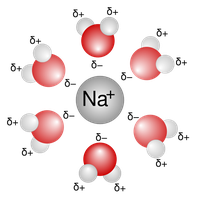
Water Interactions with Other Substances: Hydrophilic and Hydrophobic
Hydrophilic (Water-Loving): Substances that dissolve in or are attracted to water (e.g., salts, sugars, many proteins). They are typically polar or ionic.
Hydrophobic (Water-Fearing): Substances that do not dissolve in water (e.g., oils, fats, waxes). They are nonpolar and lack charged regions.
Biological Importance: Hydrophobic interactions are essential for forming cell membranes, where hydrophobic lipid tails create a barrier between the cell and its environment.
Quantifying Solutions: Concentration, Moles, and Molarity
Concentration: The amount of solute in a given volume of solvent or solution.
The Mole (mol): A unit representing 6.02 × 10²³ particles (Avogadro's number), allowing comparison of quantities at the molecular level.
Molecular Mass: The sum of atomic masses in a molecule, expressed in Daltons (Da) or grams per mole (g/mol).
Example (Sodium Chloride - NaCl):
Na: 23 Da, Cl: 35 Da, so NaCl = 58 g/mol
Example (Glucose - C6H12O6):
C: 12 Da × 6 = 72
H: 1 Da × 12 = 12
O: 16 Da × 6 = 96
Total = 180 g/mol
Molarity (M): Number of moles of solute per liter of solution.
$\text{Molarity (M)} = \frac{\text{moles of solute}}{\text{liters of solution}}$
Example: To make 1.00 L of 1.00 M NaOH solution, you need 40 grams of NaOH (molecular mass = 40 g/mol).
Acids, Bases, and pH
Dissociation of Water
Water can dissociate into hydrogen ions (H+) and hydroxide ions (OH−).
Hydrogen ions can also form hydronium ions (H3O+).
Acids
Increase the concentration of H+ in solution; pH < 7.
Strong acids dissociate completely; weak acids only partially.
Examples: Gastric juice (pH 2), vinegar (pH 3).
Bases (Alkaline)
Reduce H+ concentration (by accepting H+ or releasing OH−); pH > 7.
Strong bases dissociate completely; weak bases accept H+ reversibly.
Examples: Seawater (pH 8), ammonia (pH 11).
pH Scale
Ranges from 0 (most acidic) to 14 (most basic); 7 is neutral.
Each unit change represents a tenfold change in H+ concentration.
Most biological fluids have pH between 6 and 8.
Relationship Between pH and pOH
At 25°C, $[H^+][OH^-] = 10^{-14}$
pH + pOH = 14
Calculating pH and pOH
$\text{pH} = -\log [H^+]$
$\text{pOH} = -\log [OH^-]$
Example: For [H+] = 0.0235 M, pH = 1.629, pOH = 12.371
Buffers
Substances that resist drastic pH changes by absorbing or releasing H+.
Usually consist of a weak acid and its conjugate base.
Example: Carbonic acid (H2CO3) and bicarbonate (HCO3−) buffer blood at pH ~7.4.
Real-World Impact: Ocean Acidification
Excess atmospheric CO2 dissolves in oceans, forming carbonic acid and lowering pH (ocean acidification).
Increased H+ reduces carbonate ions (CO32−), essential for marine organisms to build shells and skeletons.
Threatens marine ecosystems and food webs.
