 Back
The Integumentary System: Structure, Function, and Dermatology Terminology
Study Guide - Smart Notes
 Tailored notes based on your materials, expanded with key definitions, examples, and context.
The Integumentary System
Overview and Functions
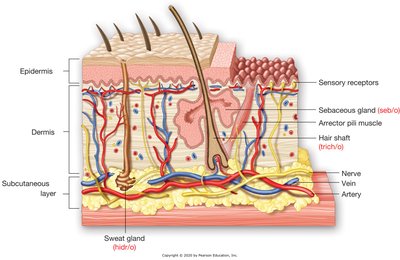
The integumentary system is a fundamental topic in general biology, encompassing the skin and its accessory structures such as hair and nails. It serves as the body's largest organ system and is essential for protection, regulation, and sensation.
Protection: The skin acts as a two-way barrier, preventing pathogens from entering and retaining vital substances within the body.
Temperature Regulation: Sweat evaporation and blood vessel dilation cool the body, while constriction and the subcutaneous fat layer conserve heat.
Sensation: Sensory receptors in the skin detect touch, pressure, temperature, and pain, relaying information to the brain.
Waste Disposal: Sweat glands excrete small amounts of waste, such as excess salts.
Accessory Structures: Hair and Nails
Hair and nails are specialized structures derived from the skin, each with unique functions and anatomy.
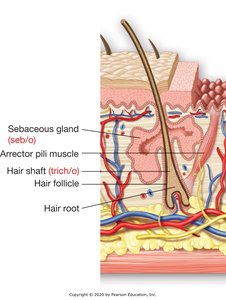
Hair: Provides protection, sensory input, and regulates temperature. The hair shaft, follicle, and root are key components.
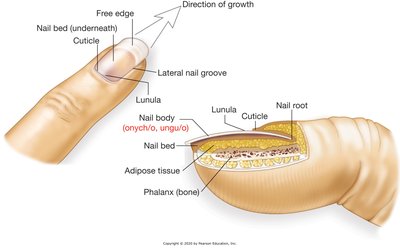
Nails: Protect the tips of fingers and toes, aid in grasping, and are composed of the nail body, bed, root, and cuticle.
Dermatology: Medical Terminology and Word Building
Combining Forms, Prefixes, and Suffixes
Understanding medical terminology is crucial for describing conditions, procedures, and anatomy related to the integumentary system.
Combining Forms: Examples include dermat/o (skin), trich/o (hair), onych/o (nail), seb/o (oil), hidr/o (sweat), melan/o (melanin).
Prefixes: Examples include an- (without), epi- (above), hyper- (excessive), hypo- (below).
Suffixes: Examples include -itis (inflammation), -oma (tumor), -logy (study of), -derma (skin condition).
Building Dermatology Terms
Medical terms are constructed by combining roots, prefixes, and suffixes.
adenitis: Inflammation of a gland (aden/o + -itis).
adipocyte: Fat cell (adip/o + -cyte).
subcutaneous: Pertaining to below the skin (sub- + cutane/o + -ous).
xeroderma: Dry skin condition (xer/o + -derma).
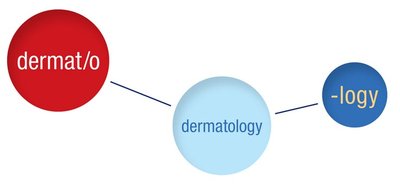
dermatology: Study of the skin (dermat/o + -logy).
hyperhidrosis: Excessive sweating (hyper- + hidr/o + -osis).
melanoma: Black tumor (melan/o + -oma).
seborrhea: Discharge of oil (seb/o + -rrhea).
Structures of the Skin
Anatomy of the Skin
The skin is composed of three primary layers, each with distinct functions and structures.
Epidermis: The outermost layer, provides a waterproof barrier and creates skin tone.
Dermis: Contains tough connective tissue, hair follicles, and sweat glands.
Subcutaneous Layer: Made of fat and connective tissue, provides insulation and energy storage.
Nail Structure
Nails are composed of keratin and serve protective and functional roles.
Nail Body: Visible part of the nail.
Nail Bed: Tissue beneath the nail.
Lunula: Crescent-shaped area at the base.
Cuticle: Protective layer at the base.
Nail Root: Source of nail growth.
Hair Structure
Hair consists of the shaft, root, and follicle, each playing a role in protection and sensation.
Hair Shaft: Visible part above the skin.
Hair Root: Embedded in the skin.
Hair Follicle: Surrounds the root and anchors the hair.
Arrector Pili Muscle: Causes hair to stand up.
Sebaceous Gland: Produces oil to lubricate hair and skin.
Common Dermatological Conditions and Vocabulary
Skin Disorders and Diseases
Dermatology encompasses a wide range of conditions affecting the skin, hair, and nails.
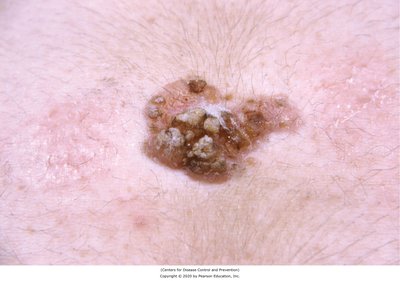
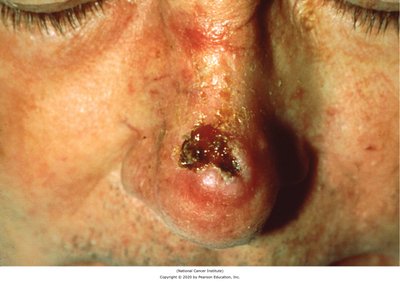
Basal Cell Carcinoma (BCC): Common skin cancer in the basal cell layer; rarely metastasizes.
Malignant Melanoma (MM): Aggressive skin cancer originating in melanocytes; prone to metastasis.
Squamous Cell Carcinoma (SCC): Skin cancer beginning in the epidermis; may grow deeper but rarely spreads.
Psoriasis: Chronic inflammatory condition with crusty papules and patches.
Impetigo: Inflammatory skin disease with pustules that rupture and crust.
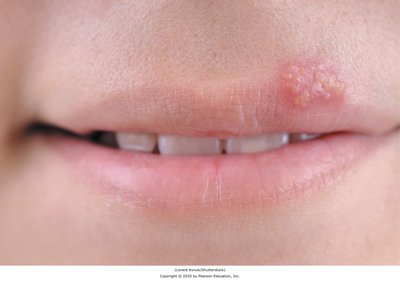
Herpes Simplex: Viral infection causing painful blisters around lips and nose.
Herpes Zoster: Viral infection causing painful blisters along nerve paths (shingles).
Varicella: Highly contagious viral infection with blistered rash (chickenpox).
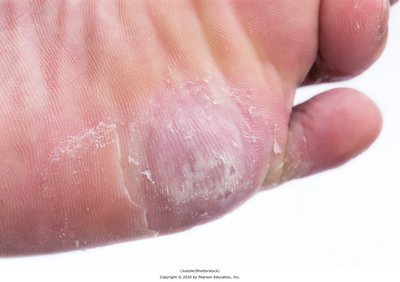
Tinea: Fungal skin disease resulting in itching and scaling lesions.
Decubitus Ulcer: Open sore caused by prolonged pressure, often in bedridden patients.
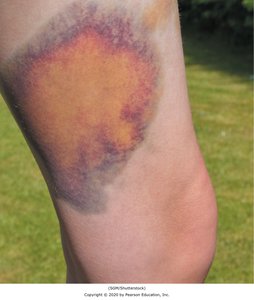
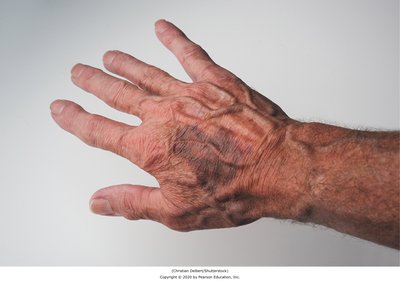
Ecchymosis: "Black-and-blue" bruise from blood collecting under the skin.
Necrosis: Area of tissue death due to loss of blood supply.
Purpura: Purplish-red bruises, often in people with fragile skin.
Pustule: Raised spot containing pus.
Ulcer: Open sore or lesion in the skin or mucous membrane.
Urticaria: Skin eruption of pale reddish wheals with severe itching (hives).
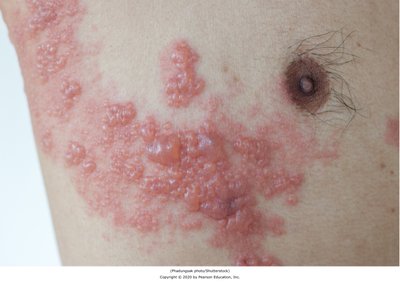
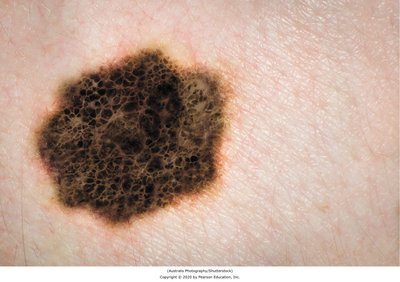
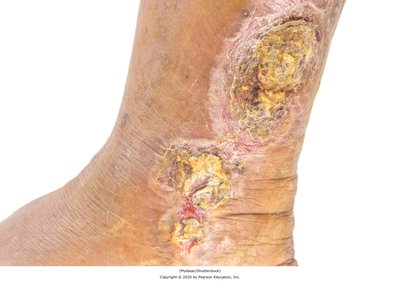
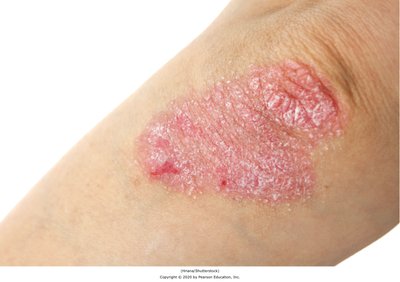
Burns: Classification and Clinical Features
Types of Burns
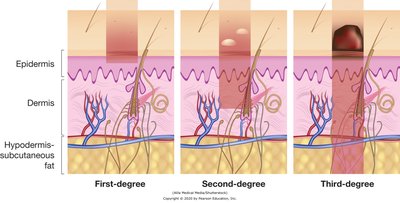
Burns are classified by their depth and severity, affecting different layers of the skin.
First-Degree Burn: Damages only the epidermis; results in erythema without blisters; no scarring.
Second-Degree Burn: Extends into the dermis; causes blisters and may result in scarring.
Third-Degree Burn: Damages full thickness of skin and underlying tissues; infection and fluid loss are major concerns; usually requires skin grafts.
Dermatology Abbreviations
Common Abbreviations in Dermatology
Abbreviations are frequently used in clinical and academic settings to streamline communication.
BCC: Basal cell carcinoma
MM: Malignant melanoma
SCC: Squamous cell carcinoma
BX, bx: Biopsy
C&S: Culture and sensitivity
SG: Skin graft
HSV: Herpes simplex virus
Subc, subq: Subcutaneous
Derm, derm: Dermatology
Summary Table: Dermatology Combining Forms
Key Combining Forms and Their Meanings
Combining Form | Definition |
|---|---|
aden/o | gland |
adip/o | fat |
cutane/o, derm/o, dermat/o | skin |
hidr/o | sweat |
kerat/o | keratin, hard, hornlike |
lip/o | fat |
melan/o | melanin, black |
onych/o, ungu/o | nail |
py/o | pus |
seb/o | sebum, oil |
trich/o | hair |
Summary Table: Dermatology Suffixes
Key Suffixes and Their Meanings
Suffix | Definition |
|---|---|
-itis | inflammation |
-oma | tumor, mass |
-logy | study of |
-derma | skin condition |
-osis | abnormal condition |
-rrhea | discharge |
-cyte | cell |
-ectomy | surgical removal |
-plasty | surgical repair |
Summary Table: Dermatology Prefixes
Key Prefixes and Their Meanings
Prefix | Definition |
|---|---|
an- | without |
epi- | above |
hyper- | excessive |
hypo- | below, insufficient |
sub- | under |
trans- | across |
Summary Table: Dermatology Abbreviations
Key Abbreviations and Their Meanings
Abbreviation | Meaning |
|---|---|
BCC | Basal cell carcinoma |
MM | Malignant melanoma |
SCC | Squamous cell carcinoma |
BX, bx | Biopsy |
C&S | Culture and sensitivity |
SG | Skin graft |
HSV | Herpes simplex virus |
Subc, subq | Subcutaneous |
Derm, derm | Dermatology |
Conclusion
Summary
The integumentary system is vital for protection, regulation, and sensation. Dermatology provides the terminology and clinical context for understanding skin, hair, and nail disorders. Mastery of combining forms, prefixes, suffixes, and abbreviations is essential for effective communication and comprehension in biology and medical fields. Additional info: The notes have been expanded to include academic context and logical grouping for completeness and clarity.
