 Back
The Internal Environment of Animals: Organization and Regulation
Study Guide - Smart Notes
 Tailored notes based on your materials, expanded with key definitions, examples, and context.
Chapter 32: The Internal Environment of Animals: Organization and Regulation
Introduction
This chapter explores how animal form and function are intricately linked at all levels of biological organization, and how animals regulate their internal environment to survive in changing or harsh external conditions. Key topics include tissue and organ system organization, physiological regulation, feedback mechanisms, thermoregulation, osmoregulation, and excretion.
Animal Form and Function
Levels of Organization
Anatomy: The study of the biological form of an organism.
Physiology: The study of the biological functions an organism performs.
Form and function are closely correlated, with emergent properties arising from hierarchical organization:
Cells → Tissues (groups of similar cells) → Organs (functional units of tissues) → Organ systems (groups of organs working together)
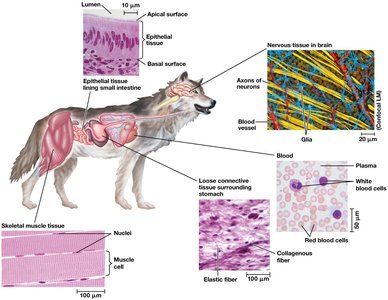
Major Organ Systems in Mammals
Organ System | Main Components | Main Functions |
|---|---|---|
Digestive | Mouth, pharynx, esophagus, stomach, intestines, liver, pancreas, anus | Food processing (ingestion, digestion, absorption, elimination) |
Circulatory | Heart, blood vessels, blood | Internal distribution of materials |
Respiratory | Lungs, trachea, breathing tubes | Gas exchange (O2 uptake, CO2 disposal) |
Immune & Lymphatic | Bone marrow, lymph nodes, thymus, spleen, lymph vessels | Body defense, fluid distribution |
Excretory | Kidneys, ureters, bladder, urethra | Waste disposal, osmotic balance |
Endocrine | Pituitary, thyroid, pancreas, adrenal, other glands | Coordination of body activities |
Reproductive | Ovaries/testes, associated organs | Gamete production, fertilization, embryo support |
Nervous | Brain, spinal cord, nerves, sensory organs | Coordination, stimulus detection, response |
Integumentary | Skin, hair, claws, sweat glands | Protection, thermoregulation |
Skeletal | Bones, tendons, ligaments, cartilage | Support, protection, movement |
Muscular | Skeletal muscles | Locomotion, movement |
Animal Tissue Types
Epithelial tissue: Sheets of closely packed cells covering body surfaces and lining organs/cavities.
Connective tissue: Cells scattered in an extracellular matrix, forming fibers and supporting structures.
Muscle tissue: Contains actin and myosin filaments for contraction and movement.
Nervous tissue: Specialized for receipt, processing, and transmission of information.
Coordination and Control: Endocrine and Nervous Systems
Overview of Regulation
Animals use the endocrine and nervous systems to coordinate responses to internal and external stimuli. A stimulus triggers a response in the body.
Endocrine System
Uses hormones (signaling molecules) released into the bloodstream by endocrine cells/glands.
Hormones affect only cells with specific receptors and are suited for gradual, widespread changes.
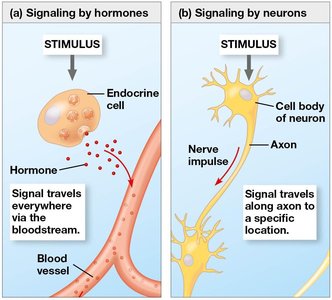
Nervous System
Uses nerve impulses (electrical signals) transmitted by neurons along axons to specific targets.
Enables rapid, immediate responses to stimuli.
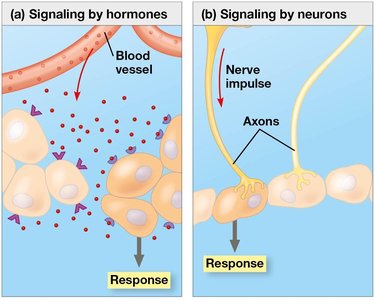
Endocrine Glands and Hormones
Endocrine glands: Ductless organs that secrete hormones directly into surrounding fluid and blood.
Exocrine glands: Secrete substances via ducts to body surfaces or cavities.
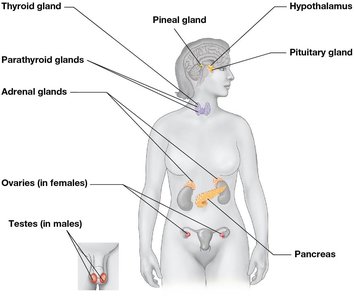
Feedback Regulation
Negative feedback: The response reduces the stimulus, maintaining homeostasis.
Positive feedback: The response reinforces the stimulus, amplifying the response.
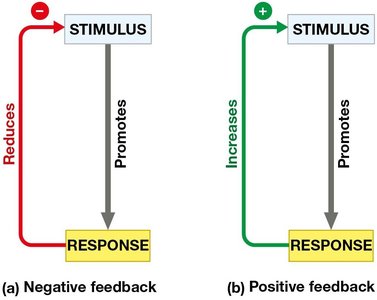
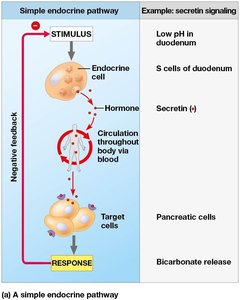
Simple Endocrine and Neuroendocrine Pathways
Simple endocrine pathway: Endocrine cells respond directly to a stimulus by secreting a hormone (e.g., secretin release in response to low pH in the duodenum).
Neuroendocrine pathway: Neurons (often in the hypothalamus) release hormones in response to neural signals (e.g., oxytocin release during nursing).
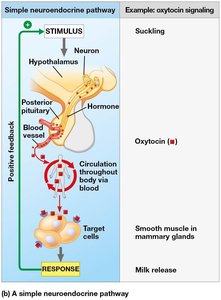
Hormone Cascade Pathways
Anterior pituitary hormones often act as tropic hormones, triggering cascades of hormonal signals and feedback regulation at multiple levels.
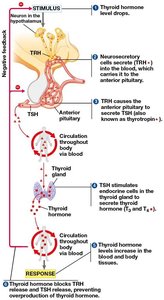
Hormone Solubility and Cellular Response
Water-soluble hormones: Bind to cell-surface receptors, triggering signal transduction pathways.
Lipid-soluble hormones: Pass through membranes, bind to intracellular receptors, and alter gene transcription.
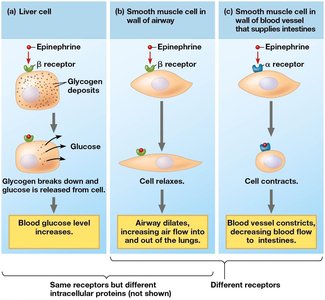
Hormones can have multiple effects depending on target cell receptor types and intracellular signaling pathways (e.g., epinephrine).
Feedback Control and Homeostasis
Regulators vs. Conformers
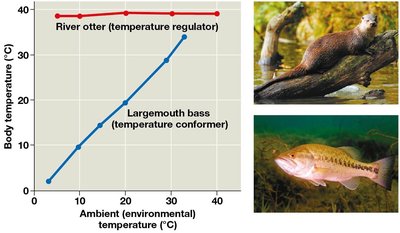
Regulators: Use internal mechanisms to maintain stable internal conditions despite external changes (e.g., river otter).
Conformers: Allow internal conditions to change with the environment (e.g., largemouth bass).
Homeostasis
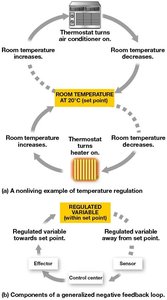
Maintaining a "steady state" or internal balance (e.g., body temperature, blood pH, glucose concentration).
Involves a set point, sensor, control center, and effector.
Negative feedback loops are central to homeostasis.
Thermoregulation
Endothermy vs. Ectothermy
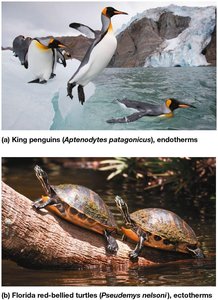
Endotherms: Generate heat metabolically (e.g., birds, mammals); maintain stable body temperature.
Ectotherms: Gain heat from the environment (e.g., most invertebrates, fishes, amphibians, reptiles); regulate temperature behaviorally.
Heat Exchange Mechanisms
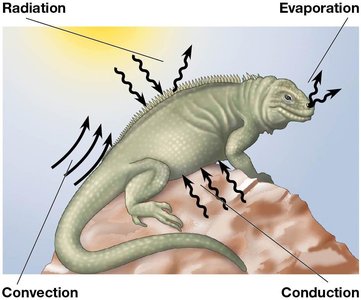
Organisms exchange heat via radiation, evaporation, convection, and conduction.
Heat always moves from higher to lower temperature regions.
Circulatory Adaptations
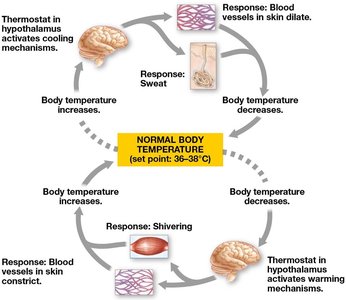
Vasodilation: Widening of blood vessels to promote heat loss.
Vasoconstriction: Narrowing of blood vessels to reduce heat loss.
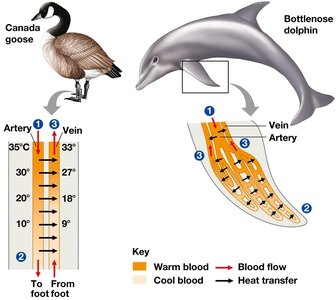
Countercurrent exchange: Transfers heat between fluids flowing in opposite directions, reducing heat loss (e.g., in bird and mammal limbs).
Thermoregulatory Feedback Loops
The hypothalamus acts as a thermostat, triggering heat loss or heat-generating mechanisms.
Fever results from a change in the set point for body temperature regulation.
Osmoregulation and Excretion
Osmoregulation
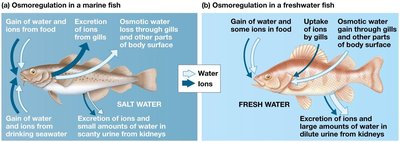
Processes by which animals control solute concentrations and balance water gain/loss in interstitial fluid.
Osmolarity: Solute concentration of a solution; water moves from hypoosmotic to hyperosmotic solutions.
Osmoconformers: Isoosmotic with surroundings (e.g., some marine animals).
Osmoregulators: Expend energy to control water uptake/loss in different environments.
Nitrogenous Wastes
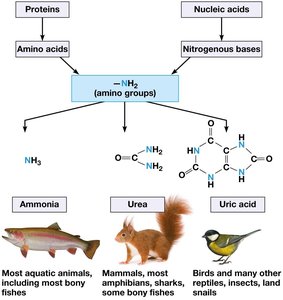
Produced from protein and nucleic acid breakdown.
Ammonia (NH3): Most aquatic animals; highly toxic, excreted directly.
Urea: Mammals, amphibians, sharks; less toxic, requires energy to produce.
Uric acid: Birds, reptiles, insects; least toxic, excreted as paste, energetically expensive.
Excretory Processes
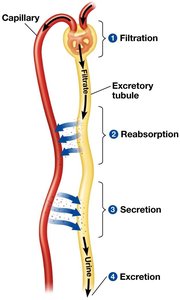
Key steps: Filtration (produces filtrate), Reabsorption (returns useful molecules/water), Secretion (adds wastes to filtrate), Excretion (removes urine).
Transport epithelia are specialized for moving solutes in controlled directions.
Invertebrate Excretory Systems
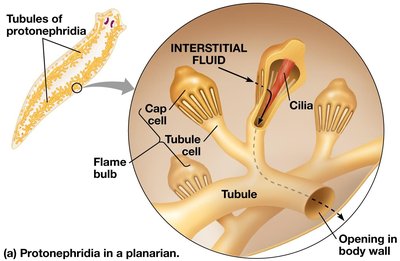
Protonephridia (flatworms): Networks of tubules with flame bulbs; produce dilute urine.
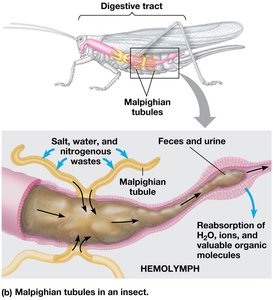
Malpighian tubules (insects): Secrete solutes/wastes into tubules; water reabsorbed in digestive tract, producing dry waste.
Vertebrate Excretory System: The Kidney
Kidney: Functions in osmoregulation and excretion; composed of tubules and capillaries.
Excretory system includes ducts and structures to carry urine out of the body.
The Mammalian Kidney and Nephron Function
Nephron: Basic unit; filtrate forms in Bowman’s capsule from blood in the glomerulus.
Filtrate passes through proximal tubule (reabsorption), loop of Henle (water/salt reabsorption), distal tubule (ion regulation), and collecting duct (urine concentration).
About 99% of water and most nutrients are reabsorbed; only ~1.5 L of urine excreted daily.
Adaptations of the Vertebrate Kidney
Desert mammals: Long loops of Henle, excrete hyperosmotic urine.
Birds: Shorter loops, excrete uric acid to conserve water.
Some mammals (e.g., vampire bats): Can produce either dilute or concentrated urine as needed.
Hormonal Regulation of Kidney Function
Antidiuretic hormone (ADH): Increases water reabsorption in collecting ducts when blood osmolarity rises.
Renin-angiotensin-aldosterone system (RAAS): Responds to low blood volume/pressure by increasing water and Na+ reabsorption; angiotensin II raises blood pressure.
Summary Table: Forms of Nitrogenous Waste
Waste Type | Animals | Toxicity | Water Requirement | Energy Cost |
|---|---|---|---|---|
Ammonia | Most aquatic animals | High | High | Low |
Urea | Mammals, amphibians, sharks | Moderate | Moderate | Moderate |
Uric acid | Birds, reptiles, insects | Low | Low | High |
Additional info: This chapter integrates concepts from animal physiology, cell biology, and ecology, providing foundational knowledge for understanding how animals survive and thrive in diverse environments.
