 Back
The Limbic System: Emotions and Memory Formation
Study Guide - Smart Notes
 Tailored notes based on your materials, expanded with key definitions, examples, and context.
The Limbic System and Its Role in Emotions
Structure and Function of the Limbic System
The limbic system is a collection of interconnected neuronal areas located around the base of the cerebrum in the forebrain. It plays a central role in controlling emotional behavior and motivational drives.
Location: The limbic system includes structures such as the hippocampus, hypothalamus, thalamus, and corpus callosum.
Function: It regulates emotions, motivation, and certain aspects of memory.
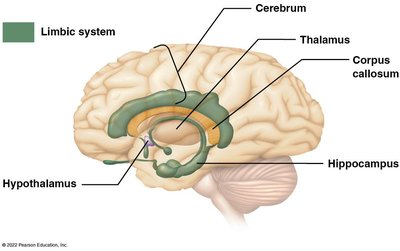
Emotions and the Limbic System
Stimulation of the limbic system results in the experience of strong emotions, which can influence behavior and decision-making.
Main emotions: Anger, fear, sorrow, and pleasure/love.
Behavioral influence: These emotions affect behaviors related to self-gratification, such as hunger, thirst, and sexual desire.
Regulation: The intensity of emotions and behavioral responses are modified by input from the cerebrum.
The Limbic System and Memory
Role of the Hippocampus
The hippocampus, a key structure within the limbic system, is essential for the formation, storage, and retrieval of long-term memories and learning.
Determines: What information is stored, how it is encoded, and where it is stored in the brain.
Long-term Memory
Long-term memory refers to the ability to retrieve information stored days or years ago. This process primarily occurs in the hippocampus.
Information deemed important is transmitted to long-term memory centers.
Neurons undergo permanent physical and/or chemical changes, creating additional synapses between connecting neurons.
This synaptic strengthening allows for easier retrieval of information in the future.
Short-term Memory
Short-term memory involves temporarily storing information and retrieving it within a few hours.
Stimuli trigger bursts of action potentials in the limbic system, creating a temporary pathway for information storage.
If the information is not important, the pathway is not maintained, and the information does not transfer to long-term memory.
Improving Memory: Practical Tips
Strategies to Enhance Memory Formation
Several evidence-based strategies can help improve memory retention and retrieval:
Say information out loud: Verbal repetition reinforces memory encoding.
Write information down: Writing by hand strengthens neural connections.
Read and use information repeatedly: Spaced repetition over several weeks enhances long-term retention.
Get adequate sleep: Sleep, especially dreaming, integrates new information into memory centers.
Exercise regularly: Physical activity increases blood flow to the brain and strengthens neural connections.
Eat a healthy diet: Nutrients such as antioxidants, omega-3 fatty acids, and medium-chain triglycerides support brain health.
Avoid multitasking: Focusing attention for at least 8 seconds is necessary to commit information to memory.
Summary Table: Short-term vs. Long-term Memory
Feature | Short-term Memory | Long-term Memory |
|---|---|---|
Duration | Seconds to hours | Days to years |
Brain Region | Limbic system (temporary pathways) | Hippocampus (permanent changes) |
Physical Changes | Temporary action potentials | Permanent synaptic changes |
Transfer to Long-term | Only if information is important | Already stored |
Lecture Summary
The limbic system is crucial for emotional responses and motivational drives.
It is also involved in the formation and retrieval of both short-term and long-term memories, with the hippocampus playing a central role in long-term memory storage.
Memory can be improved through repetition, healthy lifestyle choices, and focused attention.
