 Back
The Molecular Basis of Inheritance: DNA Structure and Replication
Study Guide - Smart Notes
 Tailored notes based on your materials, expanded with key definitions, examples, and context.
The Molecular Basis of Inheritance
Introduction
The molecular basis of inheritance centers on the structure and replication of DNA, the genetic material responsible for storing and transmitting biological information. This section explores the discovery, structure, and replication mechanisms of DNA, as well as the enzymes and processes involved in ensuring genetic fidelity.
Characteristics and Types of Genetic Material
Essential Properties of Genetic Material
Information: Must contain instructions to construct an entire organism.
Replication: Must be accurately copied for cell division and inheritance.
Transmission: Must be passed from parent to offspring and from cell to cell.
Variation: Must account for genetic diversity within and among species.
DNA and RNA: The Two Types of Genetic Material
DNA (Deoxyribonucleic Acid): The primary genetic material in most organisms.
RNA (Ribonucleic Acid): Functions as an intermediary, transcribed from DNA and translated into protein.
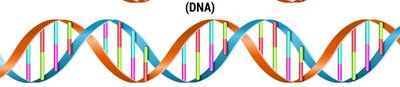
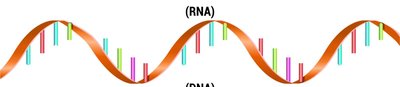
Levels of DNA Structure
Hierarchical Organization
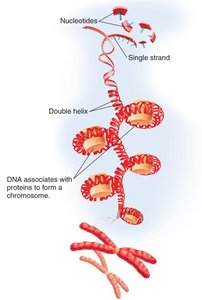
Nucleotides: The monomeric building blocks of DNA and RNA.
Strand Formation: Nucleotides are covalently linked to form a single strand.
Double Helix: Two strands bond via hydrogen bonds to form the double helix.
Chromosomes: The double helix associates with proteins to form chromosomes.
Genome: The complete set of genetic material in an organism.
Structure of Nucleotides
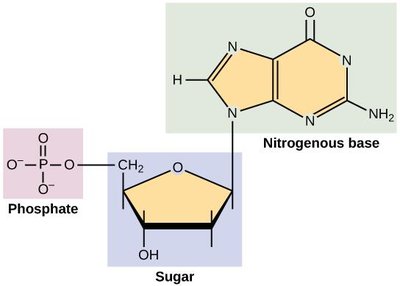
Components of a Nucleotide
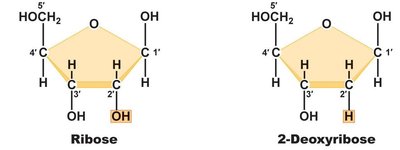
Pentose Sugar: Ribose in RNA, deoxyribose in DNA.
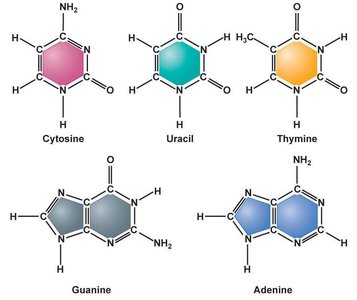
Nitrogenous Base: Purines (adenine, guanine) and pyrimidines (cytosine, thymine in DNA; uracil in RNA).
Phosphate Group: Attached to the 5' carbon of the sugar.
Pentose Sugars: Ribose vs. Deoxyribose
Ribose: Found in RNA, has a hydroxyl group at the 2' carbon.
Deoxyribose: Found in DNA, lacks the 2' hydroxyl group (has only hydrogen).
Nitrogenous Bases
Pyrimidines: Cytosine, Thymine (DNA), Uracil (RNA).
Purines: Adenine, Guanine.
Phosphodiester Bonds and Directionality
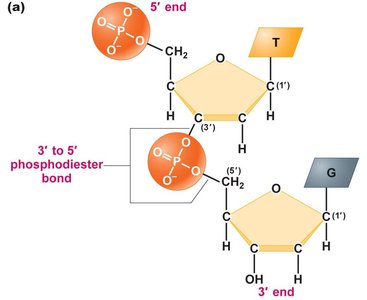
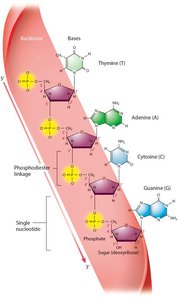
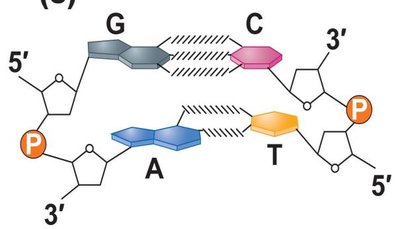
Nucleotides are linked by phosphodiester bonds between the 5' phosphate and 3' hydroxyl groups.
This linkage creates a sugar-phosphate backbone with distinct 5' and 3' ends, giving DNA strands directionality.
The Structure of DNA
Historical Discoveries Leading to the Double Helix
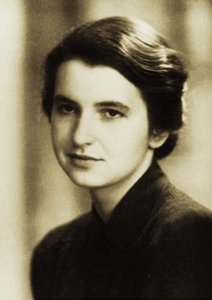
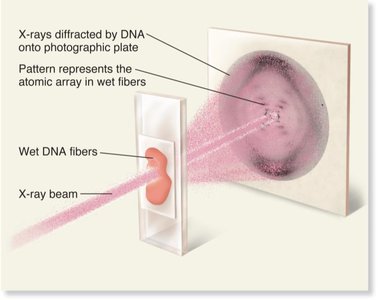
Rosalind Franklin: X-ray diffraction revealed DNA's helical structure and dimensions.
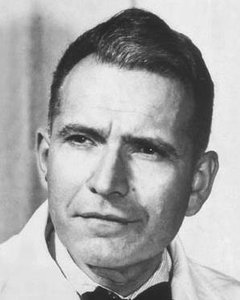
Erwin Chargaff: Base composition studies led to Chargaff's rules (A=T, G=C).
Watson and Crick: Proposed the double helix model, incorporating previous findings.
Chargaff's Rule
In any DNA sample, the amount of adenine equals thymine, and guanine equals cytosine.
This base pairing is essential for the double helix structure.
Watson and Crick's Double Helix Model
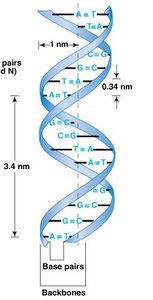
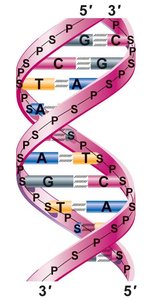
DNA consists of two antiparallel polynucleotide chains wound into a right-handed double helix.
The sugar-phosphate backbones are on the outside, with nitrogenous bases paired in the center.
Base pairs are held together by hydrogen bonds: A-T (2 bonds), G-C (3 bonds).
There are 10 base pairs per turn, with major and minor grooves.
Models and Mechanisms of DNA Replication
Proposed Models of DNA Replication
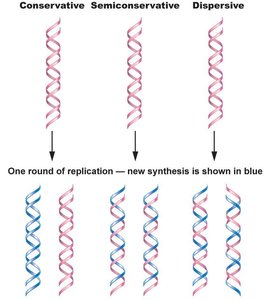
Conservative Model: Parental strands remain together; daughter molecules are entirely new.
Semiconservative Model: Each daughter DNA contains one parental and one new strand.
Dispersive Model: Parental and daughter DNA are interspersed in both strands.
Meselson and Stahl Experiment
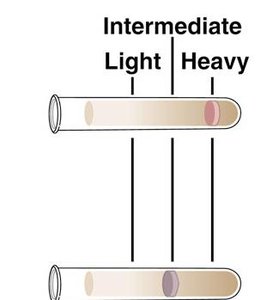
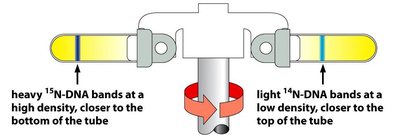
Used isotopes of nitrogen (15N and 14N) to label DNA in E. coli.
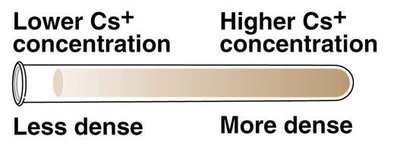
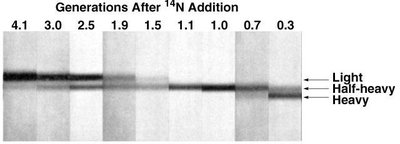
After shifting cells from 15N to 14N medium, DNA was analyzed by CsCl density gradient centrifugation.
Results showed "half-heavy" DNA after one generation and both "light" and "half-heavy" DNA after two generations, supporting the semiconservative model.
Mechanism of DNA Replication
Origins of Replication
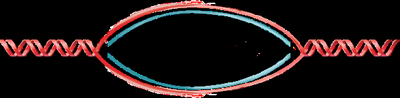
Origin of Replication: Specific DNA sequence where replication begins, forming a replication bubble with two forks.
Bacteria: Single circular chromosome with one origin.
Eukaryotes: Multiple linear chromosomes, each with many origins.
Enzymes and Proteins in DNA Replication
Protein/Enzyme | Role |
|---|---|
Helicase | Unwinds the double helix |
Single-strand binding protein | Stabilizes unwound DNA |
Topoisomerase | Relieves supercoiling |
Primase | Synthesizes RNA primers |
DNA polymerase III | Main enzyme for DNA synthesis |
DNA polymerase I | Removes RNA primers, fills gaps with DNA |
Ligase | Joins Okazaki fragments |
Telomerase | Extends telomeres in certain cells |
Leading and Lagging Strand Synthesis
Leading Strand: Synthesized continuously in the 5' to 3' direction.
Lagging Strand: Synthesized discontinuously as Okazaki fragments, later joined by ligase.
Primase: Lays down RNA primers to initiate synthesis.
DNA Polymerase III: Extends the new DNA strand from the primer.
DNA Polymerase I: Replaces RNA primers with DNA.
Ligase: Seals nicks between Okazaki fragments.
Directionality and Energy for Replication
DNA polymerases add nucleotides only to the 3' end of a growing strand, synthesizing DNA in the 5' to 3' direction.
Nucleotides are added as nucleoside triphosphates (dATP, dGTP, dCTP, dTTP), providing energy for bond formation.
Telomeres and Telomerase
Telomeres: Repetitive, non-coding sequences at chromosome ends, protecting genetic information.
Telomerase: Enzyme that extends telomeres, active in stem and cancer cells, allowing more cell divisions.
Accuracy and Proofreading in DNA Replication
Proofreading and Repair
DNA Polymerase III: Proofreads and corrects errors during synthesis.
DNA Polymerase I: Removes mismatched bases and repairs damage.
Error rate is reduced from 1 in 10,000 to 1 in 100 million bases.
Replication Speed and Fidelity
E. coli can replicate its 5 million base pair genome in less than an hour.
Human cells replicate 3 billion bases with remarkable accuracy, making only about one error per 100 million bases.
Summary Table: Key Enzymes in DNA Replication
Enzyme/Protein | Function |
|---|---|
Helicase | Unwinds DNA double helix |
Single-strand binding protein | Stabilizes unwound DNA |
Topoisomerase | Relieves supercoiling |
Primase | Synthesizes RNA primers |
DNA polymerase III | Main DNA synthesis |
DNA polymerase I | Removes primers, repairs DNA |
Ligase | Joins DNA fragments |
Telomerase | Extends telomeres |
Key Equations and Concepts
Chargaff's Rule:
Directionality: DNA is synthesized in the 5' to 3' direction.
Semiconservative Replication: Each new DNA molecule consists of one parental and one new strand.
