 Back
The Molecular Basis of Inheritance: DNA Structure and Replication
Study Guide - Smart Notes
 Tailored notes based on your materials, expanded with key definitions, examples, and context.
Chapter 16: The Molecular Basis of Inheritance
Introduction to DNA as the Genetic Material
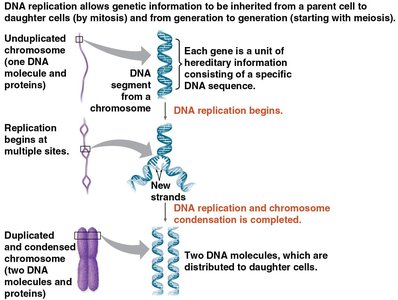
The molecular basis of inheritance centers on the structure and replication of DNA, which ensures the faithful transmission of genetic information from one generation to the next. DNA replication is essential for cell division, growth, and heredity.
Genetic information is encoded in the sequence of nucleotides in DNA.
Replication allows genetic information to be inherited by daughter cells during mitosis and from parent to offspring during meiosis.
DNA and RNA Structure
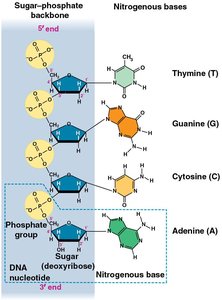
DNA and RNA are nucleic acids composed of nucleotide monomers. Their structures are fundamental to their functions in genetic information storage and transfer.
DNA (Deoxyribonucleic acid): Contains deoxyribose sugar, phosphate group, and nitrogenous bases (A, T, G, C). It is double-stranded and antiparallel.
RNA (Ribonucleic acid): Contains ribose sugar, phosphate group, and nitrogenous bases (A, U, G, C). It is typically single-stranded.
DNA | RNA | |
|---|---|---|
Monomer Components | Deoxyribose, phosphate, base | Ribose, phosphate, base |
Bases | A, C, G, T | A, C, G, U |
Strands | 2 (antiparallel) | 1 |
Discovery of DNA Structure
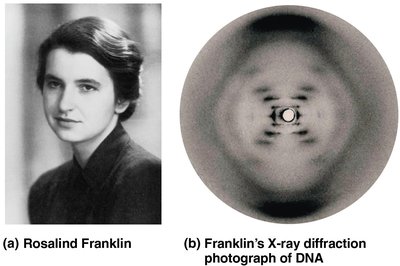
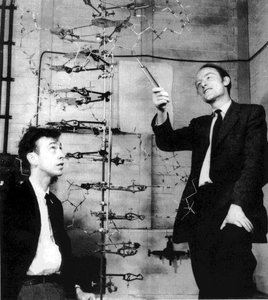
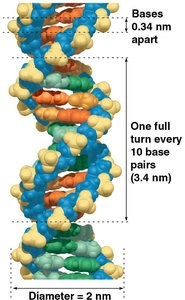
The double helix model of DNA was elucidated through the work of several scientists, notably Rosalind Franklin, Maurice Wilkins, James Watson, and Francis Crick.
X-ray crystallography (Franklin and Wilkins) revealed the helical structure of DNA.
Watson and Crick used these data to propose the double helix model, which is the foundation of modern molecular biology.
Base Pairing Rules and Chargaff’s Rules
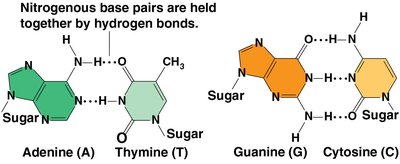
The structure of DNA is stabilized by specific base pairing between purines and pyrimidines, which also explains Chargaff’s rules.
Adenine (A) pairs with Thymine (T) via two hydrogen bonds.
Guanine (G) pairs with Cytosine (C) via three hydrogen bonds.
In any organism, the amount of A = T and G = C.
Faithful Transmission of Genetic Information
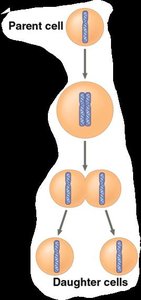
Accurate DNA replication is essential for the faithful transmission of genetic information during cell division (mitosis and meiosis).
Each daughter cell receives an exact copy of the DNA.
Errors in replication can lead to mutations, which may be inherited.
The Semiconservative Model of DNA Replication
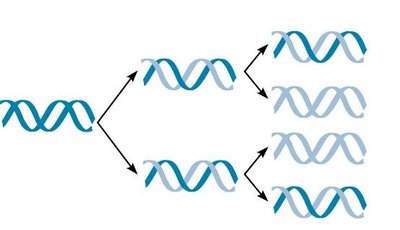
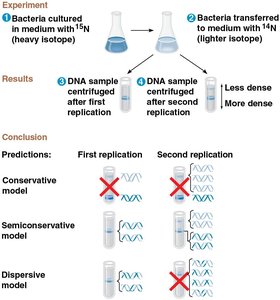
DNA replication follows the semiconservative model, where each new DNA molecule consists of one parental and one newly synthesized strand.
Each parental strand serves as a template for a new strand.
Experiments (e.g., Meselson-Stahl) confirmed this model.
Mechanism of DNA Replication
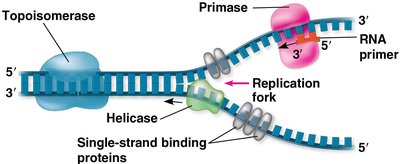
DNA replication is a highly coordinated process involving multiple enzymes and proteins. It begins at origins of replication and proceeds bidirectionally.
Origins of replication: Specific sequences where replication begins, forming replication bubbles.
Replication fork: Y-shaped region where DNA is unwound and new strands are synthesized.
Helicase: Unwinds the DNA double helix.
Single-strand binding proteins: Stabilize unwound DNA.
Topoisomerase: Relieves strain ahead of the replication fork.
Primase: Synthesizes short RNA primers needed for DNA polymerase to begin synthesis.
DNA polymerase: Adds nucleotides to the 3' end of the primer, synthesizing new DNA in the 5' → 3' direction.
Leading and Lagging Strand Synthesis
Due to the antiparallel nature of DNA, synthesis occurs differently on the two template strands.
Leading strand: Synthesized continuously toward the replication fork.
Lagging strand: Synthesized discontinuously, away from the fork, as Okazaki fragments.
DNA ligase: Joins Okazaki fragments to form a continuous strand.
Proofreading and DNA Repair
DNA polymerases have proofreading abilities to correct errors during replication. Additional repair mechanisms ensure high fidelity of DNA replication.
Mismatch repair: Enzymes correct errors missed by DNA polymerase.
Nucleotide excision repair: Removes and replaces damaged DNA segments.
Mutations that escape repair can be inherited and contribute to genetic variation.
Replicating the Ends of Linear DNA: Telomeres and Telomerase
Linear chromosomes in eukaryotes pose a challenge for complete replication of their ends. Specialized structures and enzymes address this issue.
Telomeres: Repetitive nucleotide sequences at chromosome ends that protect genes from erosion.
Telomerase: Enzyme that extends telomeres in germ cells, preventing loss of genetic information.
Shortening of telomeres is associated with aging.
Chromosome Structure and DNA Packing
DNA is packaged with proteins to form chromatin, which is further organized into chromosomes. This packing is essential for fitting large DNA molecules into the cell nucleus and for gene regulation.
Histones: Main proteins responsible for DNA packing in eukaryotes.
Nucleosome: DNA wrapped around a core of eight histone proteins.
Euchromatin: Loosely packed, transcriptionally active chromatin.
Heterochromatin: Densely packed, transcriptionally inactive chromatin (e.g., centromeres, telomeres).
Chromatin structure changes during the cell cycle, condensing into chromosomes for mitosis.
Summary Table: Key Enzymes and Proteins in DNA Replication
Enzyme/Protein | Function |
|---|---|
Helicase | Unwinds DNA at the replication fork |
Single-strand binding protein | Stabilizes single-stranded DNA |
Topoisomerase | Relieves strain ahead of the fork |
Primase | Synthesizes RNA primer |
DNA polymerase | Synthesizes new DNA strand |
DNA ligase | Joins Okazaki fragments |
Key Equations
Base pairing:
Direction of synthesis:
